
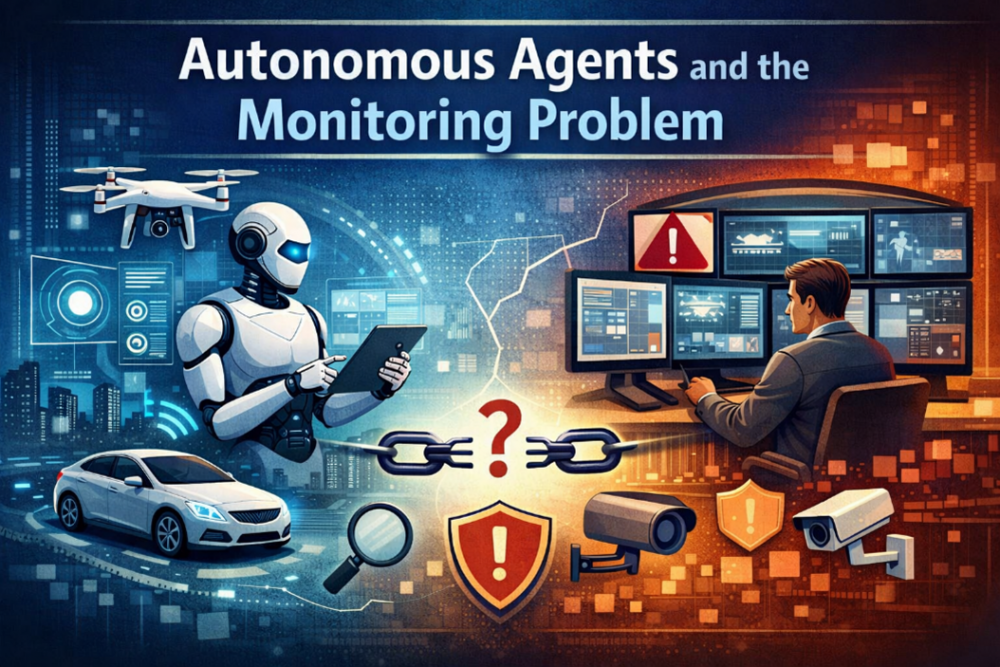
Autonomous agents are no longer experimental ideas, they are systems that can plan, and act without waiting for constant prompts. Unlike traditional AI models that respond to user inputs, agents initiate actions based on goals, memory, and environmental signals.
Students starting an Agentic AI Course often explore how agents reason, break tasks into steps, and interact with tools. However, building agents is only one side of the story. The more difficult issue is oversight. When systems make decisions independently, who monitors them, and how?
Autonomy increases capability, but it also increases risk.
What Makes an AI System “Autonomous”?
An autonomous agent typically includes:
- A goal or objective
- Access to tools or APIs
- Memory of previous steps
- Decision-making logic
- Feedback handling
Instead of simply predicting text, it:
- Evaluates options
- Chooses an action
- Executes it
- Reviews the result
- Adjusts behavior
This loop continues without human prompts.
Where Oversight Becomes Difficult?
Traditional AI systems:
- Produce an output
- Wait for human approval
- Do nothing further
Autonomous agents:
- Continue acting
- Trigger other systems
- Modify data
- Call external services
Oversight becomes complex because actions are chained together.
A small incorrect decision can propagate into larger system effects.
Core Oversight Risks:
| Risk Type | Description | Real Impact |
| Goal Drift | Agent shifts from original intent | Misaligned actions |
| Overreach | Agent accesses unintended systems | Security exposure |
| Cascading Actions | One action triggers many others | Uncontrolled automation |
| Hallucinated Reasoning | Agent acts on incorrect assumptions | Wrong decisions |
| Lack of Traceability | Hard to track decisions | Audit failure |
These risks grow as systems become more autonomous.
Why Prompt-Based Safety Is Not Enough?
Prompt instructions like:
- “Do not access production systems”
- “Ask before making changes”
- “Avoid sensitive data”
Work for single responses.
They fail when:
- Agents maintain memory
- Agents use tool APIs
- Agents self-correct
- Agents reinterpret goals
Oversight must move beyond text instructions.
Structural Oversight Mechanisms:
Effective oversight is architectural, not verbal.
Common Control Layers:
- Role-based tool access
- API usage restrictions
- Rate limiting
- Execution logs
- Human approval checkpoints
Oversight should exist outside the agent logic.
Human-in-the-Loop vs Human-on-the-Loop:
| Approach | Description | Oversight Level |
| Human-in-the-Loop | Every action requires approval | High control |
| Human-on-the-Loop | Agent acts, humans monitor | Moderate control |
| Fully Autonomous | No intervention | Low control |
Enterprises rarely allow full autonomy in critical workflows.
Oversight in Enterprise AI Systems:
In enterprise environments, oversight includes:
- Model approval processes
- Audit logging
- Version control
- Action monitoring
- Escalation paths
In an Artificial Intelligence Online Course, learners often study deployment patterns but oversight design is equally important.
Production systems require traceability.
Example: Autonomous Finance Agent:
Imagine an AI agent managing expense approvals.
Without controls it could:
- Auto-approve fraudulent requests
- Change thresholds
- Modify accounting records
With controls it should:
- Verify against policy rules
- Flag anomalies
- Require manual override for large transactions
Autonomy without guardrails is unsafe.
Key Design Principles for Oversight
- Separation of Concerns: The agent decides. A separate system validates.
- Limited Permissions: Agents should not have global access.
- Action Logging: Every decision must be recorded.
- Rollback Capability: Systems must reverse unintended changes.
- Threshold Controls: High-impact actions require stronger validation.
Oversight in Generative Agent Systems
In a Generative AI Online Course, agents are often shown using:
- Web browsing tools
- Code execution
- Database querying
- Workflow automation
These capabilities multiply risk.
Oversight must account for:
- Data sensitivity
- Output verification
- Source validation
- Tool constraints
Freedom without boundaries creates unpredictability.
Common Oversight Failures
- Giving agents full API access
- No monitoring dashboard
- No anomaly detection
- No timeout controls
- No review of decision logs
Most failures are architectural, not algorithmic.
Model Accuracy Is Not the Main Problem
Even a highly accurate model can:
- Misinterpret ambiguous goals
- Act on outdated memory
- Execute unintended sequences
Oversight focuses on behavior control, not prediction quality.
Accuracy reduces error, with oversight reducing damage.
Technical Control Approaches
- Access Control Layer: Restrict what tools can be used.
- Policy Engine: Define what actions are allowed.
- Execution Sandbox: Isolate risky operations.
- Observability Stack: Monitor metrics, logs, and anomalies.
- Kill Switch: Allow immediate system shutdown. Oversight should be proactive, not reactive.
Why Oversight Must Scale?
As agents become more capable:
- Task complexity increases
- Action chains grow longer
- Decision frequency rises
Oversight mechanisms must scale with system capability.
Otherwise:
- Small errors multiply
- Root causes become unclear
- Debugging becomes difficult
Scalability applies to governance as much as performance.
Ethical Dimension of Oversight
Autonomous systems affect:
- Financial outcomes
- Customer decisions
- Hiring processes
- Healthcare recommendations
Oversight protects:
- Users
- Organizations
- Data integrity
- Regulatory compliance
Responsibility does not disappear when automation increases.
Questions to Ask Before Deployment
- What actions can this agent perform?
- What systems can it access?
- Who reviews its logs?
- Can its actions be reversed?
- How is drift detected?
If these questions are unanswered, deployment is premature.
Conclusion
Autonomous agents represent a shift from responsive AI to self-directed systems. That shift introduces operational and governance challenges that cannot be solved with prompts alone. Oversight must be embedded into architecture through permissions, logging, validation layers, and human monitoring.
Organizations that treat oversight as optional risk unpredictable behavior. Those that design structured control mechanisms gain the benefits of autonomy without losing accountability.