


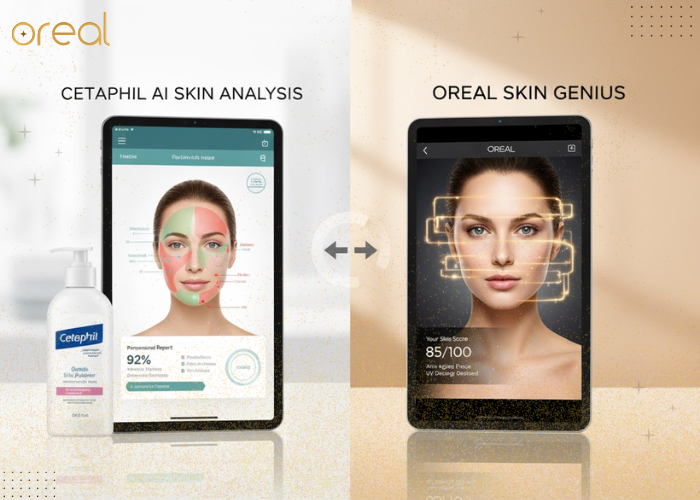
The rationale behind integrating AI into the skincare sector is clear. Consider the convenience of receiving a comprehensive skin analysis report just by taking a selfie. Oreal’s Skin Genius and the Cetaphil AI Skin Analysis Tool are examples of the use of AI and dermatological expertise.
These AI tools are intended to deliver precise, fact-based results and assist users in personalized skincare product selection. Understanding the differences is crucial to getting the most from the technology. Here’s a closer look at each product.
What is the Cetaphil AI Skin Analysis Tool?
By taking a selfie, Cetaphil’s AI Skin Analysis Tool Selfie offers a personalized skincare analysis report. The report identifies and outlines skin care issues pertaining to skin moisture content, distribution of oil, skin redness and inflammation, acne, and skin texture.
Cetaphil’s analysis takes into account the condition of sensitive and reactive skin. Cetaphil’s recommendations with gentle cleansing support and repairing enriched moisturizers that are suitable for all skin types are safe for sensitive skin products.
It is effective, rapid, and secured by dermatological expertise. The AI Skin Cetaphil Analysis Tool describes the self portrait process, and the user is directed to answer a few questions. Within a minute, the user is provided with a comprehensive self care report with product recommendations aimed at the user’s skin care issues.
What is Oreal Skin Genius?
Oreal Skin Genius is Oreal’s next-level AI-driven digital skincare assistant that brings advanced facial mapping up a few notches. It was developed and created through dermatological research and incorporated advanced computer vision technologies for the analysis of wrinkles, radiance, firmness, pore size, and overall tone.
It’s Cetaphil versus everyday skin ‘health’ against the anti-aging and advanced skin diagnostic Oreal Skin Genius measures multiple skin-aging indicators and then tracks them all into a “skin score” over time to let the user stay on top of their skin’s progress.
Oreal’s system is also supported by rigorous research and machine learning models trained on thousands of clinical skin images, making its assessments surprisingly accurate for consumer-level AI.
Accuracy and Data Insights
Both brands focus on scientific credibility and dermatological validation but their goals and strengths differ a bit.
- Cetaphil’s AI Skin Analysis Tool uses a large, diverse dataset focused on sensitive and everyday skin concerns. Its strength lies in precision around redness, barrier strength, and hydration levels—essential for those dealing with irritation or dryness.
- Oreal’s Skin Genius, on the other hand, draws from clinical datasets focused on aging and texture patterns. Its algorithms analyze fine lines, pore size, radiance, and firmness—offering more detailed anti-aging metrics.
In short: Cetaphil is great for detecting skin condition and sensitivity, while Oreal shines in anti-aging and long-term skin health analysis.
User Experience and Design
The Cetaphil AI Skin Analysis Tool provides a straightforward experience—perfect for beginners or users who prefer simplicity.
- Upload a clear selfie in natural light.
- Answer a few questions about your skin concerns.
- Get an instant analysis with personalized product suggestions and skincare advice.
The user interface is minimalistic, clean, and very easy to operate. The recommendations are gentle as well as dermatologist-backed and thus perfect for consumers seeking a minimalist skincare regime.
Oreal Skin Genius feels clinical, and more detailed than others, using advanced face mapping to specify concerning areas like fine lines on the forehead, wrinkles under the eyes and uneven skin tone – with ingredients recommendation of Hyaluronic Acid, Retinol, and Vitamin C.
This would appeal more to the skin-care hobbyist crowd looking for analytics and dipping a toe into ingredient-based solutions.
Privacy and Data Protection
Both provide strong privacy commitments. Your selfies are processed securely. Only the derived results from your image are used to deliver a personal report. However, being cloud-based, it would be wise to head over to each site’s privacy policy to find out how your data and images are kept.
Neither Cetaphil nor Oreal shares your skin data publicly, but it’s worth noting that these tools may use anonymized data to improve AI accuracy over time.
Strengths and Limitations
Cetaphil AI Skin Analysis—Strengths
Tailored for sensitive, dry, or combination skin
User-friendly interface
Quick results with dermatologist-approved tips
Gentle and minimal product recommendations
Limitations:
- Less focused on anti-aging or deep texture mapping
- Recommendations limited to Cetaphil’s product range
Oreal Skin Genius—Strengths
Deep facial mapping for anti-aging and texture analysis
Data-driven skincare scoring system
Ingredient-focused recommendations for targeted results
Limitations:
- More clinical and technical—may overwhelm casual users
- Heavily centered on Oreal’s own skincare lines
Which One Should You Try?
It really depends on your skincare priorities.
- If your main concern is sensitivity, dryness, redness, or hydration, the Cetaphil AI Skin Analysis Tool is the perfect match. It’s gentle, easy to use, and provides clear, simple steps for better skin health.
- If you’re more focused on anti-aging, wrinkles, and improving skin tone or texture, Oreal Skin Genius is the better option. It provides a deeper, more clinical analysis and ingredient-driven suggestions for long-term care.
Both tools deliver valuable insights—it’s just a matter of what you need most.
Conclusion
Both Cetaphil AI Skin Analysis and Oreal Skin Genius bring the power of artificial intelligence into the skincare routine.
- Cetaphil’s AI tool is ideal for everyday skincare users who want to understand and protect their skin barrier.
- Oreal’s Skin Genius appeals to tech-savvy users who want detailed, anti-aging insights and ingredient-based solutions.
Neither replaces professional dermatological advice, but both can be excellent first steps in creating a personalized, data-driven skincare routine.
As AI continues to evolve, tools like these will only become more precise—helping you make smarter skincare decisions right from your phone.
So whether you prefer Cetaphil’s gentle, sensitivity-focused guidance or Oreal’s in-depth, science-backed scan—your skin is about to get a lot smarter.