


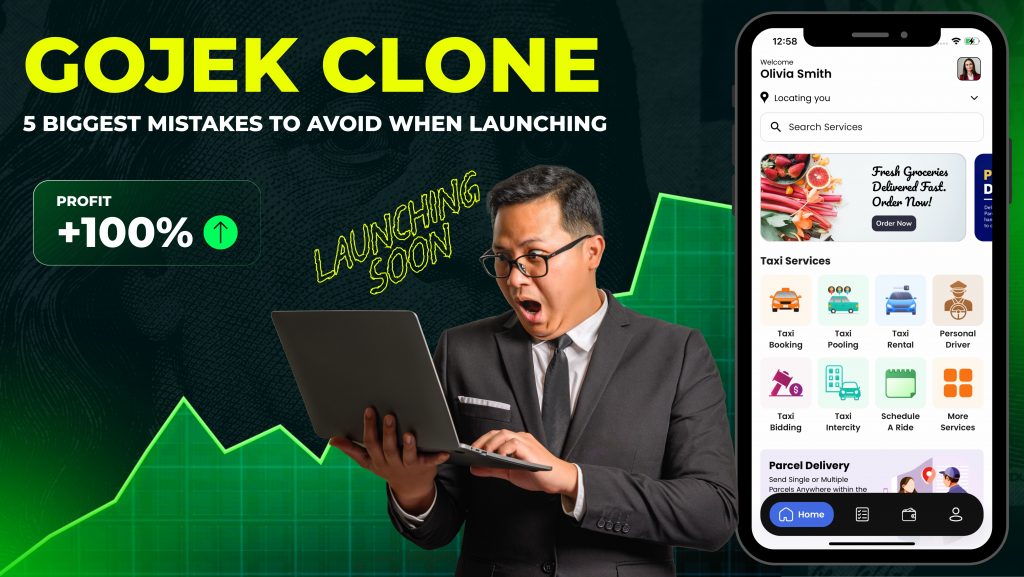
Multi-Service Apps are a goldmine. Many people have addressed this creative idea and have been planning to launch your Own Gojek Clone. Now, if you’re one of those smart people, this blog is going to be your business savior.
Before you invest your hard earned money into Gojek Clone, there are some really crucial mistakes that founders have been doing, which you must avoid. Some are critical for your business since day 1, some will sting later on, but the only thing you should be worried about here is how you are going to make a decision.
In this blog, you’ll uncover what mistakes people do, what you should do about it, and is there any place where you can find all the solutions for worry free development.
5 Mistakes that Kill your Gojek Clone App
To begin with, you must have some basic understanding. In long run, you want your Gojek Clone to earn millions, give crazy returns, raise capital and be an app that is loved by the countries. For that, you need to be precise. You must ensure that the Gojek Clone’s success can be measured on these 4 scales
1. Scalability
2. Profitability
3. Customer Experience
4. Speed to Market
These Four define if your Multi-Service App will earn millions or it will break apart in the 2nd month with continuous regret. Let’s learn what is affected with each mistake.
Mistake #1: Taking Forever to Launch
When you choose your tech partner it’s important to look how much time it will take to go live. It’s very critical to launch fast, because if you cannot launch fast, other apps will take the opportunity you see right now.
The urgency is not curated, but real & valid. Ideas are opportunity you need to grab. If you choose a custom app development agency they may take years to launch.
Mistake #2: Launching Every Service Right Away
If you have researched you may already know that it you can launch more than 101 services in your Gojek Clone. Now, if you think launching every service all together is the best thing. You are wrong buddy.
Founders who do this face a major difficulty. Imagine if you’re the user, you want a massage service booked, but as you go to the massage service section, there’s no service provider available. Would you open the app again? This is exactly what creates the problem, you can be the reliable service provider for everything from day 1.
Mistake #3: Ignoring the Local Users
Most users want to feel like using the app in their own language. If you just think of a single country or a state, you will face difficulties. Think about it. Some founders are even more rigid, they think English is all they want to scale globally.
In reality, this perspective goes totally different. Most service providers may not know English in Non-English speaking countries, every country has their own specific currency, and their own personal issues which need to be solved.
Mistake #4: I Don’t Need Tech Support
One thing about App launches is that it’s never finished. You may start with a great launch but maintenance is mandatory. Even if the code is super high quality, tech support and maintenance keeps the code alive and running.
What would you do when you’ll need an instant bug fix at an emergency hour? This is why you need to focus on tech support as well.
Mistake #5: Commissions Give Enough Money
Yes, Commissions might be the largest source of revenue. But it should not be the only one. Commissions on every model does not work. Moreover, if you just rely on commissions, you miss out scaling. Let’s elaborate.
This belief is shallow. It does not last long. You might survive only on commissions but it makes your business volatile. Then if you set commissions low, you don’t earn enough, even when a 1000 people use your app. And if you set commissions high they might leave the app because they can’t afford to pay 20-30% of their income to you.
If you think Balanced Commission Rates will be viable, yeah, of course but the revenue will be stagnant.
These Mistakes are not just small mistakes that can be reversed, your business model depends on these decisions. You need critical thinking to decide on each mistake. But don’t worry, this blog has something more to offer.
White-Label Gojek Clone: Cutting Through Clutter
So far, you’ve understood what mistakes not to do. If you are really serious about launching your own Gojek Clone, this is the answer. A White-Label Gojek Clone is a ready-made solution which draws inspiration from the best models and help you launch your Multi-Service App in just 2 weeks.
Think of it like this: A Launch pad for your Rocket, you bring the idea, you pay for its rocket and launch, then, you can launch with the rocket, and the rocket is completely yours.
In short, you come up with the idea of Launching a Gojek Clone. The White-Label firm understands your business model, and market it is establishing in and help you customize, and launch in just 2 weeks.
They give you 14 components with over 101 services included, so you can launch and scale later on. The components are as follows:
Base Components:
1. Taxi Booking
2. Parcel Delivery
3. Store-Based Delivery
4. On-Demand Services
Additional Components:
5. Online Video Consultation
6. Bid for Services in Real time
7. Buy, Sell, Rent Real Estate
8. Buy, Sell, Rent Cars
9. Buy, Sell, Rent General Items
10. Delivery Genie & Runner
11. car Pool/ Car Share
12. Medical Services
13. Track Family & Employees
14. Nearby Businesses
The solution is apt because you launch fast, create profits, and get toggles for every component. Also, it has capability of handling Unlimited users. Moreover, the app consists of 7 different monetization ways including commissions, surge pricing, subscription for service providers, priority listing for buy, sell, rent apps, subscription for family tracking apps, & In-App Advertisements.
To Conclude,
Launching a Gojek Clone with conscious choices is necessary. The difference between apps that quietly disappear and platforms that grow into household names often comes down to what founders chose to do before launch, not after things go wrong.
Every mistake discussed above connects back to the same truth, speed, clarity, and adaptability matter more than over engineering ideas on paper. Launching fast, starting with the right services, respecting local users, planning for long-term support, and diversifying revenue are not “advanced strategies”, they are survival basics. Ignore them, and the app struggles. Respect them, and the app gets room to breathe, grow, and earn trust.
This is where ready-built ecosystems quietly make sense. Not because they promise shortcuts, but because they remove unnecessary friction. When the foundation is already tested, flexible, and scalable, founders can focus on market understanding, partnerships, and growth instead of firefighting technical chaos. It’s like choosing a well-paved road instead of clearing the jungle first, the destination stays the same, but the journey becomes a lot saner.
If you’re serious about launching a multi-service app and want to see how these ideas work in the real world, exploring live demo apps can be an eye-opener. Seeing workflows, toggles, monetization options, and user journeys in action often answers more questions than a hundred feature lists ever could.
At the end of the day, the smartest founders don’t just ask “Can I build this?” They ask, “Can I launch this the right way?” That mind set alone puts you ahead of most.