


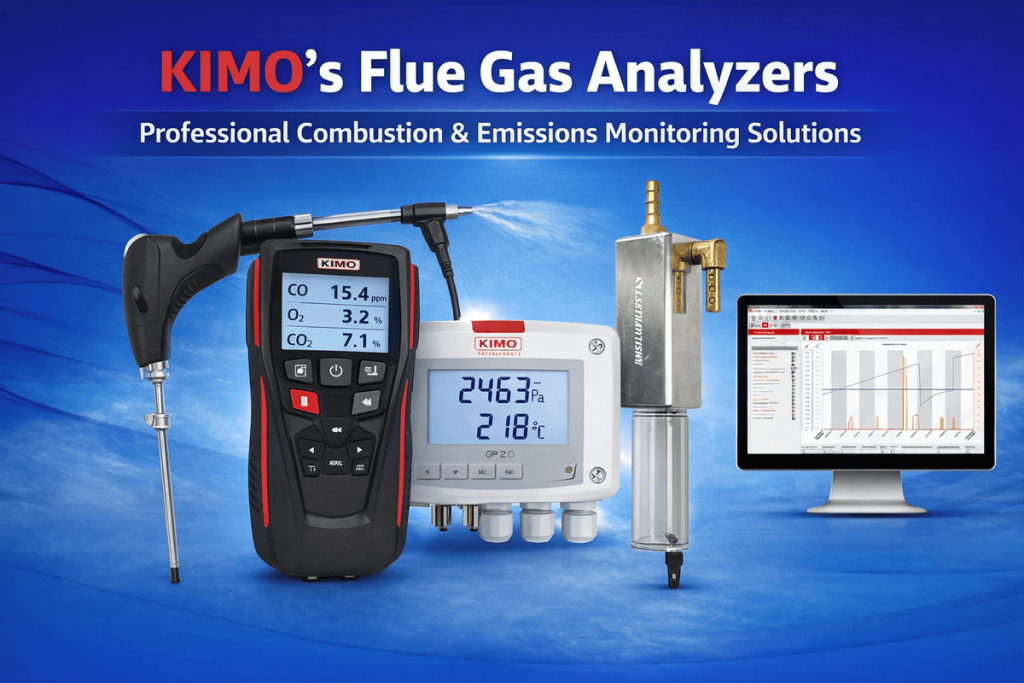
If you are working around boilers, burners, or engines, what is going out of the exhaust is a very important thing. If you know, smoke is not just smoke. But inside that smoke, there are gases, and those gases tell you whether your system is running fine or wasting fuel.
And to check that, a flue gas analyzer is used. In simple words, this device checks what gases are coming out after combustion. It helps you understand efficiency, safety, and emissions, all in one go.
What Is a Flue Gas Analyzer?
A flue gas analyzer is a handheld or portable instrument used to measure gases produced during combustion. These gases usually include oxygen, carbon monoxide, carbon dioxide, and sometimes nitrogen oxides.
When you connect the probe into a flue or exhaust line, the analyzer pulls in gas samples and shows readings on the screen. From these readings, you know whether combustion is proper or something needs correction.
If numbers are not good, fuel is getting wasted or safety risk is building up. Simple as that.
Flue Gas Analyzer Working Principle
A flue gas analyzer works by drawing a sample of exhaust gas, passing it over specialized sensors (like NDIR for CO2 or electrochemical for O₂, CO, NOₓ), which detect and measure the concentration of specific gases, then processing these signals to display real-time data for combustion efficiency and emissions monitoring. The principle relies on gases absorbing specific wavelengths of light (IR) or creating electrical changes, with the magnitude of the effect correlating to the gas’s concentration.
Core Working Principle (NDIR Example)
Sampling: A small pump inside the analyzer pulls flue gas through a probe into the analyzer.
Infrared Absorption: The gas enters a chamber in which infrared (IR) light passes through it. And target gases like CO2 absorb specific infrared light.
Detection:
- 1. Detector Cell: There are two sides inside the detector. One side has reference gas. The other has the sample gas. When CO2 absorbs light, pressure changes inside.
- 2. Diaphragm Movement: That pressure difference moves a thin diaphragm.
- 3. Signal Creation: The movement is converted into an electrical signal.
Processing: The analyzer reads that signal and converts into a concentration reading (e.g., ppm or %) and displays it.
Applications of Flue Gas Analyzers
In big industries, flue gas analyzers are used for 24/7 monitoring of large -scale combustion.
Power Plants: Power plants use them to check boilers running on coal or gas. When air and fuel are balanced properly, fuel waste comes down and harmful gases also stay under control.
Cement & Steel Manufacturing: In cement plants and steel factories, temperatures are very high. And to check that temperature, flue gas analyzers are used.
Petrochemical & Refineries: Refineries and petrochemical plants also use these analyzers. Exhaust gases from heaters and reactors are checked with these analyzers here.
Waste Incineration: In waste incineration plants, these analyzers help confirm that toxic gases are not released outside.
Commercial & Residential Applications
For day-to-day work, technicians mostly use portable flue gas analyzers.
Boiler Servicing: During boiler servicing, HVAC technicians use them to check efficiency and carbon monoxide levels.
Commercial Kitchens: In commercial kitchens, exhaust from gas appliances is checked to confirm safe operation.
Engine Testing: These devices are also used during engine testing. Because diesel generators, marine engines, and vehicle engines are checked to make sure fuel use is correct and emissions are within limits.
Why Should You Trust Kimo Instruments
At Kimo Instruments, our flue gas analyzers are 100% accurate, rugged, and easy to use in real working conditions. Our models are built for technicians who work on-site every day. All of these devices come with a clear display, fast response, and reliable sensors. If you want to buy, you can contact our team anytime.