


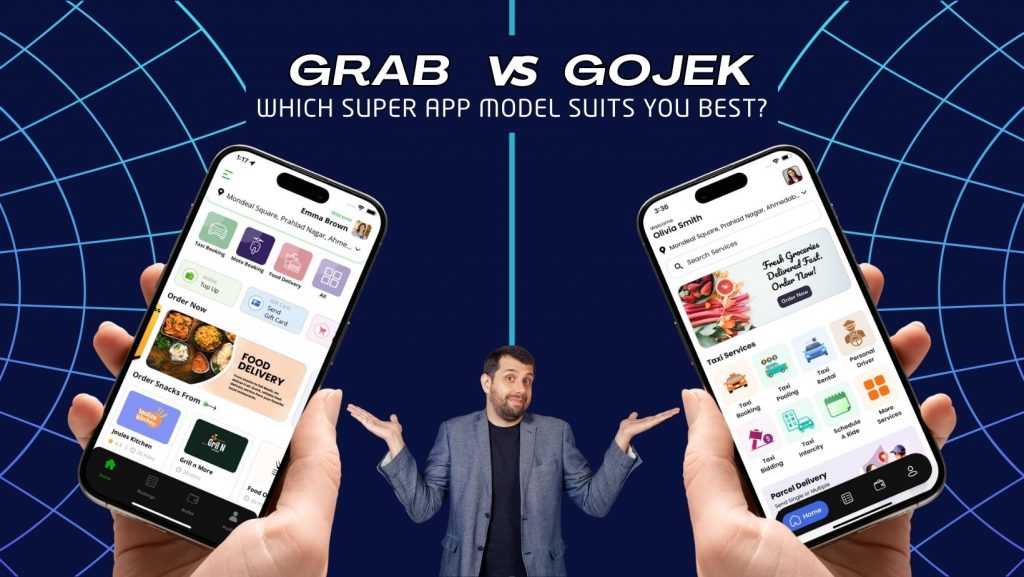
Grab Vs Gojek Debate
If you’re launching a Super App in 2026, you probably know about the Super App Model Debate. And if you’re living in South East Asia, you’re living it. While both of them have captured a strong market in themselves, they are still competing neck to neck, and have built ecosystems so deep that they no longer feel like apps, they feel like infrastructure. You book rides, order food, send packages, pay bills, and sometimes even solve life problems without leaving the app. Naturally, every entrepreneur wants to know, which model should I follow, a Grab Clone or a Gojek Clone?
Here’s the short answer upfront, so you don’t read 1400 words just to hear it later.
You don’t need to choose between Grab and Gojek.
You need to choose your services first, then build your own Super App around them.
Now let’s break that down properly.
Why this debate even exists?
If you live in Southeast Asia, the Grab vs Gojek debate is not theoretical, it is lived reality. One app dominates certain cities, the other rules elsewhere. Users switch based on discounts, driver availability, or even mood.
From the outside, they look similar. From the inside, they are built very differently.
Grab feels like a regional powerhouse that expanded carefully across borders. Gojek feels like a hyper-local product that grew roots so deep in Indonesia that expansion became inevitable. That difference alone changes how you should think about Super App Development.
This is where many founders go wrong. They copy features instead of understanding foundations.
Grab and Gojek were not built the same way
At first glance, Grab and Gojek appear to be nearly identical. When you access the app, you immediately see rides, food delivery, couriers, electronic payments, groceries, and a mall of lifestyle services. However, once you get inside the interface, the intention represented by each product becomes more visible.
Gojek was a startup that operated in Indonesia where motorcycles are the main mean of transport and daily cash transactions are very frequent but of low value. The app’s continuous usage was somehow linked to people’s daily living. One ride eventually led to food, then payment, services, and before customers knew it, Gojek became a daily necessity rather than just a tool.
In contrast, Grab successfully and patiently built the operation through Southeast Asia with a systematic plan. Its primary objective was to standardize mobility first, and then to add the food, logistics, and financial services in a way that could still work despite the complexity of regulations in the countries involved. Grab acts like a regional platform, while Gojek acts like a very local ecosystem.
Neither approach is better. They are simply different answers to different market realities. This difference shapes everything, from how features are prioritized to how merchants and drivers are onboarded.
What this Means for Super App Development Today
When founders ask, “Should I build a Grab Clone or a Gojek Clone?”, what they are really asking is this:
- Should I go deep into one market or wide across many?
- Should payments be the core or an add-on?
- Should I launch many services quickly or perfect a few first?
These questions matter more than the brand you copy.
Differences That you Should Care About!
Mobility comes first, but the type matters
Both applications share the common ground of being based on mobility, but their presumptions vary. The core of Gojek consists of two-wheelers and very frequent short rides, while Grab is more oriented to cars, taxis, and organized transport.
If your town is bike and scooter based, relocating to a car-first model will cost you heavily in terms of operations. Conversely, if your users are accustomed to comfort and longer rides, then the bike-heavy logic will not be able to grow.
This is not a matter of branding but math calculations.
Payments are not just features, they are behavior
Gojek treated payments like glue. Wallet usage wasn’t optional, it was encouraged everywhere. Small merchants, street vendors, delivery partners, everyone was pulled into the same ecosystem.
Grab introduced payments more strategically, often alongside partnerships and incentives. In some regions, users barely notice the wallet. In others, it’s central.
So ask yourself, is your market cash-heavy, QR-friendly, underbanked, or card-dominant? That answer alone can decide whether your Super App looks more like a Gojek Clone or a Grab Clone.
Merchant relationships shape your growth speed
Gojek built trust with micro-merchants early. Food stalls, local shops, service providers. The onboarding was fast, flexible, and local.
Grab leaned more into standardized merchant systems, chains, and regional partners. That makes scaling smoother across cities, but slower at the hyper-local level.
If your growth depends on onboarding thousands of small vendors quickly, a Gojek-style approach makes sense. If your strength is partnerships and structure, Grab’s model fits better.
Feature comparison without the fluff
Let’s be honest, listing features is easy. Making them work is not.
Ride-hailing, food delivery, courier services, grocery, digital payments, all of these are table stakes now. What matters is order and priority.
Gojek-style Super Apps tend to:
- Launch multiple lifestyle services early
- Push wallet adoption aggressively
- Focus on daily frequency over high-ticket orders
Grab-style Super Apps tend to:
- Perfect core services before expansion
- Standardize operations across cities
- Monetize steadily through commissions and partnerships
Both strategies work, when applied in the right context.
Choosing between a Grab Clone and a Gojek Clone
The Gojek Clone method is ideal for markets that are characterized as densely populated, hyper-local, and often frequented by high users. If your target audience consists of micro-merchants, who require quick service, and if your growth relies on daily usage, this model is perfect for you. The strategy is to gain a wide acceptance early on in order to build a strong long-term loyalty rather than focusing on high transaction values.
However, a Grab Clone strategy is appropriate for markets where the main concerns are scalability, consistency, and gradual expansion. If your plan involves multiple cities or countries, or if you are in an area that requires strict regulations and formal partnerships, then this model comes with operational clarity that is the most suitable for you.
The mistake is assuming you must fully commit to one. In reality, most successful Super Apps borrow selectively, blending approaches rather than copying them wholesale.
The Mistake most Entrepreneurs Make
Here’s the hard truth.
Most failed Super Apps didn’t fail because they chose the wrong model. They failed because they tried to copy everything.
You don’t need food, rides, couriers, groceries, payments, loyalty, subscriptions, and financial services on day one. That’s not ambition, that’s chaos.
Successful Super App Development starts with controlled focus.
A smarter way to build your Super App
Instead of asking “Grab or Gojek?”, ask these questions:
- Which 5-10 services can I operate flawlessly today?
- Which service brings users back daily?
- Which service attracts merchants easily?
- Which service generates predictable revenue?
Start there.
Build a strong core. Launch in one city. Fix unit economics. Only then expand horizontally.
That is how both Grab and Gojek actually won, even if their journeys looked different.
About Using Grab Clone or Gojek Clone Solutions
White-label solutions are powerful if used correctly. The way you go should be decided by your market, your users, and your operational strengths. Select the services that are appropriate for your ecosystem, create them properly, and open with precision.
Super App Development in 2026 is not about making giant replicas, it is about comprehending why they were successful and smartly applying the learned lessons. Choose your desired services, design around actual user behavior, and create an app that secures its spot on the home screens of your users.
Oh, How the Money Flows in Super Apps?
Super Apps do not survive on growth alone. Revenue comes from predictable sources, commissions, delivery fees, service charges, merchant subscriptions, and eventually financial products. The key is visibility. Track profitability per service, avoid excessive cross-subsidization, and let data guide expansion.
Your revenue will come from:
- Commissions on rides, food, and deliveries
- Service fees and surge pricing
- Subscriptions and promotions
- Payment-related incentives
Track margins per service. Kill what doesn’t work. Double down on what does.
Ending the debate, Finally!
So, Grab vs Gojek, which Super App model should you choose?
The debate ends when you stop comparing logos and start comparing realities. The way you go should be decided by your market, your users, and your operational strengths. Select the services that are appropriate for your ecosystem, create them properly, and open with precision.
Super App Development in 2026 is not about making giant replicas, it is about comprehending why they were successful and smartly applying the learned lessons. Choose your desired services, design around actual user behavior, and create an app that secures its spot on the home screens of your users.