


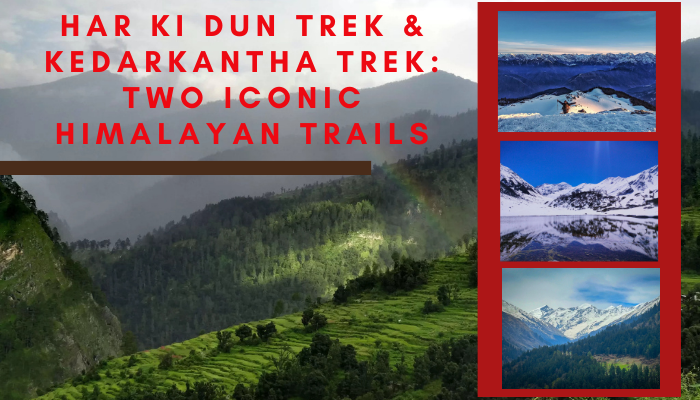
The Great Himalayas in India have so many hiking opportunities that it’s hard to pick just one, but Har Ki Dun Trek and Kedarkantha really stand out among all of them. They’re both in Uttarakhand as well, falling in the same area of Govind Pashu Vihar National Park, but still offer different kinds of experiences, like one with deep valleys and old stories and the other with snow and a big summit push. Comparing them helps figure out which might fit better, depending on what you’re looking for.
Har Ki Dun Trek
Overview
Har Ki Dun is a valley trek that’s also famous as the Valley of Gods for its own reason. It’s in the Garhwal region, surrounded by snow-capped peaks like Swargarohini and Bandarpoonch that stay snowy most of the time. You walk through pine and rhododendron forests and ancient villages like Osla, which is approximately 500 years old, and Sankri, where people still live in wooden houses from way back. The whole thing ties into mythological stories of the Mahabharata, which adds this cultural layer that feels special. It seems like a good mix for someone who wants scenery plus a bit of history without it being too intense.
Difficulty, Duration & Highlights
The difficulty level is marked as somewhere around easy to moderate, taking about five or six days to complete the trek by reaching a maximum altitude of around 3,566 meters. The ascent is gradual; hence, even if you’re a newbie or first-timer to this, with some basic fitness, it should be okay. Spring comes out as the best season, from April to June, when flowers are out and views are clear, or autumn, from September to November, with cold weather and changing colours. However, Winter gets tricky because snow blocks the ways in.
Kedarkantha Trek
Overview
Kedarkantha Trek is more of a winter thing, popular for that summit view that’s 360 degrees of mountains. Its starting point is the same as Har Ki Dun, Sankri, but it focuses on snow trails and camps like Juda Ka Talab.
Difficulty, Highlight & Duration
You climb up to about 3,810 meters in four or five days, and the last day is steep but not crazy. Highlights include the snow from December to March, which makes it feel like a real winter adventure, or April, when the snow starts melting a little.
Comparison
When you put them side by side, Har Ki Dun has more valleys, rivers, and forests, plus a stronger cultural side with those villages and myths. No real summit climb there, though, and it’s longer and better for summer or fall. Kedarkantha goes for open ridges and snow, with a yes on the summit, but less culture, and it’s shorter for winter. I might be oversimplifying, but Kedarkantha seems perfect for beginners wanting to try snow without committing to a super long trip. The trails are marked well, and the rewards feel high for a short time.
Both are beginner-friendly in their own ways.
They share stuff like safe paths, slow altitude buildup, good camping spots, and amazing views without needing ropes or anything technical. You can learn about mountains, build some stamina, and get a taste of Himalayan life.
Conclusion
In the end, it depends on what you like. Har Ki Dun for slow walks through history and green spots, or Kedarkantha for that snowy thrill and summit push with stunning views of major peaks. They keep drawing people back; I guess because Uttarakhand treks like these just hit different.