


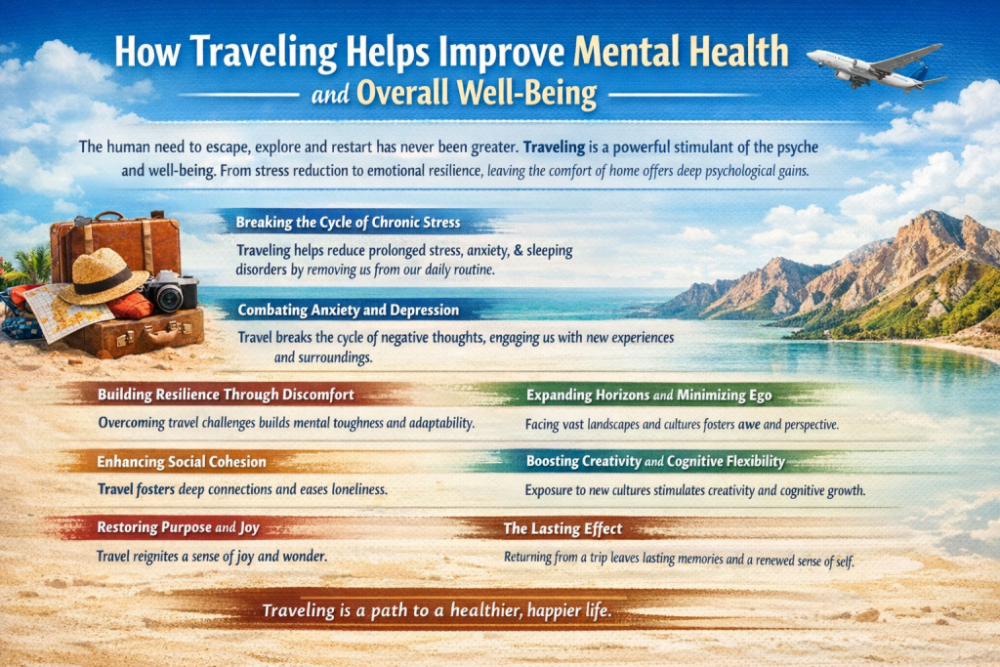
The human need to escape, explore and restart has never been as pressing in the current epoch of endless schedules and increasing pressures. Travelling is not just another leisure activity. It is an effective stimulant of the psyche and well being. Stress reduction to the development of emotional strength, leaving the comfort of a familiar environment has deep psychological gains which would be hard to achieve by any other means.
Planning a short vacation through a travel planning platform can help reduce stress and improve mental well-being as you don’t have to plan your whole journey by yourself. People usually do not want the hassle of travel planning. It is important that we break through our daily monotonous routine life to travel so that we experience the joy of living.
Breaking the Cycle of Chronic Stress
One of travel’s most immediate mental health gifts is stress relief. Prolonged stress is destructive physiologically. It results in anxiety, depression and sleeping disorders due to high cortisol levels over a long period of time. When we go on holiday, we physically withdraw ourselves out of those situations and habits that trigger these stress reactions. Traveling is perceived by the brain as a message to relax that enables the nervous system to decelerate. Research has found that even a few days away from the workplace and daily commitments can significantly reduce stress. Even the mere fact that you woke up in a different place to no meetings to be at and to no one to demand anything of you leaves the mind space.
Combating Anxiety and Depression
Travel has a remarkable ability to interrupt the thought patterns that feed anxiety and depression. Both conditions thrive on repetition — the same worries cycling through the same mental grooves in the same familiar settings. Travel disrupts that cycle forcefully. New landscapes, languages, foods and faces demand present moment attention which makes it genuinely difficult to ruminate. This is not accidental. Psychologists recognize “behavioral activation” engaging in novel and rewarding experiences as one of the most effective non-pharmacological treatments for depression. Travel is essentially behavioral activation on a grand scale. Every new experience, from navigating a foreign metro system to tasting unfamiliar street food, pulls the mind into the present and away from the spiral of negative thinking.
Building Resilience Through Discomfort
Not everything about travel is comfortable and that is precisely the point. Minor adversities like missed flights, language barriers or navigating unexpected situations build genuine psychological resilience. Each time a traveler solves a problem in an unfamiliar environment, they get more competent. This quietly rewires self-perception. People who travel regularly tend to develop a higher tolerance for uncertainty and ambiguity which are qualities that directly protect mental health in everyday life. The traveler who calmly reroutes after a cancelled train is the same person who handles a workplace crisis with composure. The skills transfer.
Expanding Horizons and Minimizing Ego
It is a humbling thing to be in the presence of an old monument, a mountainous terrain or an ocean shore. The effect of travel brings about a feeling that psychologists term awe, that feeling of facing something so huge or intricate that it seems to momentarily reduce self-esteem. Quite on the contrary, awe is highly helpful. It has been found that awe triggers a decrease in self-referential thinking, markers of inflammation and a sense of connection with other people. Our woes, upon being held in the perspective against the greater world, naturally diminish. The anxiety which seemed to be all-consuming at home starts to seem manageable when viewed on a hillside in a different country.
Enhancing Social Cohesion and Addressing Loneliness
One of the most relevant mental health crises of today with health outcomes that are even similar to smoking fifteen cigarettes a day is loneliness. Travel, especially collective travel, is a medicine. Travelling couples indicate that they feel stronger emotionally and more satisfied in their relationship. When friends are travelling together they make joint memories which strengthen the bond even after the tour has been completed. Even solo travellers are not alone for long. The hostel, the tour groups, the local experience and accidental meetings give a feeling of human connection which is usually more vibrant and real than the social interactions at home. One of the quickest means that human beings bond is through shared experience particularly in a new or challenging setting.
Boosting Creativity and Cognitive Flexibility
Travel literally changes how the brain works. Exposure to different cultures, languages and ways of organizing daily life forces the brain to form new neural pathways. This cognitive stretching enhances creativity and what psychologists call “integrative complexity”. It is the ability to hold multiple perspectives simultaneously and connect disparate ideas. Research on creative professionals has repeatedly found that those with more international experience produce more innovative work. The mind that has navigated a foreign market, attempted to communicate across a language barrier or adapted to a different cultural rhythm becomes more flexible and inventive in all domains of life.
Restoring a Sense of Purpose and Joy
Perhaps most simply, travel reminds people why life is worth living. Anticipating a trip generates measurable happiness. In some studies, the planning phase produces as much positive emotion as the trip itself. The experience of genuine delight like watching a sunset over an unfamiliar city or witnessing a cultural tradition unlike anything back home activates the brain’s reward circuits in ways that daily routine rarely does. This restoration of joy is not trivial. For people grinding through burnout or emotional numbness, travel can reignite a sense of aliveness that is difficult to manufacture any other way.
The Lasting Effect
The mental health travel advantages do not fade the moment the suitcase is unpacked. People return from meaningful trips with a refreshed sense of self, expanded perspective, stronger relationships and renewed motivation. The memories themselves serve as psychological resources which is something to draw on during difficult periods. Travel teaches a basic fact that the world is bigger and happier than the tiny segment that is seen at home. When inside, such knowledge turns mundane life into one less like a trap but as temporary refuge between exploits.
Traveling does not cure all mental health issues or it is not equally available to all. However, to the few who can accept it even in small doses, it is one of the most holistic and truly happy ways to live a healthier and more full life.