


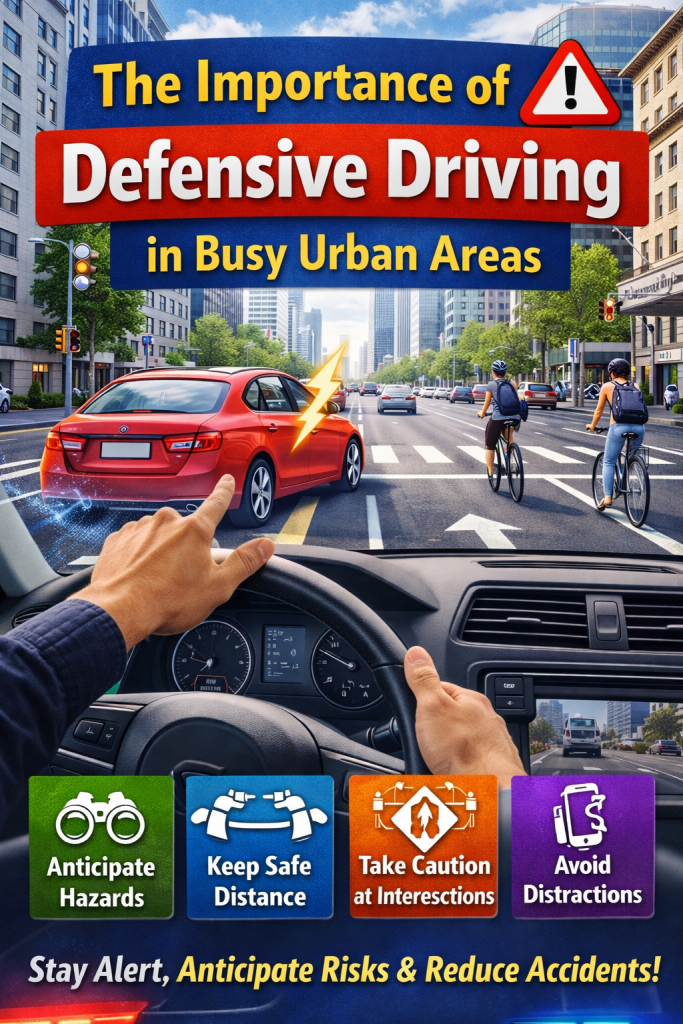
Urban roads are a world of constant motion. Intersections buzzing with pedestrians, delivery vehicles double-parked on narrow lanes, cyclists weaving through gaps, and traffic signals that seem perpetually out of sync — city driving demands far more than a valid licence and a working engine. It demands a mindset. Defensive driving is that mindset, and in the context of today’s congested urban environments, it is not just a good habit — it is an essential life skill.
What Is Defensive Driving?
Defensive driving is an approach to operating a vehicle that prioritises anticipation, awareness, and caution over reactive responses. Unlike standard driving, which focuses on following the rules of the road, defensive driving goes further — it assumes that other road users may make mistakes, and it prepares the driver to respond safely before those mistakes become accidents.
The core principle is simple: expect the unexpected. Whether it is a child who darts out from between parked cars, a motorbike that appears from a blind spot, or a driver who runs a red light, the defensive driver is mentally one step ahead. This does not mean being paranoid — it means being prepared.
Why Urban Areas Demand Extra Caution
Cities are inherently complex driving environments. Traffic density is significantly higher than on rural roads or motorways. Pedestrians cross mid-block, often while distracted by their phones. Road layouts can be confusing, with one-way streets, sudden lane reductions, and shared spaces for buses, cycles, and private vehicles all competing for the same tarmac.
Statistics consistently show that urban areas account for a disproportionate number of road accidents. According to road safety organisations, the majority of non-fatal collisions occur on urban roads where speeds are lower, but hazard frequency is much higher. The very nature of city driving — stop-start movement, frequent lane changes, and proximity to vulnerable road users — makes the risk landscape uniquely challenging.
Key Defensive Driving Techniques
Several practical techniques define effective defensive driving in urban settings:
Maintain a Safe Following Distance. The two-second rule — ensuring at least two seconds of following distance from the vehicle ahead — gives you time to react. In wet weather or heavy traffic, this should be extended. Tailgating is one of the most common contributors to urban rear-end collisions.
Scan the Road Continuously. Defensive drivers do not fixate on the car directly in front. They scan ahead at least 10–15 seconds into their path of travel, checking mirrors regularly and noting what is happening at the periphery of their vision. This wide-angle awareness allows earlier identification of developing hazards.
Manage Your Speed Intelligently. Posted speed limits represent maximum legal speeds, not always safe speeds. Near schools, in narrow residential streets, or during peak hours, dropping below the limit is a sensible and courteous choice. Speed is a critical variable in both accident prevention and injury severity.
Avoid Distractions Completely. Mobile phone use while driving remains one of the most dangerous behaviours on urban roads. Even hands-free conversations impair cognitive attention. A true defensive driver eliminates all non-essential distractions: no texts, no social media, no eating, no adjusting playlists mid-journey in traffic.
Anticipate Pedestrian Behaviour. In cities, pedestrians are unpredictable. Always be prepared to yield, especially near school zones, bus stops, and busy market areas. Eye contact with pedestrians at crossings is a good practice to confirm mutual awareness before proceeding.
The Psychological Dimension
Defensive driving is as much about mindset as mechanics. Aggression on the road — speeding to beat a light, responding to provocations, refusing to let another driver merge — dramatically increases risk. Remaining calm, patient, and non-confrontational is not a weakness; it is a strategy. Road rage incidents have escalated in many cities globally, and the ability to de-escalate tension by simply backing off is a genuine safety skill.
Driver fatigue also plays a significant role in urban accidents. Long commutes through high-stimulus environments are mentally exhausting. Recognising when you are too tired to drive with full attention, and choosing to stop or use public transport, is itself a defensive decision.
Why Every Driver Should Invest in Defensive Driving
Many countries offer accredited defensive driving courses, and for good reason. Research suggests that drivers who complete such programmes significantly reduce their likelihood of being involved in accidents over subsequent years. Beyond the safety benefits, defensive driving can reduce fuel consumption (through smoother acceleration and braking), lower vehicle wear, and even attract insurance premium discounts with some providers.
For new drivers, the fundamentals of defensive driving should be woven intoDriving educationfrom day one — not treated as an advanced add-on. For experienced drivers, periodic refreshers challenge complacency, which is itself a silent road hazard.
Conclusion
Busy urban roads will only grow more complex. Increased vehicle ownership, the rise of delivery fleets, micromobility options like e-scooters, and changing pedestrian patterns all add new layers of unpredictability to city driving. In this environment, the ability to drive defensively is not just commendable — it is indispensable.
Arriving at your destination safely is the only goal that matters on the road. Defensive driving is the discipline that makes that goal achievable, day after day, in even the most chaotic urban conditions. Slow down, look further ahead, and drive as though everyone else might make a mistake — because one day, they will.