


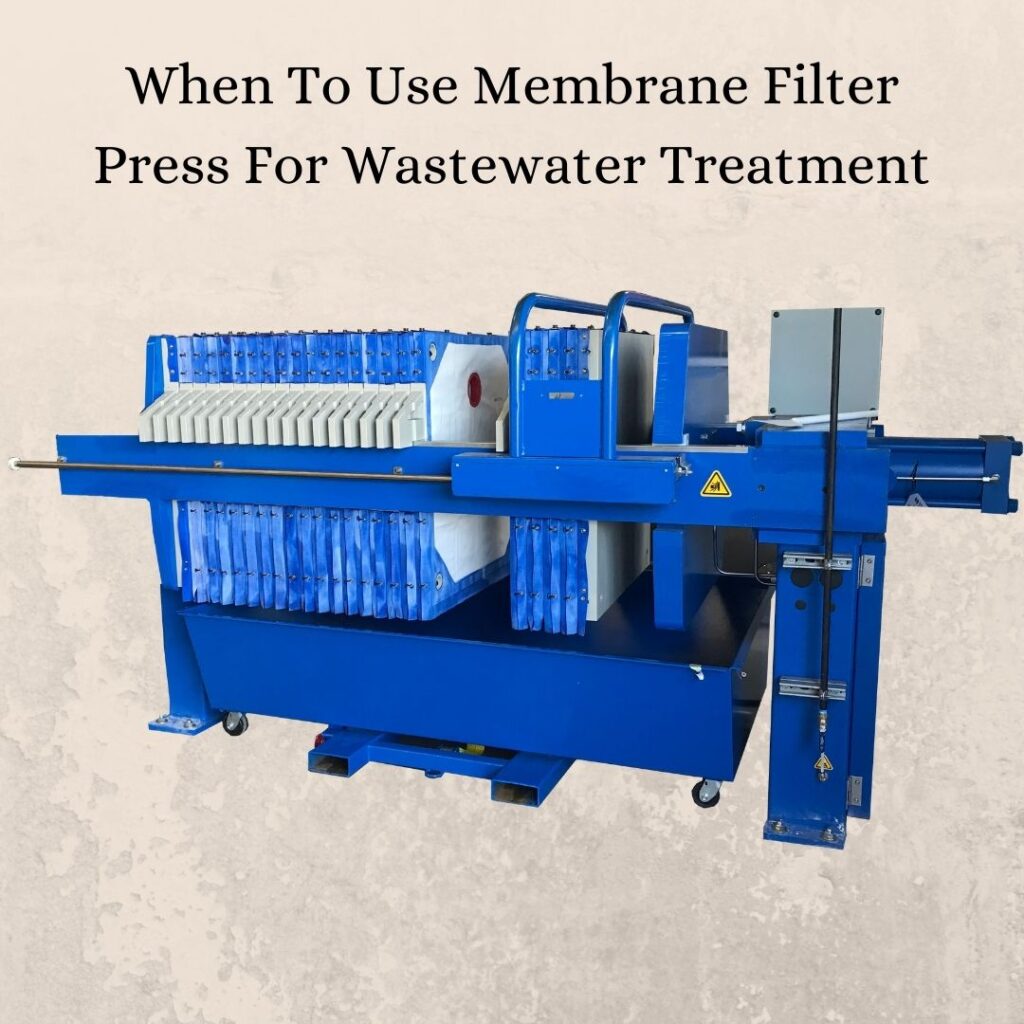
A membrane filter press, also called an automatic filter press, has three main components: the housing, the plate assembly, and the support frame. If you want to use one to treat wastewater at home or in a business, it is important to understand how each component works. Knowing this helps treat wastewater on a larger scale than standard septic tanks can handle. In this guide, we will examine each component separately. We will also discuss when it is useful in a wastewater treatment process.
What Is A Membrane Filter Press?
A membrane filter press is a type of filtration unit that uses membranes or plates to filter out materials and contaminants. The membrane filter press is commonly used in conjunction with fluid filters, such as centrifugal and belt filters, to remove particulates from fluids. It may also be called a membrane plate filter or automatic filter press depending on its specific use and construction. What are membrane filter presses used for? Membrane filter presses are used in wastewater treatment plants, water purification facilities, oil refineries, and other industrial settings.
They are necessary when unwanted substances need to be removed from liquids. Also be used in situations where it’s necessary to increase a liquid’s purity by removing small particles. They can achieve both tasks by filtering out undesirable particles through their membrane filter plates. How do they work? : There are two main types of membrane filter presses: fixed-plate and continuous flow units.
How Does A Membrane Work?
The membrane is a thin plastic sheet, with tiny holes in it. These holes are small enough that when water flows through them, only tiny particles of matter will get through. These tiny particles are called solids and can be anything from dirt to bacteria. Anything bigger than 0.0001 microns (0.00004 inches) cannot pass through these holes on their own, which makes membranes a great option for removing pollutants and pollutants that exist at very low concentrations.
But what about smaller pollutants? Those two can’t pass through on their own; they need some help getting where they need to go! That’s where chemicals come into play. Chemicals such as surfactants or detergents work by reducing the surface tension between two liquids, allowing smaller particles to travel more easily through membranes because there is less resistance against their movement. So how do you use a membrane filter press for wastewater treatment? Read on…
The Advantages Of A Membrane Filter Plate Over Other Types Of Filtration Systems
There are many types of wastewater treatment systems. A membrane filter plate is one option used in the purification process. It removes contaminants by mechanically filtering water through a membrane of various sizes. Its structure allows both permeability and pressure filtration. Membrane filter plates are easy to use and maintain. They are ideal when you need something more advanced than a chemical filtration system but less complex than an RO (reverse osmosis) or NF (nano-filtration) system.There are several advantages associated with choosing a Automatic filter press over other filtration methods as well as circumstances where you might want to consider using it in your own home or business.
What Are The Disadvantages Of Using A Regular Filtration System Instead Of A Membrane Plate?
For example, a regular filtration system has disadvantages. For example, wastewater treatment often requires both clean water removal and contamination reduction. Regular filtration systems can handle only one of these tasks at a time. By using membrane filter plates instead of regular filters, you can achieve both goals with a single water-cleaning tool. With membrane filter plates, your wastewater treatment process can remove both contaminants and excess water from your waste stream efficiently. This means you will use fewer resources and spend less money on maintenance and replacement. In addition, membrane filter plates are highly effective at removing particles smaller than 1 micron. Regular filtration systems cannot effectively remove particles smaller than 10 microns.
This means they cannot treat very small contaminants properly. By utilizing membrane filter plate for your wastewater treatment needs, you will ensure that all contaminants are removed efficiently and completely from your waste stream. Membranes last longer than other filtering materials. They do not rely on pores, which can become clogged, to separate particles from liquids. Instead, membranes use their structural integrity to remove impurities from water molecules. Because of this design, membranes do not clog like traditional filters over time.