
The rain was just beginning to tap against the windows of a small coffee shop in Seattle, where I sat across from Sarah Chen, a developer who has built apps through three distinct eras of mobile development. She gestured toward her tablet, where a complex 3D garden responded to real-time weather data streaming from outside.
“You want to understand mobile frameworks in 2026?” she asked, rotating the garden with a swipe. “Then you need to understand how we got here. It’s not just a story about code, it’s a story about how we stopped fighting our tools and started thinking about what actually matters.”
What followed was a masterclass in the technical evolution that has reshaped how we build for mobile devices. It set the mood and I took the opportunity to distill that conversation into a comprehensive look at where mobile frameworks have been, where they stand today, and the subtle but profound shifts that define development in 2026.
The Native Era – When Every Platform Spoke Its Own Language
If you want to understand the present, you must first acknowledge the foundational period that shaped mobile development: the age of native frameworks. Between 2008 and roughly 2015, building a mobile app meant committing to a platform
…and learning its language intimately.
iOS app development demanded mastery of Objective-C, and later Swift. Developers worked directly with UIKit, designing interfaces that felt intuitively Apple-like because they were Apple-like. The performance was exceptional, the animations were buttery, and the integration with hardware features like the camera or accelerometer were easy. But this intimacy came at a cost: your iOS knowledge was worthless on Android.
Android development required Java, and eventually Kotlin, paired with the Android SDK. Material Design guidelines replaced Apple’s Human Interface Guidelines. Fragment lifecycles behaved differently from view controllers. What took a week to build for one platform required another week, and another developer, or at least another skillset to replicate on the other.
Here’s the thing, native frameworks offered direct compilation to machine code, zero abstraction overhead, and immediate access to platform-specific APIs. For apps pushing graphical boundaries or requiring deep hardware integration, native was non-negotiable. Games, camera applications, and performance-critical tools lived here. But for businesses trying to reach both iOS and Android users, the native-only approach created a fundamental scaling problem. You weren’t building one product; you were building two, with separate teams, separate codebases, and separate maintenance burdens.
Unfortunately, the technical excellence of native development became a business liability.
The First Wave of Cross-Platform: The WebView Compromise
The first attempts to solve this problem emerged from an obvious source: the web. After all, web developers had been building cross-platform experiences for decades. Why not wrap a web application in a native container and call it a mobile app?
Apache Cordova, and its predecessor PhoneGap, pioneered this approach. Developers wrote HTML, CSS, and JavaScript, and Cordova packaged it into a native application shell that embedded a WebView, essentially a full-screen browser instance, to render the interface. JavaScript bridges allowed limited access to native device features like the camera or geolocation.
The appeal was undeniable. Web developers could suddenly build “apps” using skills they already possessed. Development cycles were fast, and the same codebase deployed to both platforms.
But the technical limitations proved fatal. WebViews rendered slowly compared to native UI components. Scrolling felt janky, a cardinal sin in mobile user experience. Animations stuttered because they ran through layers of abstraction: JavaScript executing in a web context, passing messages through bridges, finally rendering in a browser engine never designed for the fluidity users expected from native apps.
Worst of all, the apps never felt right. They were impostors wearing native skins, and users could tell. They deleted these apps in favor of experiences that respected the platform’s conventions and performance expectations.
The Second Wave: Bridging Worlds with JavaScript
The breakthrough came when developers asked a different question: what if we kept the web’s development model but rendered actual native components?
React Native, introduced by Facebook in 2015, revolutionized cross-platform development with exactly this insight. Developers wrote JavaScript, but instead of rendering HTML in a WebView, React Native communicated through a “bridge” to native UI components. Your JavaScript code described what the interface should look like, and the bridge instructed iOS to render a real UIView or Android to render a real ViewGroup.
The technical architecture deserves attention because it explains both React Native’s success and its limitations. The JavaScript code runs in a separate thread (the JavaScript thread), while the native UI renders on the main thread. Communication between them happens asynchronously through a serialized JSON bridge. This separation prevents JavaScript performance issues from blocking UI rendering, but the bridge itself becomes a potential bottleneck, every interaction, every state change, every animation requires crossing this bridge.
NativeScript and Ionic offered variations on this theme. NativeScript provided direct access to native APIs without the React abstraction. Ionic continued refining the WebView approach, betting that browser engines would eventually become fast enough.
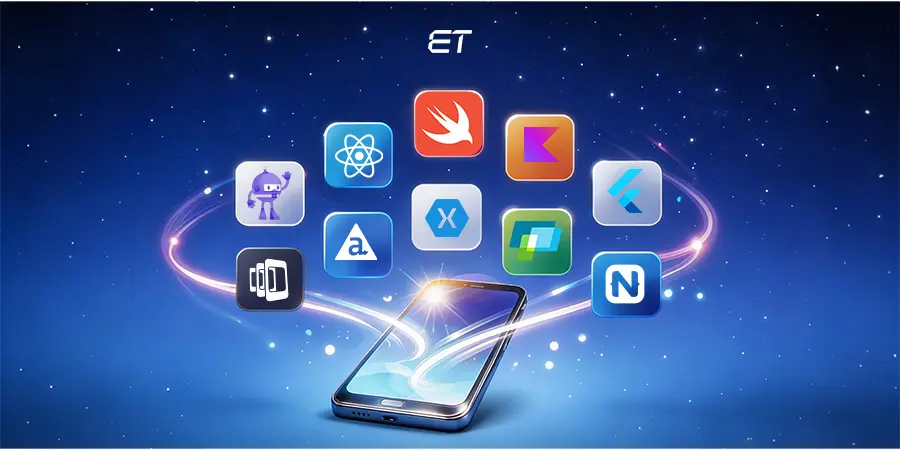
Then came Flutter in 2017, and Google took a radically different approach. Instead of using native components at all, Flutter brought its own rendering engine (Skia) and drew every pixel itself. Rather than asking the platform for a button, Flutter painted the button exactly as it wanted, every frame. This “paint your own canvas” approach eliminated the bridge entirely. Everything (logic, layout, rendering) happened in a single context, compiled ahead-of-time to native machine code.
The performance difference was immediately noticeable. Flutter apps maintained a consistent 60 or even 120 frames per second, with identical behavior across iOS and Android. Developers gained complete control over every pixel, enabling custom designs that were difficult or impossible with native components.
But Flutter introduced its own complexity. Developers had to learn Dart, a language used almost nowhere else. The framework was comprehensive but opinionated, you built apps Flutter’s way or not at all. And because Flutter painted everything itself, it occasionally felt slightly disconnected from platform conventions, like a guest who brings their own furniture to your house.
The WebAssembly Revolution: A New Foundation
While React Native and Flutter battled for developer mindshare, a quieter revolution was building in the browser. WebAssembly (Wasm) emerged as a binary instruction format that could run in browsers at near-native speed. Instead of sending JavaScript source code for the browser to interpret, developers could compile C++, Rust, Go, or other languages directly to Wasm and execute it with minimal overhead.
By 2023, WebAssembly had escaped the browser. Runtimes like Wasmtime and Wasmer enabled Wasm execution outside the web entirely. Mobile frameworks took notice.
The technical implications are profound. JavaScript, even with just-in-time compilation, carries inherent overhead. It’s dynamically typed, garbage-collected, and interpreted at runtime. WebAssembly, by contrast, is a compact binary format designed for efficient parsing and execution. It provides predictable performance, near-native speeds, and the ability to reuse code written in systems languages across any platform.
This shift enabled new hybrid frameworks that combined the best of previous approaches. A developer could write performance-critical code in Rust, compile it to Wasm, and use it within a mobile app solutions alongside UI code written in JavaScript, TypeScript, or Dart. The framework handled the integration, and the Wasm modules executed with minimal overhead.
Mobile Frameworks in 2026: The Unified Landscape
Which brings us to the present. Mobile development in 2026 has matured into something far more nuanced than the framework wars of previous years. The question is no longer “native or cross-platform?” but rather “how do we assemble the right tools for this specific problem?”
The Dominant Players
Flutter has evolved significantly, embracing WebAssembly as a compilation target. Flutter apps can now run in browsers with near-native performance, and the framework’s widget system remains the most comprehensive in the industry. Google has addressed the platform-convention criticism by introducing platform-aware widgets that automatically adapt their behavior and appearance to iOS, Android, and even desktop environments. Flutter’s “write once, run anywhere” promise has largely been fulfilled.
React Native has undergone its own transformation. The new architecture, fully mature by 2024, replaces the asynchronous bridge with a direct JavaScript-to-native interface called JSI (JavaScript Interface). This allows synchronous communication and significantly improves performance for animations and gesture handling. React Native can also host WebAssembly modules directly, enabling performance-critical code to run outside JavaScript entirely.
But the most interesting development is the emergence of Wasm-first frameworks like Spin and Extism that treat mobile as one target among many. These frameworks prioritize modularity above all else. An application becomes a collection of WebAssembly components, each potentially written in a different language and handling a specific responsibility, assembled within a lightweight host that manages communication between them.
The AI Co-pilot Shift
Perhaps the most significant change in 2026 isn’t in the frameworks themselves but in how developers interact with them. Integrated development environments now include sophisticated AI assistants that understand not just syntax but intent.
The technical nuance here is that these AI co-pilots do not simply generate boilerplate. They understand framework architecture, API contracts, and performance implications. A developer can describe a feature in natural language, “create a smooth parallax effect when scrolling through this image gallery,” and the AI generates optimized code using the appropriate framework APIs, complete with performance annotations and edge-case handling.
This has fundamentally changed the skill requirements for mobile development. Memorizing framework APIs is no longer valuable. Understanding architectural patterns, user experience design, and performance optimization—these remain essential because the AI handles the mechanical translation of intent into code.
The Integration Economy
Frameworks in 2026 excel at one thing above all: integration. Modern mobile apps solution rarely exist in isolation. They pull data from multiple sources, interact with wearable devices, connect to IoT sensors, and maintain real-time synchronization with cloud services.
The frameworks that thrive are those that abstract away the complexity of these integrations. A weather app shouldn’t need to understand the nuances of pulling data from five different APIs, caching it efficiently, and displaying it with appropriate animations. The framework should provide declarative primitives that handle these concerns, allowing developers to focus on the unique value their app provides.
Performance Without Pain
The performance characteristics of modern frameworks deserve special attention. In 2026, the abstraction overhead that plagued early cross-platform tools has largely been eliminated through a combination of:
- Ahead-of-time compilation to native code for critical paths
- WebAssembly modules for computationally intensive operations
- Intelligent caching at multiple levels of the framework stack
- Predictable rendering pipelines that maintain 120fps even under load
Developers no longer sacrifice performance for cross-platform reach. The gap between native and framework-based applications has narrowed to the point of irrelevance for all but the most demanding use cases.
The Developer Experience in 2026
What does it actually feel like investing in mobile app development today?
You start with a project template that includes your chosen framework, perhaps Flutter for a UI-heavy consumer app, React Native for a team already invested in the React ecosystem, or a Wasm-first framework for an application with significant computational requirements.
Your IDE, aware of your framework choice, provides intelligent suggestions based on best practices from thousands of similar applications. As you describe components, the AI co-pilot offers implementations, complete with accessibility annotations, performance optimizations, and error handling.
When you need to integrate a device feature such as the camera, Bluetooth, or machine learning models, you import framework modules that handle the platform specific complexity. The same code works across iOS and Android app development with appropriate fallbacks when features are not available.
Testing happens continuously. The framework provides performance profiling tools that identify bottlenecks before they reach users. Accessibility checks run automatically. Platform convention validation ensures your app feels native on each device.
Deployment packages your application for both platforms simultaneously, generating appropriate app store assets and metadata.
The Subtle Nuance – What’s Been Lost and Gained?
For all the technical progress, something has shifted in the culture of mobile development. The frameworks have become so capable, the AI assistants so helpful, that the mechanical difficulty of building apps has plummeted.
This is undeniably good for innovation. A developer with a good idea can now build and deploy a polished application in days rather than months. The barrier to entry has never been lower.
But something has been lost, too. The deep intimacy with platform internals that characterized early mobile development is increasingly rare. Few developers today understand the intricacies of UIKit or the Android view system because they rarely interact with them directly. The frameworks handle those details.
Sarah Chen, my coffee shop guide through this evolution, put it this way: “We’ve traded deep platform knowledge for broader creative reach. Whether that’s a loss or a gain depends on what you value. But there’s no question which approach builds better products for more people.”
Looking Forward – The Next Horizon
As 2026 unfolds, several trends suggest where mobile frameworks are heading:
WebAssembly continues its expansion. The ability to run any language anywhere will eventually make “cross-platform” a meaningless distinction. All platforms will run all code.
AI integration deepens. Future frameworks won’t just help you write code; they’ll help you design experiences, analyze user behavior, and optimize for business outcomes.
Hardware abstraction increases. As devices diversify beyond phones, including watches, glasses, car dashboards, and home appliances, frameworks that can target any screen with appropriate adaptations will dominate.
The line between web and native blurs further. Progressive Web Apps already rival installed applications in capability. Frameworks that can deploy to both distribution models from a single codebase will become increasingly attractive.
Conclusion
The evolution of mobile frameworks from the native era through WebAssembly and into 2026 tells a story of progressive abstraction. Each layer of tooling has moved developers further from the hardware while enabling them to build more sophisticated applications more quickly.
In 2026, the best frameworks are invisible. They handle complexity so developers can focus on creativity. The bridge platforms so products can reach everyone. They integrate AI so human effort concentrates on what machines cannot yet do: imagine experiences that users will love.
The tools have never been more capable. What matters now is what we build with them.