


A few years ago, translating product pages into multiple languages felt like a long-term commitment. It meant weeks of coordination, spreadsheets flying back and forth, and the uncomfortable moment when a campaign went live in English while every other language lagged behind. For most D2C brands, the effort simply did not seem worth the trouble.
That thinking is changing fast.
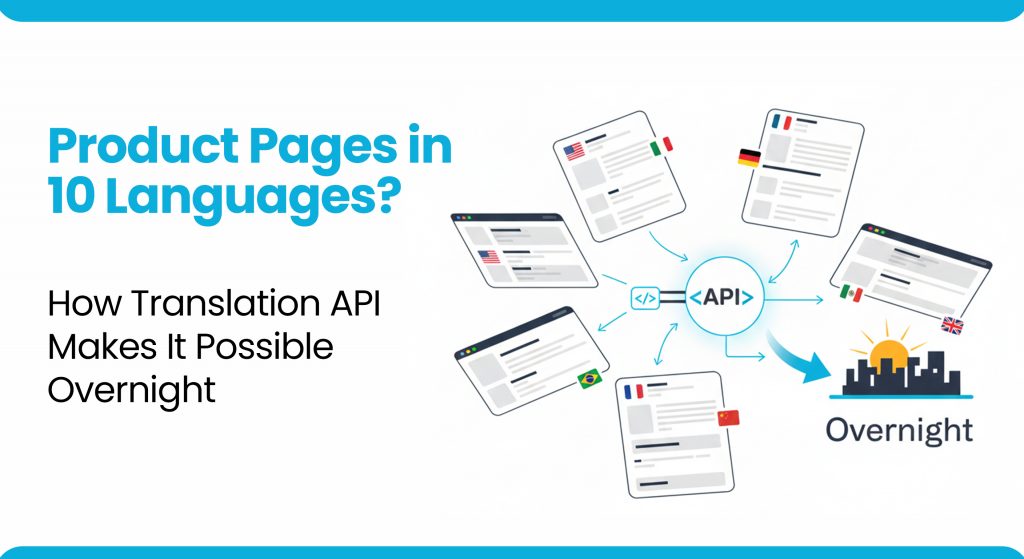
Today, Translation API has made it possible for D2C companies to launch product pages in 10 or more languages almost overnight. Not as a gimmick, and not as a rough experiment, but as a practical way to reach customers who already want what you sell, just not in English.
This shift is especially visible in markets like India, where English to Kannada translation and other regional language conversions are becoming a growth driver rather than a support activity.
Why Language Suddenly Matters More in D2C?
D2C brands live and die by their product pages. These are not just information hubs. They are where trust is built, objections are handled, and buying decisions are made. Every word carries weight.
What many brands are discovering is that even customers who understand English do not always prefer it when making a purchase. They read faster, process details more clearly, and feel more confident when content is presented in their primary language. This is not a cultural theory. It is a behavioral reality.
Insights frequently cited by Harvard Business Review show that customers are significantly more likely to engage and convert when content feels familiar and accessible. In D2C, where margins are tight and attention spans are shorter, that difference matters.
The Old Problem with Multilingual Product Pages
Until recently, translating product pages at scale came with real trade-offs. Manual translation took time and money. Outsourced workflows introduced delays. Updates to pricing, offers, or product descriptions created version mismatches across languages.
As a result, many brands settled for partial localization. A homepage in one or two languages. Product pages left untouched. Support content is lagging behind. It worked well enough, but never well.
Translation API changes this equation by removing the friction that made multilingual product pages feel risky in the first place.
How Translation API Changes the Game for D2C Brands
AI-powered translation goes beyond speed. The way teams look at language varies a lot. Brands may now include multilingual publishing in their usual work instead of having to do translations individually.
You don’t have to book English to Kannada translation weeks in advance anymore. English product updates can be translated into Kannada quickly, ensuring regional consistency. This helps during launches, discounts, and seasonal campaigns when timing matters.
The World Economic Forum has regularly noted how Translation API is lowering language barriers to digital inclusion. D2C brands gain market access from this inclusion.
Five Ways Translation API helping D2C Teams Quickly
Explore the ways how translation APIs are helping out D2C companies to automate and scale their translation and localization workflows.
1. Speed is better than perfection as long as quality stays the same.
Customers don’t expect great writing on product pages. They want everything to be clear. Translation API lets brands move swiftly while keeping the same tone and language on all of their pages, which is sometimes more essential than making things look nice.
2. Regional languages open up demand that is already there.
Ads, influencers, and word of mouth are already helping many shoppers find things. People are less likely to hesitate when they see a product page in their own language. For example, translating from English to Kannada helps brands reach clients who are already interested but weren’t sure before.
3. Consistency makes people feel more sure of themselves.
Inconsistent information is one of the major hazards for multilingual D2C sites. The names of the features, the return policies, and the prices must all be the same. AI-powered solutions help keep things the same across languages, which cuts down on confusion and support requests.
4. Translation is now an element of optimizing conversions.
There are more things that can be done to optimize a product page than just photos, prices, and where to put the call to action. Language has become a tool for conversion. Brands that test and improve translated content notice real improvements in how many people engage with it and how many people finish it.
5. Operations are more important than tools
Translation API works best when it is built into the way teams publish content. Deloitte says that companies that make automation a part of their main operations have better results than those that approach it as an extra. Translation is no different.
A Simple D2C Scenario
Here’s something that happens more often than teams admit.
A skincare brand launches a new product. Everything looks ready. The English product pages are live, ads are running, and traffic starts coming in from different regions, including Karnataka. On paper, nothing seems wrong. People are clicking through. Time on page looks decent.
But conversions are not where the team expected them to be.
There is no obvious red flag. Pricing is fine. The product is strong. Reviews are decent. Now imagine the same setup, except the product pages are available in Kannada from the beginning. Not as a follow-up. Not weeks later. Right from day one. Ingredients are easy to read. Usage instructions do not require extra effort. Benefits make sense immediately.
The product does not change. The formulation stays exactly the same. The price does not move. Even the page layout remains untouched. The only thing that changes is the language. And yet, the page feels more approachable. Less effort is required to understand it. The decision feels lighter.
That difference rarely shows up in loud ways, but it shows up where it matters.
Where DOTA Fits In?
This is usually where teams hesitate, because translation sounds like extra work they do not have time for. Managing multiple languages manually is slow, and keeping every version updated is even slower.
DOTA reduces that friction by keeping translated product pages connected to the original content. When the English version changes, the other languages follow without the team having to rework everything from scratch. For D2C teams moving quickly, this matters. Launch timelines stay intact. Content stays aligned.
Most importantly, stop treating language as a finishing touch. In D2C, it is part of the product experience itself.
Closing Thought
Translation API has not made multilingual product pages fashionable. It has made them practical.
When language stops being a bottleneck, brands stop choosing between speed and reach. They get both. And in a competitive D2C landscape, that combination is hard to ignore.
The fastest way to feel local is to speak like one.