


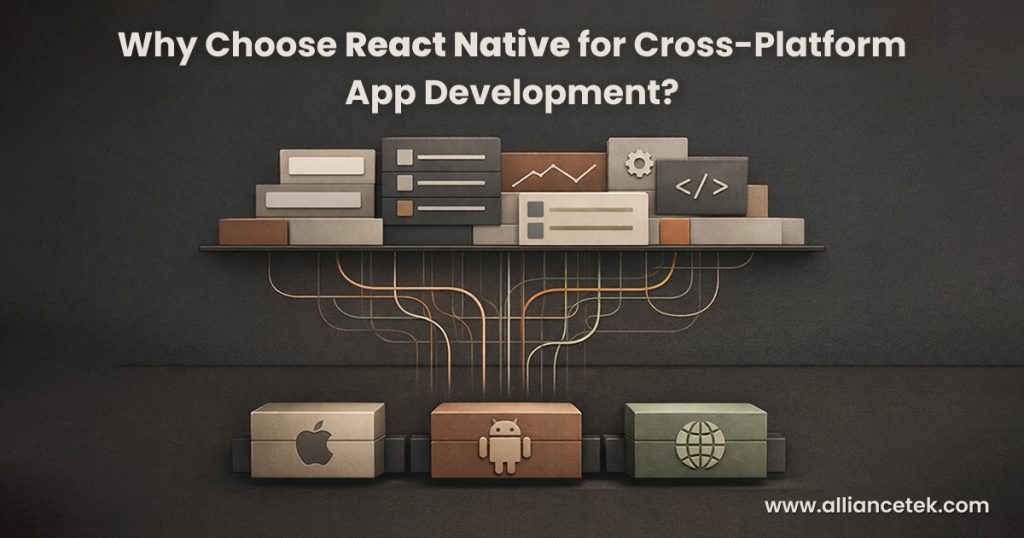
Mobile cross-platform development allows you to create applications that run on iOS and Android based on a single codebase. It is an ingenious method of reducing expenses, accelerating the delivery process, and maintaining uniformity across platforms. This is where React Native Cross-Platform app development stands out as a powerful and future-ready solution.
React Native is unique in this area. It was originally developed by Meta and allows you to write applications using JavaScript and React, with native performance. Businesses worldwide rely on React Native app development services to accelerate time-to-market and ensure consistent user experiences across platforms.
What is React Native?
React Native is an open-source platform to develop real, native rendering mobile applications in JavaScript and React. In contrast to hybrid apps, which render within a webview, React Native apps utilize the native UI components of the platform, which makes them higher-performing and more interactive.
React Native offers a collection of fundamental elements, such as Text, View, and Image, that are equivalent to native building blocks of the UI. JavaScript is used to write logic, and platform-native APIs are used to render the UI.
Because of this architecture, React Native application development services combine the flexibility of web development with the power of native mobile performance, making them ideal for startups and enterprises alike.
The Benefits of React Native
React Native cross-platform development has several benefits, including:
1. Single Codebase on Multiple Platforms
You do not have to employ two different teams for Android and iOS. React Native allows using the same JavaScript codebase to run both applications. Even business logic can be shared across the web using tools such as React Native Web. This significantly reduces development overhead and makes custom React Native app development solutions highly cost-effective.
2. Developer Efficiency
Such features as Hot Reloading and Fast Refresh enable previewing the changes in real time without reloading the entire app. The result is quicker debugging and reduced development time. This efficiency is a major reason businesses partner with a React Native app development company instead of managing separate platform teams.
3. Performance
Although you’re using JavaScript, your app runs using native views. The bridge between JS and native modules is optimized, and you can always drop into native code when needed for high-performance tasks. This level of performance is one reason why which is why many consider it when searching for a top React Native development company.
4. Active Community and Ecosystem
React Native has a thriving ecosystem. Thousands of libraries, tools like Expo, and community-backed plugins make building and scaling apps much easier. This enables any React Native development services remain scalable and future-proof.
5. Cost Savings
Reusing components across platforms means fewer developer hours and less duplication. Companies can build MVPs faster and iterate quickly based on user feedback. This cost-efficiency is a major draw for clients seeking React Native consulting services.
As cross-platform projects grow in complexity, many businesses choose to hire React Native app developers who can build scalable features while maintaining a single, shared codebase for iOS and Android.
How React Native Works?
React Native works by leveraging a JavaScript bridge that connects your logic to native modules. While the UI is written using React, the components are rendered using native views for iOS and Android. For example, a <Text> tag becomes a UILabel on iOS and a TextView on Android.
This architecture balances performance with flexibility:
- Native modules handle performance-heavy operations
- JavaScript takes care of UI logic and interaction
- You can write custom native modules in Java or Swift when needed
This means your app gets the look and feel of a native app, but with the efficiency of React and JavaScript, allowing teams to hire React Native developers without expanding their native dev team.
For applications that demand performance optimization and clean architecture, it is often essential to hire expert React Native developers with hands-on experience in native modules and advanced integrations.
Tooling and Ecosystem
Expo is a powerful toolchain built around React Native. It lets developers create, build, and deploy apps quickly without having to touch native code. Expo handles common tasks like push notifications, camera access, file storage, and more.
Benefits of using Expo include:
- Easy setup and configuration
- Over-the-air updates without App Store resubmission
- Access to device features without writing native code
This flexibility is invaluable for enterprises seeking React Native app development consulting services for long-term digital transformation.
Large organizations and funded startups typically prefer to hire top React Native developers who follow best practices, ensure long-term maintainability, and align development with business goals.
React Native for Web, Windows, and macOS
React Native Web allows you to turn React Native components into web components and increase the reach of your app without the need to rewrite logic. Likewise, React Native on Windows and macOS enables you to create desktop applications with the same codebase, which is ideal when creating productivity applications or enterprise apps that cut across platforms and need advanced React web development services.
Real-World Adoption of React Native
Some of the most popular tech brands use React Native:
- It is used in Facebook and Instagram, apps of Meta.
- Shopify embraced the use of React Native in its apps for merchants.
- Microsoft makes donations to React Native on Windows.
- It is also used in parts of the apps of Coinbase, Pinterest, Uber Eats, Tesla, and Bloomberg, validating its strength for React Native app development services.
These businesses opt to use React Native to minimize the duplication of code, coordinate development processes, and accelerate the process of iteration.
When to Avoid React Native
React Native is not a universal solution, although it has its advantages:
- High-performance gaming: Native code remains superior in the case of applications that are highly graphics-intensive or require 3D rendering.
- Native integrations: Apps that require access to features specific to the device that React Native does not yet support may need native workarounds.
- Big apps with complicated architecture: React Native can be scaled, but it might need additional architecture design and performance optimization.
In such cases, businesses often hire dedicated React Native developers or native specialists to evaluate feasibility.
Best Practices for Cross-platform with React Native
To make the most of React Native for cross-platform development:
- Use TypeScript for predictable code and type safety
- Modularize components so code is reusable and testable
- Avoid unnecessary re-renders by using React. memo and useCallback
- Test across platforms regularly to avoid OS-specific UI bugs
- Use platform-specific code where needed to deliver polished experiences
These practices are essential whether you hire remote React Native developers or work with an in-house team. Ultimately, companies aiming for reliability, speed, and future scalability look to hire best React Native developers to deliver high-quality cross-platform mobile experiences.
Final Thoughts
React Native is also one of the most viable cross-platform mobile development solutions in 2026. It provides the tradeoff between performance, speed, and cost-effectiveness that most teams require.
Its powerful community, scalable architecture, and continuously expanding ecosystem make it a tested framework for both startups and businesses, particularly those considering React Native migration services or long-term React Native support and maintenance services.
React Native delivers both teams with frontend development experience with React.js and enterprises developing large-scale platforms. It is also compatible with the requirements of the best React Native development teams, as well as the teams that develop enterprise React Native application solutions.