
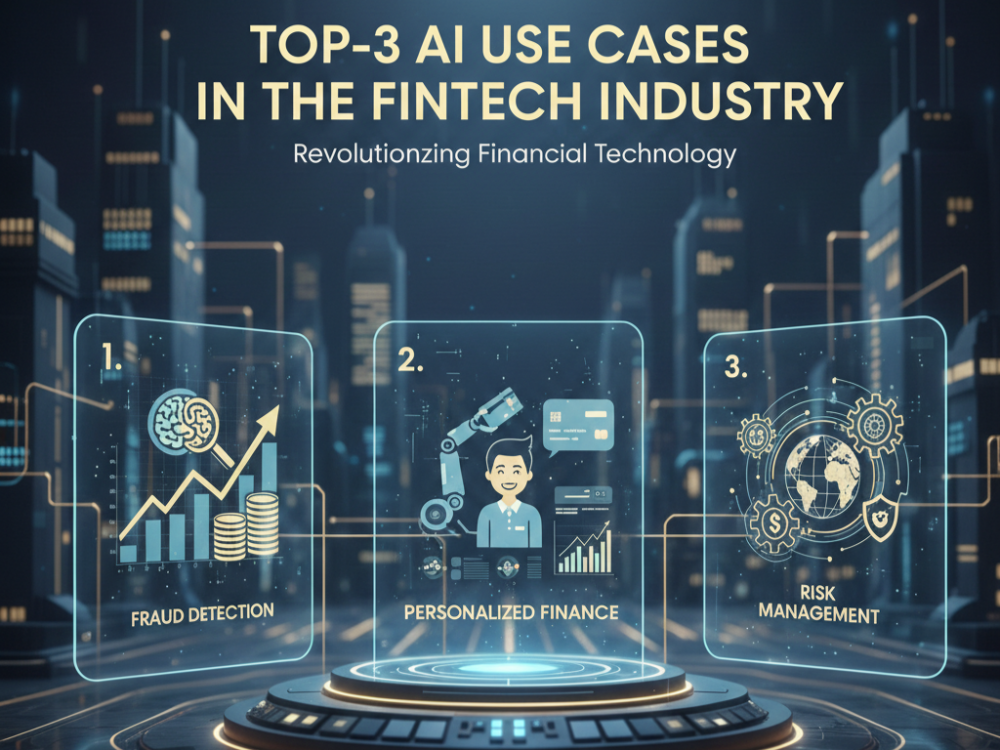
The adoption of artificial intelligence has become a necessary component for financial technology after its initial development as an experimental technology. Fintech companies in 2026 implement artificial intelligence systems to automate processes and evaluate risks and identify fraudulent activities and assess loans and enhance customer service. The development of intelligent systems needs custom fintech software development services which create safe connections between artificial intelligence models and essential banking systems and payment networks and compliance systems.
AI has become a fundamental requirement for businesses to implement. The technology forms a fundamental part of systems which include transaction processing and compliance monitoring and digital banking operations. Organizations that use AI as an integrated system instead of a standalone tool achieve superior operational results and improved risk management capabilities.
The three AI use cases present themselves as the most successful applications which generate significant business value across multiple business domains.
1. AI-Powered Fraud Detection and Transaction Monitoring
Fraud continues to be the most costly risk which fintech companies face. Payment platforms and digital banks and neobanks handle millions of transactions every day. The existing rule-based systems face difficulties because fraudsters keep developing new methods to commit their crimes.
Why Traditional Fraud Systems Fall Behind
Existing fraud detection systems depend on unchanging operational rules and predefined limit values for their functioning. Criminals develop new methods to commit fraud at a speed which exceeds the ability of organizations to revise their established protective measures. This situation produces multiple negative consequences which include:
- High false-positive rates
- Blocked legitimate transactions
- Manual review overload for compliance teams
- Poor customer experience
False declines which happen during customer verification processes result in financial losses and decreased customer confidence.
How AI Improves Fraud Detection
The AI-based fraud detection system performs real-time analysis of transactions. The machine learning models use their ability to learn from data patterns to detect fraud by analyzing extensive datasets.
Common techniques include:
- Supervised learning to detect known fraud behaviors
- Unsupervised anomaly detection to flag new patterns
- Graph analytics to uncover fraud networks
The AI models assess various transaction variables which include device information and user behavior patterns and geographic location and customer spending patterns.
Business Impact
AI fraud systems will achieve their best results when they are implemented according to established best practices. The system produces a 30 to 50 percent reduction of false positives which enables faster detection of fraudulent activities while decreasing the need for manual reviews and increasing customer retention.
Modern fintech companies increasingly rely on secure system integration and compliance-driven architecture, which they obtain through fintech software development services to protect their AI fraud pipelines from operating outside of regulated environments.
The use of artificial intelligence for fraud detection in the fintech industry provides the fastest return on investment according to current research.
2. AI-Driven Credit Scoring and Lending Decisions
Traditional credit scoring methods depend on complete financial data which provides banks with accurate information about customers’ creditworthiness. The process creates barriers which prevent underbanked people from obtaining credit while it creates delays during the process.
The Problem with Traditional Credit Models
The traditional scoring models use three main data sources which include:
- Credit bureau data
- Income history
- Loan repayment records
If applicants lack formal credit history, they are often rejected. This creates missed opportunities for lenders and limited access to credit for consumers.
How AI Enhances Credit Scoring
AI models evaluate both traditional and alternative data sources, including:
- Transaction behavior patterns
- Income consistency signals
- Spending trends
- Banking API data
Machine learning models identify correlations that static scoring systems miss. AI systems use new data to enhance their learning.
Measurable Outcomes for Fintech Lenders
The implementation of AI-powered credit scoring systems delivers three key benefits for lenders. The system provides faster loan processing times while the system also enables lenders to reach customers who previously lacked access to credit.
The system helps lenders decrease default rates while it improves their capacity to forecast potential credit risks. The system allows lenders to assess different risk scenarios before they introduce new products to the market which helps them minimize potential financial losses.
Governance and Fairness
AI lending systems must comply with their established regulatory requirements. The system requires three specific elements which include:
- The system needs to provide understandable explanations for its decision-making process.
- The system needs to conduct regular audits for potential bias in its operations.
- The system requires organizations to provide specific information about their rejection of applications.
- The system needs human supervisors to monitor all operations which involve critical cases.
Governance frameworks establish the permanent existence of fintech AI systems through their control of system operation.
3. AI-Powered Customer Support and Financial Assistance
Fintech companies establish their competitive position through their customer experience delivery. Digital banking platforms provide service throughout the day but their support teams face challenges because they depend solely on human employees.
Why Automation Is Necessary
Fintech companies face:
- High volumes of repetitive inquiries
- Demand for instant support
- Complex account-related questions
- Global customer bases
Without automation, support costs escalate rapidly.
AI Support Use Cases
Modern AI assistants handle:
- Transaction inquiries
- Card blocking requests
- Payment status tracking
- Account setup guidance
- Dispute initiation
The systems use natural language processing together with secure backend system connections to operateTheir functions.
From Chatbots to Financial Copilots
Today’s AI assistants use automated responses to handle customer inquiries but they offer more advanced capabilities.
- The system provides personalized responses through its ability to access account information.
- The system functions inside protected login processes which require user verification.
- The system transfers issues to human support when it needs human assistance.
- The system delivers forward-looking financial information to users.
AI-powered assistants deliver two benefits to businesses by decreasing operational expenses and increasing their operational response rate.
Security Considerations
Financial AI assistants must:
- Encrypt all user interactions
- Limit access to information
- They need to record their activities for auditing purposes
- The system requires users to access resources based on their defined roles
Trust serves as a fundamental requirement for financial services. The security protocols must control all operations of the AI interface.
Conclusion
The adoption of artificial intelligence has become a necessary component for financial technology after its initial development as an experimental technology. Fintech companies in 2026 implement artificial intelligence systems to automate processes and evaluate risks and identify fraudulent activities and assess loans and enhance customer service. The development of intelligent systems needs custom fintech software development services which create safe connections between artificial intelligence models and essential banking systems and payment networks and compliance systems.
AI has become a fundamental requirement for businesses to implement. The technology forms a fundamental part of systems which include transaction processing and compliance monitoring and digital banking operations. Organizations that use AI as an integrated system instead of a standalone tool achieve superior operational results and improved risk management capabilities.
The three AI use cases present themselves as the most successful applications which generate significant business value across multiple business domains.