


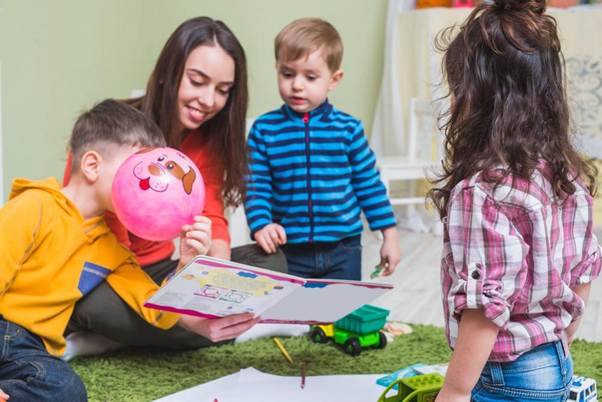
Young children must participate in organised and creative activities in their early development and learning. The use of simple activities that help to improve creativity and communication skills includes colouring, storytelling, and singing. Puzzles and building blocks can be utilised in enhancing eye-hand integration and problem-solving capabilities. Outdoor games encourage socialisation with peers and health. Role-play games improve the confidence of children and their emotional intelligence. Dancing and music are some of the activities that effectively enhance motor and rhythmical skills. These fascinating experiences are what characterise the worth of a good nursery preschool. Together, they make a good foundation of life long learning. All these fun activities promote early cognitive child development, autonomy, imagination and fascination.
1. Creative Arts and Crafts
Art and craft projects are one of the most appropriate ways to motivate young children to use their imagination. Children can demonstrate their thoughts and emotions by means of the simplest tasks, such as colouring, drawing, cutting, and pasting. Motor activities are also useful in building the fine motor skills of the kids as they learn to use crayons, scissors, and brushes. More so, art encourages choice as children choose colours and patterns. It also gives them self-esteem when they accomplish their work, and they feel they are accomplished.
2. Reading and Storytelling Activities
Narration is an efficient way of creativity and language of child development. The language comprehension and listening abilities of children are also improved when they hear stories. It also enhances their ability to think imaginatively and visualise situations. Picture books give children the opportunity to learn about new things, cultures and to feel different.
3. Activities: Music And Movement
Music and movement practices play a very essential role in the body and mind of child development. Playing small musical instruments, dancing, clapping and singing songs help children to enhance their rhythm and coordination. Moreover the exercises develop listening, memory and understanding. The children are given the motivation of expressing themselves physically through the activity-based chores that are very important in their overall child development. Moreover, children will be able to enjoy the calming power of music, regulate their mood and reduce stress.
4. Building Blocks And Puzzle Games
You can be good at solving logical problems and issues by building block play and solving puzzles. Such activities help children to learn the sizes, shapes, and spatial associations. When children complete puzzles or stack blocks, they become patient and determined. Group projects in the form of blocks encourage teamwork and interaction between children.
5. Outdoor Games And Physical Exercises
Play in the outside world is a necessity for the overall child development and health of the child. Examples of such activities that develop the muscles and gross motor skills are running, jumping, climbing and playing games. Moreover, it promotes an active lifestyle since childhood and reduces screen time.
6. Role-Playing And Dramatic Play
Role climbing, where one imagines oneself as a teacher, a doctor, or a shopkeeper, is just one of the few examples of activities that are good for emotion and social child development. Through such exercises children are able to learn and experience different roles as well as understand real life situations. The dramatic play boosts confidence and communication skills. It also builds empathy as the kids acquire knowledge of other people and their feelings and opinions. Role-playing promotes creativity and helps in developing problem-solving capabilities of children in an enjoyable and involving way.
7. Activities for Sensory Play
Sensory play is defined as actions that attract the senses of a child like touch, smell, sight, sound and taste. Some choices include playing with sand, water, clay or textured materials. With the help of sensory activities children can study and learn the surrounding world better. They also improve the concentration capacity and facilitate thinking. The exercises are extremely useful in calming down nervous children and enhancing fine motor skills. Sensory play enables the child to learn through practical means safely and enjoyably.
The Importance of these Activities to Child Development
Each of these activities makes its own contribution towards the development of a child. Motor skills, research, creativity and language are promoted by physical and sensory, art and storytelling activities, respectively. Emotional and social intelligence is developed through the use of role-playing and group activities. These activities together enable an environment of learning that is balanced and helps support all the child developmental aspects.
Final words
Preschool and nursery activities play an important role in the early child development of a child. The different activities facilitate the growth of children in various ways, including outdoor play and the value of the senses in artistic activities.