


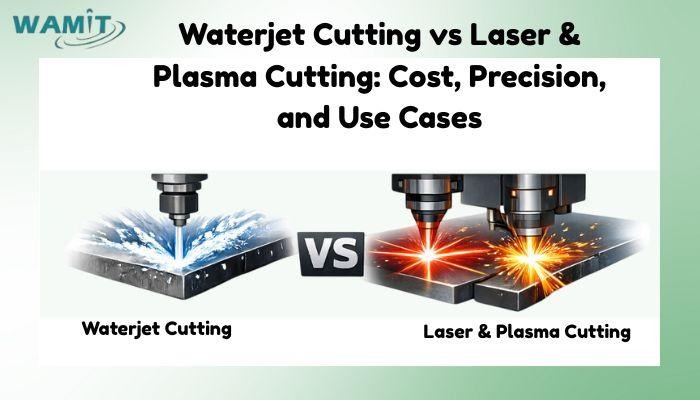
In modern manufacturing, advanced cutting technologies are utilized to ensure accuracy and efficiency. Waterjet, laser, and plasma cutting are frequently contrasted to find the most appropriate fabrication technique for specific applications.
The appropriate choice of cutting process influences production speed, cost, material waste, and overall quality. This guide tells what each cutting technology costs, what precision to expect, what materials to use, and when to use each one in an easy-to-understand manner.
Overview of Industrial Cutting Technologies
Industrial cutting technologies enable accurate and efficient material processing across modern manufacturing industries.
What Is Waterjet Cutting?
Waterjet cutting is a cold-cutting method in which ultra-high-pressure water—often containing abrasive particles—is used to cut materials with a high level of accuracy.
Types of waterjet cutting:
- Pure waterjet: Applied to soft materials such as rubber, foam, and food products.
- Abrasive waterjet: This also utilizes garnet abrasives to cut stone, metals, and composites.
Key advantages:
- No heat-affected zone (HAZ).
- Preserves material integrity.
- Applicable to heat-sensitive and multi-layered materials.
What Is Laser Cutting?
Laser cutting is a process that involves a high-energy laser beam focused to melt or vaporize material along a designated path or design.
Common laser types include:
- CO2 lasers
- Fiber lasers
- Nd:YAG lasers
Strengths of laser cutting:
- Very fine accuracy of thin materials.
- Fast cutting speeds
- Very good edge finish on sheet metal.
Laser cutting is common in electronics, automotive, and signage.
What Is Plasma Cutting?
Plasma cutting is a technique that utilizes ionized gas through an electric arc to cut electrically conductive metals.
Key characteristics:
- Fits well for heavy metals such as steel and aluminum.
- Faster for heavy fabrication than waterjet cutting.
- Reduced accuracy compared to laser cutting.
- Plasma cutting is frequently employed in the shipbuilding, structural steel and heavy industry sectors.
Cost Comparison – Waterjet vs Laser vs Plasma
Knowing the cost difference can assist manufacturers in selecting a cutting method that fits budget and production requirements.
Initial Equipment Cost
The initial price of the two cutting procedures varies. Waterjet machines tend to be more expensive. The laser machines are very costly as well. The least expensive are plasma machines.
Cost factors include:
- Machine size and cutting bed
- Power requirements
- Automation and software integration of CNC.
Operating & Maintenance Costs
Consumables comparison:
- Waterjet: Water, Pumps, seals.
- Laser: Helping gases, optics, lenses.
- Plasma: Gas, nozzles, electrodes.
Energy consumption:
- Cuts made on thin materials by laser cutting consume less energy.
- Plasma consumes more electrical power.
- High pressure pumps increase the amount of power consumed by waterjet.
Long-Term Cost Efficiency
Long-term ROI depends on production volume and material usage:
- Waterjet minimizes wastes and rework.
- Laser has the advantage of being cheaper on high volume in thin-sheet.
- Plasma offers economical fabrication of rough and thick metals.
Precision & Cut Quality Comparison
Cutting precision and edge quality play a crucial role in product performance and overall manufacturing accuracy.
Cutting Accuracy & Tolerances
Typical tolerance ranges:
- Laser cutting: ±0.05 mm
- Waterjet cutting: ±0.1 mm
- Plasma cutting: ±0.5 mm
Laser gives the most smooth edges, whereas waterjet has uniform quality of materials.
Heat-Affected Zone (HAZ) Impact
Heat causes HAZ and can weaken or warp materials. Waterjet cutting will not produce heat and thus HAZ will not exist. Heat is used in laser and plasma cutting and it may damage the material. HAZ control is highly significant in aerospace and in medical industries.
Complex Shapes & Fine Detail Capability
Small and detailed designs in thin materials are better performed using laser cutting. Waterjet cutting is suitable for intricate design cuts in high-density solid materials. CNC machines assist in ensuring that cuts are precise and repeatable.
Material Compatibility & Thickness Capabilities
Each cutting technology supports different materials and thickness ranges, influencing its suitability for specific applications.
Metals
| Material | Waterjet | Laser | Plasma |
| Steel | Excellent | Excellent (thin) | Excellent (thick) |
| Aluminum | Excellent | Good | Good |
| Titanium | Excellent | Limited | Not recommended |
Non-Metal Materials
Waterjet cutting is unsurpassed in:
- Stone and marble
- Glass and ceramics
- Rubber, plastics, composites
This renders waterjet suitable for cutting multiple materials.
Thick vs Thin Material Performance
- Thick plates: Waterjet or plasma
- Thin sheets: Laser cutting
Quality vs speed trade-off depends on application
Speed & Production Efficiency
Speed and efficiency define the effectiveness of a technology in supporting production schedules and manufacturing targets.
Cutting Speed Comparison
Thin materials can be laser cut in minimal time and thus, this process is ideal when production is required in a short time. Plasma cutting is suitable for heavy metals, which are good cutters that are quick in heavy work. Waterjet cutting emphasizes precision and quality rather than cutting speed.
Production Volume Suitability
Waterjet cutting is appropriate for low-volume, high-precision work. Laser cutting is suited best in large production capacities that demand volume production.Plasma cutters are ideal for fabrication involving thick materials.
Industry-Specific Use Cases
Industries rely on different cutting technologies depending on material, accuracy, and production requirements.
Aerospace & Defense
Waterjet cutting is used because:
- No thermal distortion
- High material integrity
- Tight tolerances
Automotive & Heavy Fabrication
- Body panels cutting using laser.
- Frame and chassis plasma cutting.
Architecture, Stone & Glass
Waterjet prevents cracking and chipping, making it ideal for decorative and structural stone applications.
Food Processing & Medical
Waterjet cutting supports:
- Hygienic processing
- No contamination
- Clean, precise cuts
Environmental & Safety Considerations
Evaluating environmental impacts and workplace safety helps ensure sustainable and compliant manufacturing operations.
Energy Consumption & Emissions
Assessing environmental impacts and workplace safety ensures that manufacturing processes remain sustainable and compliant.
Workplace Safety
Laser and plasma cutting use high heat, which can cause burns and fire hazards. The use of waterjet cutting is less dangerous since the process does not require the use of heat. Despite this, appropriate protective attire is to be used by workers in any cutting procedure.
Which Cutting Technology Is Best for Your Business?
The right cutting method depends on balancing cost, precision, materials, and production volume.
Key Decision Factors
- Budget constraints
- Material type and thickness
- Precision requirements
- Production volume
When to Choose Waterjet Cutting
Waterjet cutting is well suited for heat-sensitive materials since it does not involve use of heat and damages the materials. It works best with high-value metals when accuracy and material quality are of concern. Multi-material applications are also suitable for waterjet cutting since it is able to cut various materials with a different process with the same precision.
When Laser or Plasma Cutting Makes Sense
Laser cutting and plasma are applicable in the production of high speed thin sheets where speediness is needed in production. Plasma cutting is applicable in fabrication of heavy industries, particularly heavy metals. In cost oriented projects they are more economical in terms of cutting speed and overall costs of production.
Conclusion
The choice of cutting method depends on application needs, material type, and production goals. Waterjet cutting delivers high precision, versatility, and heat-free processing, while laser and plasma cutting excel in speed and high-volume production.
The waterjet technology should be proposed to manufacturers that work with high-value or heat-sensitive materials. Wamit Waterjet assists businesses in choosing the most efficient cutting solutions to maximize performance, quality, and return on investment.
FAQs – People Also Ask
Q. What is the main difference between waterjet and laser cutting?
Waterjet cutting uses high-pressure water without heat, while laser cutting uses focused thermal energy.
Q. Is waterjet cutting more expensive than laser cutting?
Initial costs may be higher, but waterjet can reduce waste and rework, improving long-term ROI.
Q. Which cutting method is best for thick metal?
Plasma and waterjet cutting are better suited for thick metal compared to laser cutting.
Q. Does waterjet cutting damage materials?
No, waterjet cutting does not create a heat-affected zone, preserving material properties.