


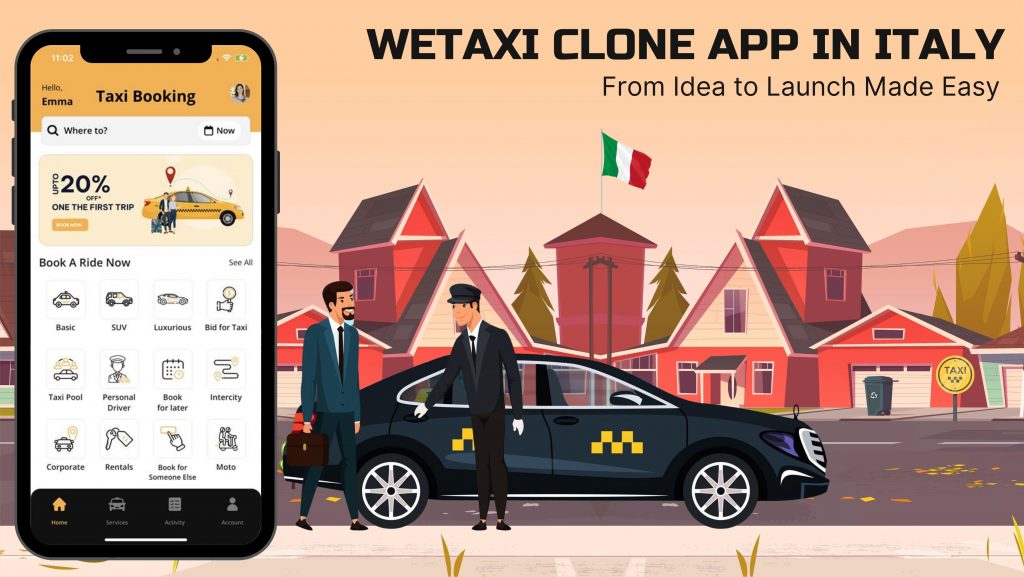
The taxi industry is evolving faster than any other industry in the market. In a place like Italy, where tourism is thriving each year, the year 2025, has brought in fabulous apps like the WeTaxi Clone that puts in Italy Taxi and all mobility in one app.
This blog post dives into some of the best features that you must ensure that you pick and choose when you pick your own WeTaxi clone app from the myriad of options available in the market.
Legal & regulatory checklist for Italy (short, crucial items)
- Taxi license rules vary by municipality, consult a local mobility/regulatory lawyer.
- Data protection: Italy enforces GDPR, your clone must come with data processing agreements, consent flows, and a privacy policy.
- Payment compliance: follow PSD2 and Strong Customer Authentication if you handle EU payments.
- Consumer protection: clear terms for guaranteed fares and refunds.
- Local taxation and invoicing: support Italian invoice formats (e.g., FatturaPA if dealing with public bodies) and VAT handling.
Side note: legal speed bumps are not always technical, sometimes it’s one city’s taxi regulator who simply won’t allow certain booking methods. Get local counsel early.
UX & product experience: what users in Italy expect (and what you should prioritize)
Italian users are familiar with both taxi apps and multimodal mobility players. Expectations include:
- Predictable pricing (hence Guaranteed Fare is powerful).
- Multiple cashless payment options (Satispay is local and valued).
- Clear multi service flows, e.g., if you provide transit tickets, the ticket purchase path must be pure and frictionless.
- Accessibility options, users often need wheelchair friendly taxis or assistance. WeTaxi already highlights features for differently abled passengers; your clone should too.
Design detail: one bad expectation breach, e.g., a mismatched guaranteed fare or a glitchy ticket QR code, will haunt your reputation on the app stores. Prioritize reliability for these small but critical flows.
Tech stack & architecture recommendations (for founders who want to peek under the hood)
If the clone vendor won’t share architecture details, be cautious. You should at least confirm:
- Micro services or modular monolith, dispatch, fare calculation, payments, and ticketing should be modular so you can replace or update parts without breaking the whole app.
- Real time dispatch, web socket or push based mechanisms for driver app updates and accurate ETAs.
- Payment & reconciliation module, bank level reconciliation, multi currency support (if you plan cross border), PCI compliance for card processing.
- Admin & reporting, detailed financial exports, driver statements, tax ready receipts.
- Extendability to add local partners, e.g., Trenitalia API plugin, scooter/bike provider adapters.
If you plan to scale to multiple Italian cities (or beyond), pick a vendor whose clone is already modular with adapter patterns for integrations.
Go to market: local tactics that actually work (not fluff)
Okay, you have a clone app, you’ve tested basic flows. Now what?
- Begin with one pilot city, pick a city where you can secure a cooperative or a small set of drivers. Launch small and iterate quickly.
- Leverage partnerships, local hotels, airports, train stations (if you have Trenitalia like integrations), and even municipal tourist boards can be early distribution partners. WeTaxi’s Trenitalia tie shows the value of such channels.
- Driver first incentives, subsidize first rides or give commission guarantees for early months. Driver on boarding momentum matters more than flash ad campaigns early on.
- Parking + ticketing as acquisition hooks, promote parking payments for commuters; if you can offer monthly parking convenience that saves time, you win habitual users.
- Transparent pricing marketing, “Know your price before you ride” resonates. Push the guaranteed fare message hard.
When in doubt, prioritize retention over acquisition. Getting a user to use your app weekly is more valuable than one off installs.
Cost & pricing model for purchasing a WeTaxi clone (realistic numbers and expectations)
Vendors and agencies price clone solutions differently, but expect:
- One time licensing + source code: can range from a modest five figure USD price (for a basic, white label package) to six figures for a fully customized, heavily integrated solution.
- SaaS/hosting & maintenance: monthly fees for servers, push notifications, maps/route APIs, and support.
- Integration costs: each local partner (Trenitalia, municipal parking, scooter suppliers) often has separate integration fees or engineering time.
- Operational budget: driver on boarding teams, customer support, legal compliance, marketing, these are recurring and often larger than your technical hosting.
Note: if the vendor pitches “no maintenance required”, treat that as a red flag. Mobility platforms require ongoing ops and updates.
Metrics to watch the first 6 months
- Weekly active users (WAU) and retention at day 7 and day 30.
- Average trips per active user per week, shows the app is becoming habitual.
- Driver supply ratio, number of drivers per active request during peak hours.
- Take rate & pay outs, commission kept vs. driver pay outs (operational health).
- Tickets & parking revenue relative to taxi revenue, helps you prioritize features and partner focus.
If your WAU growth is flat but trips per user rise, that’s still a win (engagement > vanity installs).
Common pitfalls I see founders make (short list, avoid these)
- Prioritizing flashy UX over reliability for critical flows (ticket scan ability, guaranteed fare math).
- Under investing in driver incentives and on boarding (drivers gate keep the supply).
- Overlooking local regulations and municipal integrations (parking is trickier than it looks).
- Not building a local customer support operation from day one.
A quick case study style thought experiment (play by play)
Imagine launching in a mid sized Italian city with an airport and a train station. You already have a clone:
- Month 0 to 1: finalize branding, localize copy, on board 150 drivers via cooperative integration (CSV upload), enable parking with the municipality (or a third party PSP), and integrate local scooter provider.
- Month 2: soft launch with tariffs and guaranteed fare enabled for airport and downtown routes. Partner with the local tourist board to promote in hotels.
- Month 3 to 6: iterate on driver incentives, launch Trenitalia ticketing if possible, cross promote with train station kiosks (if partnership negotiated). Start moving parking and ticketing users into habitual commuters.
That’s a plausible, stepwise path to product market fit in a localized context. You’ll need capital for incentives and ops, not just devs.
Why clones beat custom builds for most entrepreneurs (summary)
- Faster time to market.
- Predictable costs and risks.
- Built in patterns for monetization that have been battle tested.
- Easier to iterate on go to market rather than debugging foundational systems.
Still, buy smart. Vet vendors for code quality, modularity, and especially their experience integrating with local partners (that is the hard part).
Final practical checklist (double check before you sign anything)
- Confirm Guaranteed Fare logic and its test cases.
- Ask for demo integrations: Trenitalia (or placeholders), local scooter provider, parking municipality.
- Driver on boarding demo: CSV upload, driver app screenshots, and bulk on boarding flow.
- Payment stack review: PCI/SCA, wallets, and reconciliation statements.
- Source code escrow or handover terms and maintenance SLA.
- Legal checklist: GDPR, local taxi license review, municipal parking arrangments.
If the vendor won’t give you the code or refuses escrow for source, walk away. This is not theater, it’s your leverage.
Closing thoughts, yes, it can get tough but it is for sure also exciting
Mobility is messy. Regulations, incumbents, shifting user habits, and the operational grind make it complicated. But that complexity is precisely where clones show value: they zoom you past the predictable technical traps and let you focus on local partnerships, driver supply, and product market fit. If you’re serious about launching in Italy (or rolling out a similar multimodal mobility product elsewhere), a well built WeTaxi clone app is not cheating, it’s pragmatic.