


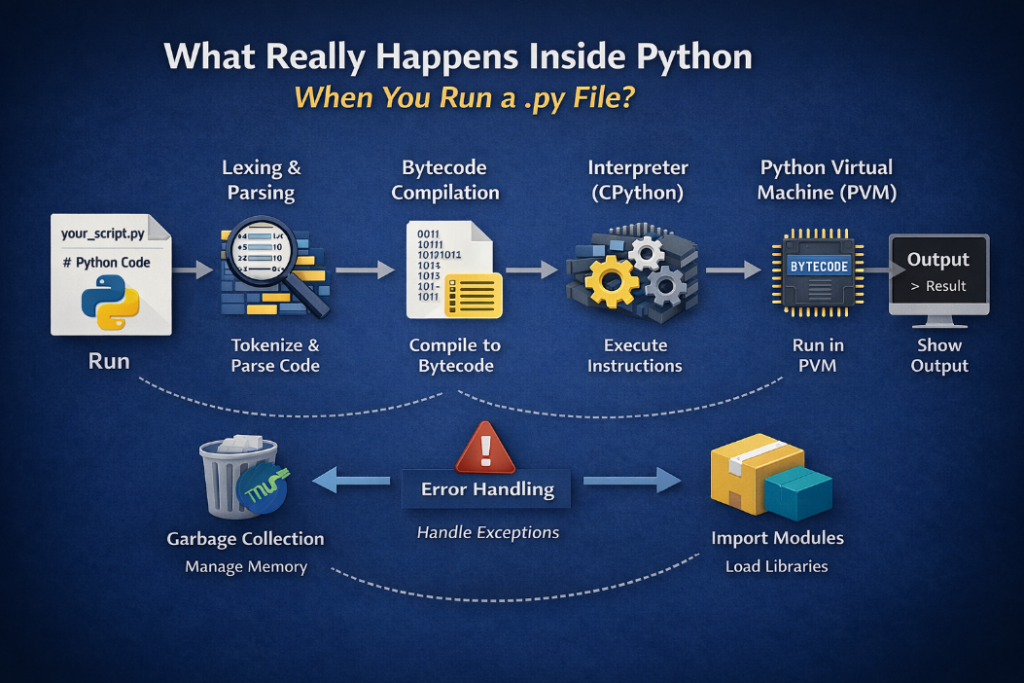
When a python file is executed with a .py extension, Python does not execute the code that is written. It follows a proper internal flow. Each step checks, converts, and prepares the code before it is executed. This is something that you should know if you want better control over performance and errors. Many people start realizing this when they move further in a Python Online Course. Execution is not only about writing code.
Step 1: Reading and Breaking the Code:
The first step is to read the file. This is done in plain text format. Python divides this plain text into smaller parts. These smaller parts are called tokens. Tokens can be keywords, variable names, operators, and symbols. This step is known as tokenization.
If there is any kind of syntax error in the code, Python stops here. It does not go any further. This is exactly why a single error like a missing bracket can cause the whole code to come to a halt. Students of a Python Certification Course can pay special attention to this step because they can understand how Python works internally.
Step 2: Creating a Structured Format (AST):
The next step is to create a structured format. This is done by Python. This is known as an Abstract Syntax Tree (AST). This is like a map of your code. This shows how your code is connected.
Instead of reading the code line by line, Python understands it. This step is like a preparation for the next step. Advanced topics of a Data Science Online Classes course can include this.
Step 3: Converting Code into Bytecode:
When the structure is ready, Python converts it into bytecode. It is a lower-level code than the original. It is not machine code, but it is easier for Python to execute.
This is the compilation step. Even though Python is referred to as an interpreted language, this compilation is always done. This is a very important stage in a Python Certification Course, as it is a reason why Python works differently from compiled languages.
Step 4: Saving Bytecode for Reuse:
In this step, Python may save the bytecode in a .pyc file. This .pyc file is saved in a directory named “__pycache__.”
When a Python program is executed a second time, it uses this saved bytecode. This speeds up the preparation of the code. It improves speed, especially for long codes. Many codes in Data Science Online Classes require this for faster execution.
Step 5: Running Code Using Python Virtual Machine:
The Python Virtual Machine (PVM) is invoked at this step. It reads the code and runs it step by step. This is where the actual program is executed.
The PVM is responsible for executing functions, loop statements, and conditional statements. All that is printed is executed at this step. This is one of the basic ideas that are explained in a Python Certification Course because this is how Python is executed.
Step 6: Memory Handling and Cleanup:
Python takes care of memory management automatically. It keeps a count of how many times a variable has been referenced. Once this count is zero, it is removed from memory.
There is a garbage collector that takes care of memory that is not used. This is how a system is kept efficient. This is an important idea that is explained in Data Science Online Classes.
Step 7: Dynamic Typing During Execution
Variable types in Python do not have to be declared before they are used. Instead, the types are determined at runtime.
This makes the program easy to write, but it also involves a little more work at runtime. Some students understand this concept better after going further into a Python Online Course and working on projects.
Internal Execution Flow Table:
| Step | What Happens |
| Reading Code | Python reads the .py file as plain text |
| Tokenization | Code is broken into small tokens |
| Parsing | AST (structure of code) is created |
| Compilation | Code is converted into bytecode |
| Bytecode Storage | Saved as .pyc file in pycache |
| Execution | Python Virtual Machine runs the code |
| Memory Management | Objects are tracked and cleaned automatically |
| Error Handling | Errors detected at different stages |
Key Pointers to Remember:
- Python never executes raw code directly
- First, the code is split into tokens
- Then, a tree structure (AST) is constructed
- Before the actual execution, bytecode is generated
- The Python Virtual Machine executes the bytecode
- Memory allocation is handled automatically
- Errors may be encountered at different stages
- Understanding the above flow makes debugging easier
Why Does This Understanding Matters?
Understanding the processes that happen inside the Python program makes it easier to write better code. This makes the program less prone to errors and makes it run faster. It also makes it easier to debug the program since the exact location where the error could be encountered is well understood.
While most people may be concerned with the syntax of the program, the actual knowledge of the processes that happen inside the program comes from the understanding of the flow.
When the above processes are well understood, it makes the person writing the program not just a coder but the controller of the program.