


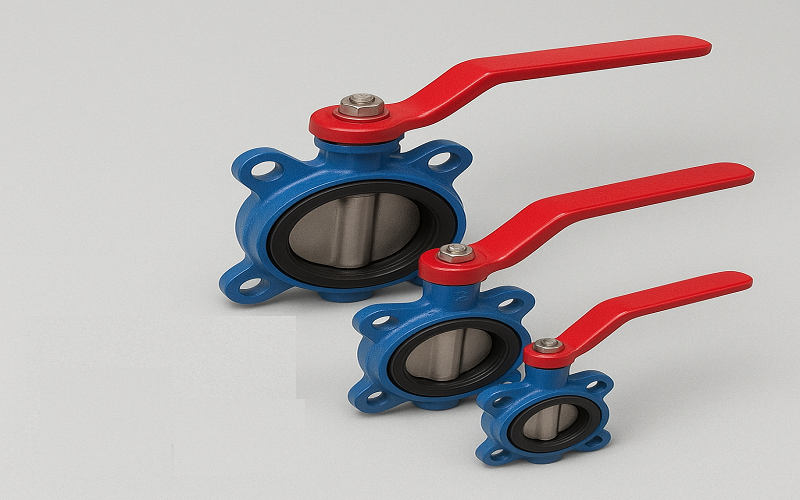
Butterfly valves are becoming increasingly popular within contemporary piping systems, and they have redefined the practice of fluid control in industries. With a smaller footprint and more economical material of construction, front loaded units are less costly to purchase and maintain than top load or other filter designs used in water treatment, cooling towers, chemical processing and power generation. Butterfly valves are small and lightweight compared to bulkier gate or globe valves, and their up-to 90% space savings is huge advantage in both new installations and retrofits. In order to satisfy these expanding industrial needs, top butterfly valve manufacturers are still innovating today.
Compact Design Maximizes Space Savings
Other conventional valves such as gate or ball type generally have large face to face dimensions which make difficult designing a compact piping arrangement. Butterflies address this with wafer thin profiles frequently just 1.5-2 inches thick for even 12-inch sizes that can fit between regular flanges without spacers. This saves material costs of 30-50% and makes it easy to place in tight mechanical rooms or below grade vaults. They’re championed by municipal water districts for distribution networks that do double duty with limited space while accommodating higher volume flows.
Great Flow Performance Leads to Energy Savings
When the butterfly valve is open a thin disc that lines up with the flow is exposed, thus causing a very small pressure drop and allowing for little turbulence to occur (1-2 psi as opposed to 5-10 psi in gate valves). And this efficiency leads to savings of 15-20 % on the pumping energy in large installations as electricity is not cheap any more. Wastewater plants see the payback in 2-3 years from reduced operating costs. Large Cv values provide throttling characteristics not specifically available with most isolation valves, and allow for accurate flow modulation without system bog down.
Easy to Handle and Install Being Lightweight
Butterfly valves are 70% -80% lighter than comparable gate valves, making them easier to crane lift and position manually and provide better access for maintenance. A 24 inch ductile iron butterfly valve weighs only 150 lbs compared to 800 lbs for the gate valve, greatly reducing labour and equipment costs. Lug-style allows dead end service and in-line maintenance to reduce system downtime on critical utilities. This mobility fits with the modular construction mode of ready-to-use packages and containers plants.
Cost-Effectiveness across the Lifecycle
Ahead of the game: Up to 40-60% less than comparable gate valves in first cost, less maintenance, fewer unplanned shutdowns and longer life considering all costs! Actuation is also cost-effective; low operating torque (less than 100 in-lbs on the 6” valves) allows for direct-mounted manual, pneumatic, or electric operators without gear boxes. Life cycles are over 100,000 due to the tough EPDM or nitrile seat that lasts longer than many of the rubber seals in competing valves. Total ownership costs are also reduced via simplified automation connection and a smaller stock of spare parts.
Versatility across Media and Conditions
Butterfly valves are available in wafer, lug, and flanged body designs with siliconized and micro finished surfaces for longer life. Concentric butterfly valves are commonly used for water and air up to 10 bar. Double offset valves handle tougher duties such as slurry, chemical, and steam services up to 300 psi.
Triple offset metal seated butterfly valves offer Class VI leak proof shut off at high temperatures up to 450°F and pressures up to 600 psi. Cryogenic extensions are also available for LNG and low temperature applications.
Speed of Operation Improves Safety and Faster Response
1/4 turn actuation for open/close operation and standard (multi-gas) service, gate valve dependability when you need it most. API 607 fire-safe designs assure bubble tight seals through 1900°F fired and explosions with metal to metal backup. Pneumatic actuators provide an immediate response to ESD signals, effectively ensuring refinery or generation plant personnel safety and the preservation of their respective asset integrity. This high speed is the basis of its fail safe positioning and rapid purging in dirty processes.
Maintenance Simplicity Drives Uptime
Top entry configuration lets seat/disc replacement be made without removing the pipe, reducing repairs by 75%. Self-cleaning seats on the resilient type provides protection from sealing surface contamination due to dirt or slurry. Visual position indicators and modular actuators allow for easy field servicing, with no special tools required. Modern butterfly valves address long standing challenges associated with packing leakage. Improved data tracking further enhances equipment lifespan by maximizing allowable service intervals.
Sustainability Edge in Green Projects
Less weight equals less transport emissions; streamlined flow saves you kilowatts of pumping energy per year. Bodies of recyclable ductile iron and stainless contribute to circular economy objectives. Precise throttling in irrigation districts Water conservation is increased by precise throttling in irrigation district.
Industry Adoption Trends Confirm Dominance
Recent AWWA surveys show that municipalities were 60% more likely to use butterfly valves in 2026 than in 2021. Nearly 80% of HVAC contractors now prefer butterfly valves for chilled and hot water isolation. In chemical plants, triple-offset butterfly valves are replacing gate valves for harsh slurry service due to 30% lifecycle cost savings. Bolt-mounted butterfly valves are also widely used on offshore platforms where space is limited. These changes are supported by strong performance data and updated standards such as MSS SP-67.
Butterfly valves operate quickly and require minimal maintenance. They are also environmentally friendly, making them the most common valve type in modern plumbing systems. Engineers and architects specify them for both new and retrofit projects. They are easy to use and cost-effective to install. This makes them ideal for controlling fluid flow in pipes up to 10 inches. Sleek disc designs now replace bulky valves. Innovations from leading butterfly valve manufacturers continue to reshape the future of fluid control.