
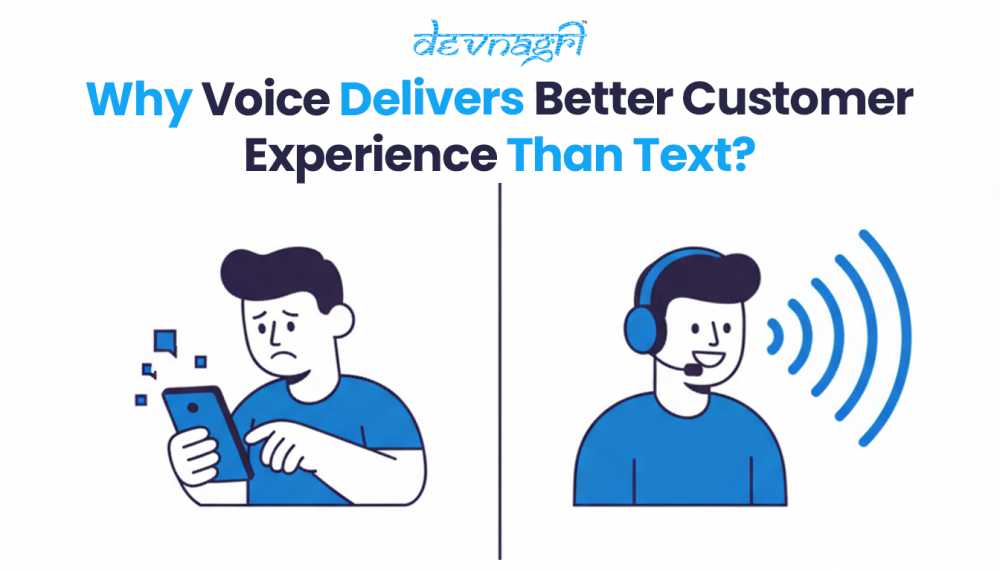
Most customer intelligence still arrives flattened. Surveys reduce people to checkboxes. Chats strip away tone. Emails hide urgency behind polite phrasing. Even the most advanced text analytics tools work on a narrow slice of what customers actually express.
Listen to a real customer conversation, especially over the phone, and you hear something else entirely. A pause before an answer. A raised voice when expectations aren’t met. Relief when a problem is finally resolved. Silence where confidence should exist.
That difference explains why Speech AI is steadily overtaking Text AI as the most powerful source of customer intelligence.
Not because it’s newer.
Because it captures what text never can.
The real gap isn’t format. Its depth.
Text AI analyzes what customers say.
Speech AI reveals how they say it, and often what they mean, but never spell out.
At a technical level, Speech to Text software for Indian Languages converts spoken language into text. Modern speech systems go further. They track pace, tone, interruptions, stress, and emotional shifts across a conversation. Those signals add layers of context that plain text simply doesn’t carry.
This is why many CX researchers estimate that voice interactions contain several times as much actionable insight as written interactions. Emotion, not wording, drives memory, loyalty, and churn.
Text records content.
Voice records intent.
1. Voice surfaces emotion before customers articulate it
Customers rarely say, “I’m frustrated and about to churn.”
They hesitate. They sigh. Their pitch rises. They repeat themselves.
Speech to Text software for Indian Languages can surface these emotional signals in real time. Text-based systems usually detect dissatisfaction only after it hardens into a complaint or cancellation.
By the time frustration appears in text, the decision is often already made.
2. Spoken language is less filtered than written language
People edit when they type.
They soften emails. There rethink chat responses. They remove edge cases.
Speech is different. It’s spontaneous. Customers think out loud. They contradict themselves. They reveal uncertainty.
That rawness is invaluable. Speech-to-text makes conversations searchable, but the real value lies in analyzing patterns within speech: emphasis, hesitation, and avoidance. These signals rarely survive in writing.
3. Voice preserves complexity that text compresses
A chat message might say, “Issue not resolved.”
A phone call reveals confusion around policy, disappointment with prior support, urgency driven by a deadline, and reassurance once a capable agent steps in.
Speech AI preserves that complexity. Text to Speech software for Indian Languages simplifies it.
This is why teams that use voice analytics typically identify problems with products, training, or policies weeks earlier than those who only look at ticket text.
4. Real-world markets are voice-first
In many markets, including India, voice remains the dominant interface. People switch languages mid-sentence. They mix dialects. They explain problems conversationally rather than neatly.
Text systems struggle here. Speech systems trained on real, multilingual audio perform far better.
This is where platforms like Devnagri have taken a different approach. Built for Multilingual Digital Bharat, Devnagri Speech AI focuses on how India actually speaks, across languages, accents, and code-mixed conversations. No one understands the multilingual Bharat better than systems designed inside it, rather than adapted from elsewhere.
For millions of users, voice, not keyboards, is the most natural interface.
5. Speech AI turns insight into action faster
One of Speech AI’s most overlooked advantages is timing.
Insights can surface during the conversation itself. Agents can be prompted. Escalations can happen sooner. Offers can adjust in real time.
Text analytics usually works after the interaction ends.
That difference turns Speech AI from a reporting layer into an operational one.
Where Text AI still matters, and where it falls short
Text AI remains essential for scale. Emails, chats, reviews, and documents bring structure and efficiency. Text to Speech software for Indian Languages plays a key role in accessibility and outbound communication.
But when the goal is to understand customers deeply, emotionally, contextually, behaviorally, text is a compressed signal.
Speech is the full waveform.
A practical takeaway for leaders
This isn’t about choosing Speech AI over Text AI. It’s about recognizing they are not equals.
If customer intelligence truly matters, voice cannot sit on the sidelines. It needs to be central to how organizations detect risk, understand intent, and improve experience.
The shift isn’t about technology hype.
It’s about listening better.
Final thought
Text tells you what customers said. Speech to Text software for Indian Languages tells you what they meant. And in a world where experience is the real differentiator, meaning is where the intelligence lives.