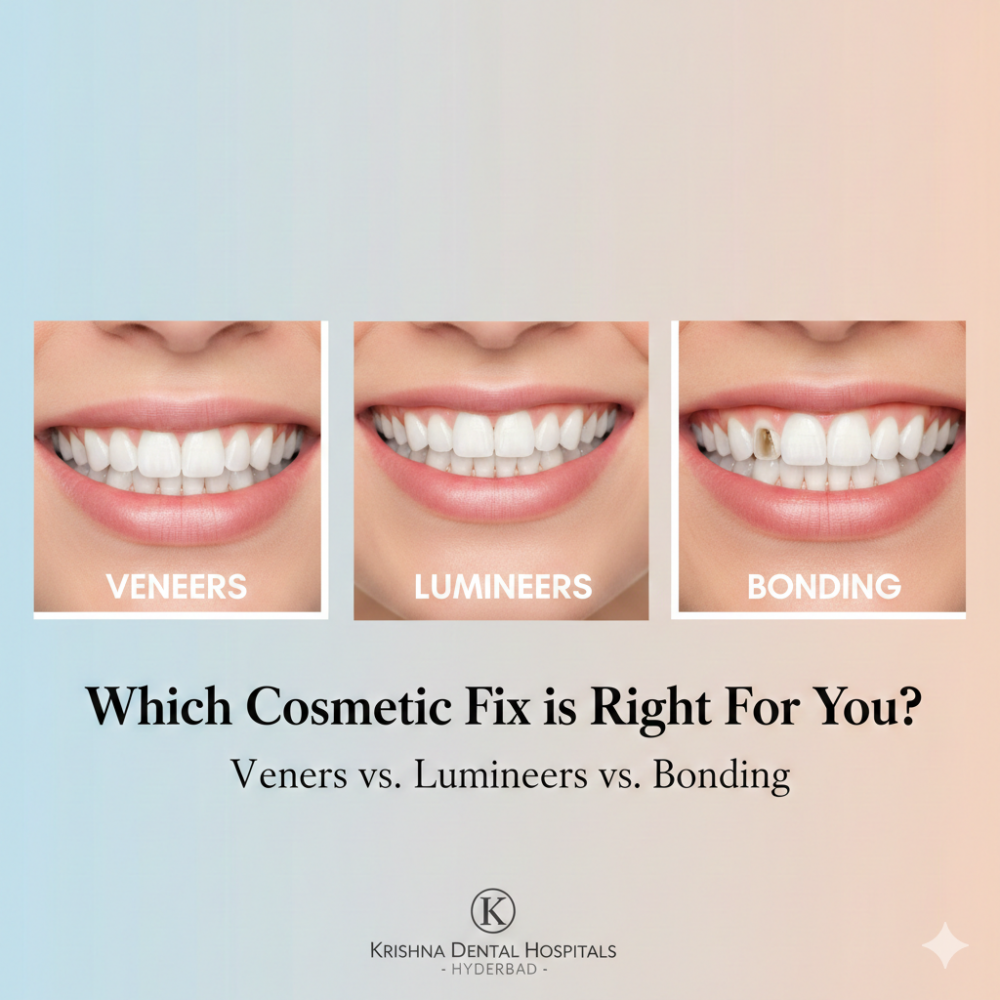
Choosing to upgrade your smile is a significant decision. Whether you are looking to fix a chipped tooth, close a gap, or achieve that “Hollywood white” glow, the path you take depends on your aesthetic goals, budget, and how much of your natural tooth structure you want to keep.
In the modern dental landscape, there is a massive shift toward minimally invasive dentistry. Patients no longer want to sacrifice healthy enamel for the sake of beauty. This guide breaks down the three heavyweights of cosmetic dentistry—Porcelain Veneers, Lumineers, and Dental Bonding—to help you decide which is right for your smile.
1. Traditional Porcelain Veneers: The Gold Standard
Traditional veneers are thin, custom-made shells of high-quality ceramic designed to cover the front surface of the teeth. They are widely considered the gold standard because of their ability to mimic the light-reflecting properties of natural teeth and their incredible resistance to stains.
The Process and “Invasiveness”
Traditional veneers are not considered “minimal prep.” To ensure the veneer doesn’t look bulky or “chiclet-like,” a dentist must remove a small amount of enamel—usually about $0.5\text{ mm}$ to $0.7\text{ mm}$—from the front and sides of the tooth.
- Permanent Change: Once the enamel is removed, the process is irreversible. You will always need a restoration on that tooth.
- Customization: Because they are fabricated in a lab, the shape, translucency, and shade are matched perfectly to your facial features.
Durability and Cost
- Lifespan: 10 to 15 years (sometimes up to 20 with excellent care).
- Cost: Generally the most expensive option due to the lab craftsmanship and materials involved.
2. Lumineers: The “No-Prep” Revolution
Lumineers are a specific brand of “ultra-thin” veneers (about the thickness of a contact lens). The primary selling point of Lumineers is that they often require no grinding or shaving of the natural tooth structure.
+1
The Minimal Prep Trend
Lumineers sit at the heart of the minimal prep trend. Because they are so thin (roughly $0.2\text{ mm}$), they can sometimes be bonded directly over existing teeth without local anesthesia or drilling.
+1
- Reversibility: In many cases, because the natural enamel remains intact, the procedure is technically reversible (though removing the bonding agent is complex).
- The Trade-off: Because they are added on top of the tooth, they can occasionally feel slightly bulkier at the gumline if not placed by an expert. They are also highly translucent, meaning they may not hide severely dark stains as well as traditional veneers.
Durability and Cost
- Lifespan: 10 to 20 years.
- Cost: Comparable to traditional veneers, sometimes slightly higher due to the proprietary laboratory costs.
3. Dental Bonding: The Quick and Versatile Fix
Dental bonding involves applying a tooth-colored composite resin (a durable plastic material) to the tooth and hardening it with a special light. This “bonds” the material to the tooth to restore or improve a person’s smile.
Why It’s Popular
Bonding is the ultimate “conservative” treatment. It is usually completed in a single visit and requires little to no enamel removal.
- Invasiveness: Lowest. It is ideal for minor corrections like closing small gaps (diastemas) or repairing a single chipped tooth.
- Artistry: The result depends entirely on the dentist’s ability to sculpt the resin by hand.
Durability and Cost
- Lifespan: 3 to 7 years. The resin is porous, meaning it will stain over time (unlike porcelain) and is more prone to chipping.
- Cost: The most affordable cosmetic option.
Which One is Right for You?
Choosing between these three depends on your specific dental “starting point.”
Case A: You have deep tetracycline staining or very crooked teeth.
Winner: Traditional Veneers. Because traditional veneers are thicker and more opaque, they can mask dark internal stains that Lumineers cannot. The preparation process also allows the dentist to “realign” the appearance of slightly crooked teeth more effectively.
Case B: You have healthy, straight teeth but want a “Permanent Whiteness.”
Winner: Lumineers. If your teeth are already well-aligned and you just want a more uniform, brighter smile without “drilling down” your healthy teeth, Lumineers are the ideal “minimal prep” solution.
Case C: You have a single chipped tooth from an accident.
Winner: Dental Bonding. There is no need to veneer an entire arch for one small chip. Bonding is cost-effective, fast, and preserves the rest of your natural tooth.
The Importance of Professional Consultation
While guides are helpful, the health of your bite (occlusion) and the quality of your enamel play a huge role. For instance, if you grind your teeth (bruxism), you might chip dental bonding within weeks, making porcelain a better long-term investment.
For those seeking expert guidance and high-tech application, visiting a specialized center like Krishna Dental Hospitals in Hyderabad can provide the clarity needed to choose the right procedure for your facial structure and oral health.
Maintenance and Aftercare
Regardless of which “fix” you choose, none of these options are “set it and forget it.” To protect your investment:
- Avoid “Teeth as Tools”: Never use your teeth to open packages or bite fingernails. Composite bonding and even porcelain can fracture under that type of pressure.
- Night Guards: If you have a history of grinding, a custom night guard is non-negotiable to prevent your veneers or bonding from popping off.
- Regular Cleanings: While the restorations themselves don’t decay, the natural tooth structure underneath and around them can.
Final Thoughts: The Trend Toward “Less is More”
The dental industry is moving away from the “aggressive” filing of the 1990s. Today, the goal is to achieve the highest aesthetic result with the least amount of biological cost.
- Bonding is your entry-level, non-invasive “touch up.”
- Lumineers are your premium, “no-prep” transformation.
- Veneers are your comprehensive, permanent smile makeover.
The best smile is one that looks natural, feels comfortable, and lasts for decades. By weighing the invasiveness against the durability, you can find the perfect balance for your lifestyle and your confidence.