Introduction
When it comes to humanoid robotics, most people attribute high performance to software, sophisticated AI models, and motion algorithms. While this is certainly a part of the equation, there remains the question of hardware. Regardless of meticulous design considerations, a large number of robot designs have failed because of an inherent design flaw that cannot be addressed through standard fabrication processes.
That’s where metal 3D printing (additive manufacturing) steps in as a revolutionary technology.
Requirements for Humanoid Joints
Humanoid joints are subject to severe conditions and constant use, which makes them one of the most important elements of robotic technology.
1. Cyclic Fatigue Resistance
The joints of robots perform millions of movement cycles per year. The constant strain causes microfractures and, finally, breakdowns. It is necessary that materials be able to withstand cyclic loads for a long time.
2. Ratio between Mass and Strength
Weight affects efficiency. Joints with more mass overload actuators, require more power, and create additional complexity. Light and durable parts are required.
3. Environmental Resilience
Humanoids can work in industrial and outdoor environments. Parts should withstand corrosion, moisture, chemical resistance, and wear.
4. Multifunctionality
Joints in modern robotics are not simple mechanical elements. They should contain:
- Mechanical supports
- Sensing equipment
- Wiring
- Lubrication pathways
- Compact design
It is extremely challenging to reach such multifunctionality with conventional manufacturing techniques.
Why Titanium + Metal 3D Printing = The Best Choice Possible
Titanium has been employed in the aerospace and medical industries for years thanks to its excellent qualities. However, when coupled with metal 3D printing technology, all these characteristics come into play.
- High Strength, Lightweight
Metallic elements like titanium have high tensile strength compared to steel and are very light. As such, they are best suited to be used in robotic parts.
- Durability Against Fatigue
As metallic elements, titanium performs excellently well even under fatigue stresses making it the best option for moving robot parts.
- Corrosion Protection
There is a protective coating that naturally occurs on titanium making it resistant to corrosion even under industrial and medical conditions.
The Importance of Metal 3D Printing Technology
Although titanium is a very strong metal, metal 3D printing is the key factor that enables its use for humanoid robots.
1. Design Flexibility
Designers have unlimited freedom with metal 3D printing as opposed to machining and tooling.
This includes:
- Cooling and lubricating paths
- Optimized topology structures
- Load-optimized designs
- Integrated sensor pathways
- Lattice structures that save weight
The possibility to design based on performance and not manufacturability.
2. Parts Consolidation
Standard assemblies consist of multiple pieces including brackets, fasteners, and housings, thus creating a lot of weak spots and complicating the assembly process.
Additive manufacturing, on the other hand:
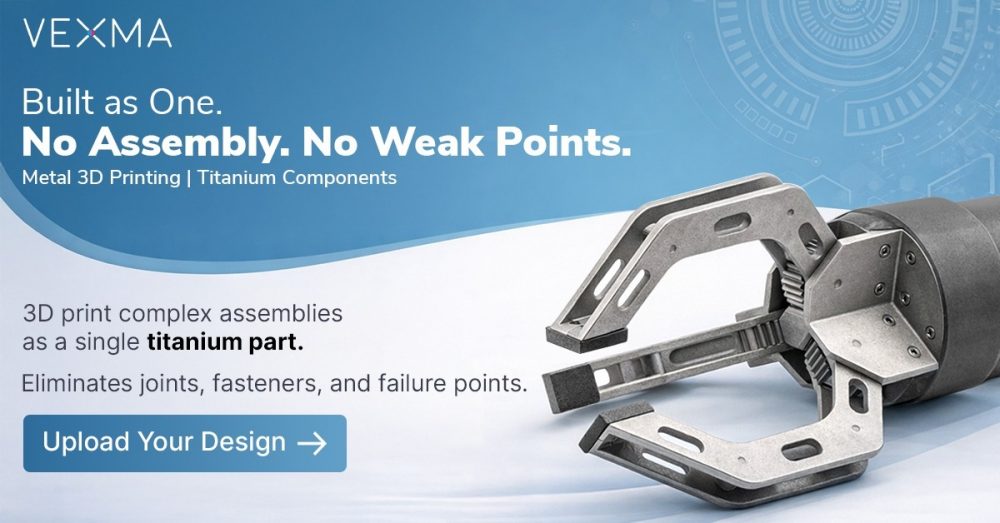
- Allows for combining several separate pieces into one
- Eliminates the need for fasteners and joints
- Increases reliability of assemblies
- Saves on weight
- It is particularly useful in the case of humanoid robotic joints.
3. Faster Product Innovation
Innovation in humanoid robotics happens quickly, requiring constant redesigns.
Traditional manufacturing processes:
- Require tooling
- Take time to produce
- Delay innovations
- Metal 3D printing allows for:
- CAD-to-part production
- Toolless fabrication
- Rapidly producing functional parts.
4. Higher Precision
The advantages of using metal 3D printing include:
- Precise control over tolerances
- Complex internal structures
- Very high repeatability
All of which is important for:
- Housings for actuators
- Interfaces of joints
- Integrating sensors into parts
- Use in Humanoid Applications
Titanium additive manufacturing has already found applications in various humanoid applications:
- Ankle/Knee Joints: Light and fatigue-resistant structures
- Wrist/Fingers Assemblies: Small and complicated geometries
- Hip/Shoulder Assemblies: Heavy load bearing and consolidation
- Exoskeleton interfaces: Robust, accurate, and safe design
In the case of small-volume and highly optimized applications, 3D printing becomes not only possible but also the best choice.
Change in Engineering Thinking
Changing to 3D printing implies changing an entire mentality of the engineer.
Conventional thinking:
“What can we manufacture?”
Additive thinking:
“What does our system require, and how do we optimize its construction?”
Such approach enables:
- Optimized for performance
- Efficient use of materials
- Function integration
- Ability to incorporate complexity at no extra cost
Conclusion
The development of humanoid robots will rely on the use of materials and methods that are capable of coping with tough environmental challenges.
For these purposes titanium will provide the needed toughness, endurance, and resistance; and for rapid prototyping with design flexibility metal 3D-printing becomes a solution.
With the development of additive manufacturing, not only are parts getting better, but designers’ views on the process of creation itself are changing as well.