There is a particular kind of clinical helplessness that intensivists and infectious disease physicians know too well. A ventilated patient with a gram-negative bloodstream infection. Cultures back. The organism is resistant to carbapenems, colistin, and everything in between. The susceptibility report has a column of R after R after R. And then, somewhere near the bottom, there is a single S.
That S — susceptible — against Cefiderocol is increasingly the reason some of these patients survive.
Antimicrobial resistance is one of the defining public health crises of our time, and India is at the centre of it. The country carries one of the highest burdens of carbapenem-resistant organisms globally — NDM-1-producing Klebsiella pneumoniae, carbapenem-resistant Acinetobacter baumannii, and multidrug-resistant Pseudomonas aeruginosa are not theoretical concerns in Indian ICUs. They are everyday realities. And the treatment options for these organisms have historically been limited to combinations of last-resort agents — Colistin, Tigecycline, Fosfomycin — that are effective in some patients, toxic in others, and unavailable in their ideal combinations in many Indian hospitals.
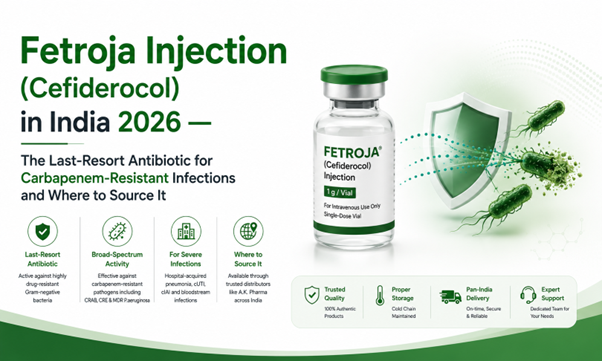
Cefiderocol — available in India as Fetroja injection from A.K. Pharma, a licensed medicine distributor and pharmaceutical distributor in Delhi — represents something genuinely new in this space. It is not just another beta-lactam. Its mechanism is fundamentally different from every other antibiotic currently available, and its activity against the most resistant gram-negative organisms in the world is unlike anything the class has produced before.
This article explains what Cefiderocol is, how it works, what the evidence says, who needs it, and how Indian hospitals can access it reliably.
The AMR Crisis in India — Why a New Mechanism Matters
India’s antimicrobial resistance problem has several defining characteristics that make it qualitatively different from the AMR situation in Europe or North America.
First, the sheer prevalence of resistance. Studies published from Indian tertiary care centres consistently show carbapenem resistance rates in Klebsiella pneumoniae of 30-50% in healthcare-associated infections — rates that would be considered a national emergency in most high-income countries but have become a baseline clinical reality in Indian ICUs.
Second, the NDM-1 factor. New Delhi Metallo-beta-lactamase 1 — first described in India and named after the city — is a carbapenemase that confers resistance to virtually all beta-lactam antibiotics including carbapenems. NDM-1-producing organisms are now endemic in Indian healthcare settings and have spread globally. They are also resistant to most of the combination strategies that work against KPC-producing organisms in Western centres.
Third, the limited formulary. Ceftazidime-Avibactam (Zavicefta) — available from A.K. Pharma — is highly effective against KPC and OXA-48 carbapenemase-producing organisms but has limited activity against NDM-1 producers because Avibactam does not inhibit metallo-beta-lactamases. For NDM-1-producing organisms, the treatment options narrow dramatically.
Cefiderocol retains activity against NDM-1-producing organisms because its mechanism bypasses the resistance mechanisms that defeat conventional beta-lactams. That is what makes it clinically significant in the Indian context in a way that is genuinely distinct from its importance in Western settings.
What Is Cefiderocol and How Does It Work?
Cefiderocol is a siderophore cephalosporin — the world’s first antibiotic of this class to reach clinical approval. Understanding what that means requires a brief explanation of how gram-negative bacteria acquire iron.
Gram-negative bacteria require iron to survive and replicate. In the human body — where free iron is tightly sequestered by host proteins like transferrin and lactoferrin — bacteria have evolved sophisticated iron-acquisition systems using molecules called siderophores. Siderophores are secreted into the environment, where they chelate (bind) iron with extremely high affinity. The iron-siderophore complex is then actively transported back into the bacterial cell through dedicated outer membrane transporter proteins.
Cefiderocol exploits this system in a way that is almost elegantly deceptive. The cephalosporin molecule is conjugated to a catechol siderophore moiety — essentially disguising it as an iron carrier. When the bacterium secretes its outer membrane iron transporters to bring iron-siderophore complexes inside, it simultaneously imports Cefiderocol. The antibiotic is actively transported into the bacterial cell — not passively diffusing through porins that resistant organisms have downregulated or lost.
Once inside the periplasm, Cefiderocol binds penicillin-binding proteins (primarily PBP3) and inhibits cell wall synthesis — the same fundamental mechanism as other beta-lactams. But the critical difference is getting inside. Conventional carbapenems depend on outer membrane porins (OprD, OmpK36/OmpK35) for entry — porins that carbapenem-resistant organisms routinely downregulate or delete. Cefiderocol bypasses this entirely by hitching a ride on the iron transport system that the bacterium cannot afford to downregulate, because it needs iron to survive.
Additionally, Cefiderocol is stable against hydrolysis by all known beta-lactamases — including serine carbapenemases (KPC, OXA-48) and metallo-beta-lactamases (NDM-1, VIM, IMP). This comprehensive beta-lactamase stability, combined with the active transport mechanism, explains why Cefiderocol retains activity against the most resistant gram-negative organisms currently encountered in clinical practice.
Full prescribing information is available at the FDA Fetroja label.
The Evidence — CREDIBLE and APEKS Trials
CREDIBLE-CR Trial
The CREDIBLE-CR trial, published in The Lancet Infectious Diseases, compared Cefiderocol against best available therapy (BAT — a regimen chosen by the treating physician using available agents including Colistin, Tigecycline, and combination carbapenem therapy) in patients with carbapenem-resistant gram-negative infections including pneumonia, bloodstream infection, and urinary tract infection.
The primary endpoint — clinical cure at test-of-cure — was similar between Cefiderocol and BAT. However, the all-cause mortality at 28 days was numerically higher in the Cefiderocol arm (24.8% vs 18.4%) — a finding that generated substantial discussion and initially created uncertainty about the drug’s role.
Subsequent analyses clarified the picture. The excess mortality in the Cefiderocol arm was predominantly in patients with Acinetobacter baumannii infections — a notoriously difficult organism where BAT in this trial included high-dose Colistin combinations that are not always available or feasible in routine clinical practice. In patients with Klebsiella pneumoniae, Escherichia coli, and Pseudomonas aeruginosa infections, outcomes were similar or favourable with Cefiderocol. The mortality differential with Acinetobacter has been an area of ongoing research and has not prevented regulatory approval — the FDA approved Fetroja based on the totality of evidence.
APEKS-NP and APEKS-cUTI Trials
The APEKS trials compared Cefiderocol against Imipenem-Cilastatin in non-carbapenem-resistant infections — demonstrating clinical non-inferiority in nosocomial pneumonia (APEKS-NP) and complicated urinary tract infections (APEKS-cUTI). These trials established Cefiderocol’s efficacy in a broader population of serious gram-negative infections — not only in the carbapenem-resistant setting.
Real-World Evidence
Real-world case series and observational studies published in 2024-2026 from European, North American, and increasingly Asian centres demonstrate meaningful clinical success rates with Cefiderocol in patients with infections caused by organisms for which no other active agent was available — including several cases of pan-resistant organisms with susceptibility only to Cefiderocol on testing.
Who Needs Fetroja (Cefiderocol) in Indian Clinical Practice?
Fetroja is not a first-line antibiotic. It is reserved for the most resistant gram-negative infections — the situations where conventional agents have failed or are not active based on susceptibility testing. The organisms and clinical scenarios where Cefiderocol should be considered include:
Carbapenem-Resistant Enterobacterales (CRE) — especially NDM-1 producers In patients with CRE infections where Ceftazidime-Avibactam (Zavicefta) is not active (NDM-1, VIM, IMP carbapenemases), Cefiderocol is one of the few agents with consistent in vitro activity. Combination therapy with Aztreonam-Avibactam (where available) or other active agents should be considered based on susceptibility data.
Carbapenem-Resistant Acinetobacter baumannii (CRAB) Extensively drug-resistant Acinetobacter baumannii is one of the most challenging organisms in Indian ICUs. Cefiderocol has in vitro activity against most CRAB isolates. Given the CREDIBLE-CR mortality data in Acinetobacter, combination with Sulbactam-Durlobactam (where available) or other active agents is preferred where options exist.
Carbapenem-Resistant Pseudomonas aeruginosa (CRPA) Multidrug-resistant Pseudomonas with loss of OprD porin and upregulated efflux pumps — Cefiderocol’s siderophore transport mechanism bypasses OprD dependence, maintaining activity in isolates resistant to all other beta-lactams.
Stenotrophomonas maltophilia Cefiderocol has documented activity against Stenotrophomonas maltophilia — an organism intrinsically resistant to carbapenems and a recognised pathogen in immunocompromised patients.
Pan-resistant or nearly pan-resistant gram-negative infections For patients with organisms susceptible only to Cefiderocol on comprehensive susceptibility panels — it may be the only active agent available.
The Treatment Ladder in Indian ICUs — From Zavicefta to Fetroja
For Indian intensivists managing carbapenem-resistant infections, the treatment decision depends critically on the specific carbapenemase mechanism — which requires molecular testing or PCR-based identification:
KPC-producing organisms (rare in India but present): Zavicefta (Ceftazidime-Avibactam) is highly active — preferred first choice. Cefiderocol is an alternative.
OXA-48-producing organisms: Zavicefta has activity — use based on susceptibility. Cefiderocol is an alternative.
NDM-1-producing organisms (dominant in India): Zavicefta has limited activity against metallo-beta-lactamases. Cefiderocol is one of the few active beta-lactam options. Colistin combinations remain an option but are nephrotoxic. Tigecycline-based combinations have limited data for bacteraemia.
OXA-23/24/51-producing Acinetobacter: Colistin-based combinations — traditional approach. Cefiderocol has activity but consider combination. High-dose Ampicillin-Sulbactam combinations where Sulbactam remains active.
MDR Pseudomonas: Cefiderocol, Ceftolozane-Tazobactam (where available), Imipenem-Cilastatin-Relebactam — based on susceptibility profile.
A.K. Pharma supplies both Fetroja (Cefiderocol) and Zavicefta (Ceftazidime-Avibactam) — enabling Indian hospitals to access the two most important newer beta-lactam agents for carbapenem-resistant infections from a single trusted pharmaceutical distributor in Delhi.
Dosage and Administration
Standard dose for most indications: 2g intravenously every 8 hours as a 3-hour extended infusion
Complicated urinary tract infection: 1g IV every 8 hours as a 1-hour infusion
Renal adjustment: Cefiderocol is renally eliminated — dose reduction required for creatinine clearance <60 mL/min. Dose increase recommended for augmented renal clearance (CrCl >120 mL/min) — a common phenomenon in critically ill patients with hyperdynamic circulation who will underdose standard regimens. Pharmacokinetic/pharmacodynamic (PK/PD) monitoring is ideal where available.
Duration: Typically 7-14 days depending on infection type, source control, and clinical response. Bacteraemia — minimum 14 days from first negative blood culture.
Reconstitution: Fetroja is supplied as a powder for reconstitution. Reconstitute with 10mL of normal saline, then further dilute in 100mL of normal saline or 5% dextrose. Administer via central or peripheral IV access. Stable for 6 hours at room temperature after reconstitution and dilution.
Why Sourcing Fetroja From a Reliable Pharmaceutical Distributor Matters
Fetroja (Cefiderocol) is an imported specialty antibiotic — not a medicine that sits in general wholesale pharmaceutical warehouses. Supply chain reliability matters enormously for a medicine used in critically ill patients where treatment cannot be delayed.
A.K. Pharma is a licensed medicine distributor and pharmaceutical distributor in Delhi with 25 years of experience in specialty and imported medicine distribution. As a distributor of Fetroja, A.K. Pharma provides:
Reliable supply: Buffer stock management and proactive inventory planning ensure Fetroja is available when clinical need arises — not ordered on demand after a critical patient has been identified.
Authorised sourcing: Fetroja supplied by A.K. Pharma comes from manufacturer-authorised distribution channels — with complete documentation and verifiable supply chain provenance.
Rapid response: For ICU situations where treatment urgency is real, A.K. Pharma’s team responds promptly to availability and supply enquiries. Call 011 4172 6999 or WhatsApp +91 9810034827 for same-day responses.
Complete AMR portfolio: A.K. Pharma supplies both Fetroja (Cefiderocol) and Zavicefta (Ceftazidime-Avibactam) alongside Ambisome (Amphotericin B) for invasive fungal infections — covering the key last-resort anti-infective needs from a single distributor.
Important Precautions
- Susceptibility testing is mandatory before use — Cefiderocol should only be prescribed where susceptibility is confirmed by a validated testing method. Disk diffusion and broth microdilution using CLSI or EUCAST breakpoints — note that standard cephalosporin disks cannot be used; dedicated Cefiderocol disks with iron-depleted media are required for accurate testing
- Not for carbapenem-susceptible infections — Reserve for documented resistant organisms; unnecessary use accelerates resistance to this important last-resort agent
- Monitor renal function throughout treatment — dose adjust for CrCl changes
- Augmented renal clearance — Consider dose escalation to 2g every 6 hours for critically ill patients with high CrCl (>120 mL/min) per PK/PD modelling data
- Seizures — Beta-lactam class effect — monitor for neurological adverse events, particularly in patients with renal impairment or CNS pathology
- Refer to IDSA Guidance on AMR for complete management framework
Frequently Asked Questions
Q. What is Fetroja used for in India? Fetroja (Cefiderocol injection) is used for serious gram-negative bacterial infections caused by carbapenem-resistant organisms including carbapenem-resistant Enterobacterales (CRE), carbapenem-resistant Acinetobacter baumannii (CRAB), and carbapenem-resistant Pseudomonas aeruginosa (CRPA) — in patients with limited or no other treatment options. More information at MedlinePlus.
Q. What is the generic name of Fetroja? Cefiderocol. It is a siderophore cephalosporin antibiotic — the world’s first antibiotic of this class approved for clinical use. Manufactured by Shionogi and distributed in India through licensed pharmaceutical distributors.
Q. How is Cefiderocol different from other antibiotics? Cefiderocol uses a unique iron transport mechanism — disguising itself as a siderophore to be actively transported inside gram-negative bacteria through their iron uptake systems. This bypasses the outer membrane porin loss that confers resistance to conventional carbapenems, and the drug is stable against hydrolysis by all known beta-lactamases including metallo-beta-lactamases (NDM-1, VIM, IMP) that defeat Ceftazidime-Avibactam (Zavicefta).
Q. What is the difference between Fetroja (Cefiderocol) and Zavicefta (Ceftazidime-Avibactam)? Zavicefta (Ceftazidime-Avibactam) is highly effective against KPC and OXA-48 carbapenemase-producing organisms but has limited activity against NDM-1, VIM, and IMP metallo-beta-lactamase-producing organisms — which dominate in India. Fetroja (Cefiderocol) retains activity against metallo-beta-lactamase producers including NDM-1 — making it the more appropriate choice when NDM-1 is confirmed or suspected. Both are available from A.K. Pharma.
Q. Is Fetroja available in India? Yes — Fetroja (Cefiderocol injection) is available in India through licensed pharmaceutical distributors. Contact A.K. Pharma — medicine distributor and pharmaceutical distributor in Delhi — at 011 4172 6999 or WhatsApp +91 9810034827 for availability and pricing.
Q. How should Fetroja be stored? Store at room temperature below 30°C in original packaging protected from moisture. Once reconstituted and diluted, use within 6 hours at room temperature. No cold chain required for storage — though proper storage conditions must be maintained throughout the supply chain.
Q. Does A.K. Pharma supply Fetroja in bulk to hospitals? Yes — A.K. Pharma supplies Fetroja in bulk to ICUs, hospitals, and pharmacies across Delhi and India. Contact us for bulk pricing and availability.
Contact A.K. Pharma for Fetroja Supply
A.K. Pharma is a licensed medicine distributor and pharmaceutical distributor in Delhi supplying specialty anti-infective, oncology, immunology, and rare disease medicines to hospitals and pharmacies across India.
📍 E-2/257A, 2nd Floor, Shastri Nagar, New Delhi 110052 📞 011 4172 6999 📱 WhatsApp: +91 9810034827 🌐 akpharma.in
Browse our complete anti-infective portfolio including Fetroja (Cefiderocol) and Zavicefta (Ceftazidime-Avibactam).