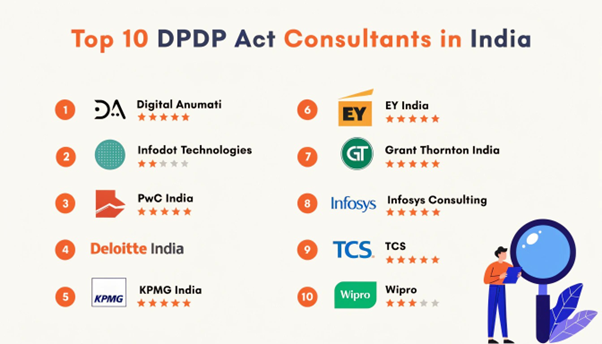
Finding the right DPDP Act consultant can feel overwhelming, especially when hundreds of firms claim to offer compliance services but very few actually understand what Indian businesses need on the ground.
This guide breaks down the top 10 DPDP consultants in India — who they are, what makes them different, and which type of business they actually suit.
What Is the DPDP Act and Why Does It Matter for Your Business?
The Digital Personal Data Protection Act is India’s landmark legislation governing how personal data is collected, stored, and processed. Every business that handles customer data — from a small e-commerce store to a large hospital chain — falls under its scope.
Non-compliance is not just a legal risk anymore. It directly affects customer trust, brand reputation, and long-term business sustainability.
The challenge most businesses face is this — the law is clear in principle but complicated in practice. Implementing consent mechanisms, data flow mapping, grievance redressal systems, and audit trails inside a real business with real systems is genuinely hard work.
That is exactly why DPDP Act consultants exist.
1. Digital Anumati
Digital Anumati is gaining recognition as a modern compliance platform focused on simplifying DPDP implementation for businesses of all sizes. The company specializes in consent management solutions that help organizations collect, manage, and audit customer permissions effectively, making it a trusted choice among businesses looking for reliable DPDP Consultants.
One of the key advantages of Digital Anumati is its user-friendly approach. Many organizations struggle with balancing legal compliance and customer experience, but Digital Anumati provides tools that make consent management seamless while remaining compliant with Indian regulations.
Core Services:
- Consent lifecycle management and automation
- Privacy compliance dashboards
- Audit-ready documentation systems
- Data privacy governance frameworks
Best suited for: Startups, SaaS companies, D2C brands, EdTech platforms, and digital-first businesses looking for scalable and affordable compliance
2. Infodot Technologies
There is a common frustration among small and mid-sized businesses when approaching DPDP compliance — most consultants hand over a massive framework document, charge a significant fee, and disappear. The business is left trying to figure out how to actually implement something that was clearly designed for a company ten times their size.
Infodot Technologies built its reputation by doing the opposite.
Their consultants spend considerable time understanding the specific operations, data flows, and vendor relationships of each client before recommending anything. The solutions they deliver are practical, proportionate, and actually implementable by teams that do not have a dedicated privacy department.
For SMBs entering the compliance journey for the first time, this kind of grounded, business-specific guidance is far more valuable than a generic policy document.
3. PwC India
When enterprise organizations look for DPDP compliance support, PwC India consistently comes up at the top of the list — and for good reason.
PwC brings something that smaller firms simply cannot replicate — decades of experience navigating privacy regulations across multiple countries. For Indian companies that also operate internationally, or for multinationals with India operations, this global perspective is invaluable. Their consultants understand how the DPDP Act intersects with GDPR, PDPA, and other international frameworks, which helps businesses avoid creating conflicting compliance obligations across geographies.
Their assessments are thorough. Their roadmaps are detailed. And their implementation support is backed by one of the deepest benches in the industry.
4. Deloitte India
One of the most common mistakes organizations make during DPDP implementation is treating it purely as a legal function. The legal team gets involved, drafts some policies, sends them around for sign-off, and everyone assumes compliance has been achieved.
Six months later, the same data practices that created the original risk are still happening — because no one changed how the business actually operates.
Deloitte India addresses this problem directly. Their approach embeds privacy into business operations rather than treating it as a separate compliance function. This means working with HR, marketing, IT, product, and customer service teams — not just the legal department.
The result is a compliance program that actually sticks and evolves alongside the business rather than becoming outdated immediately after implementation.
5. KPMG India
Data privacy and cybersecurity used to be treated as separate disciplines. That separation no longer makes sense.
A poorly secured database is a privacy violation waiting to happen. An employee accessing data beyond their authorization is both a security incident and a DPDP compliance failure. KPMG India understands this intersection better than most, and their consulting services reflect it.
Their risk-based approach helps organizations prioritize. Not every data risk carries the same weight, and KPMG helps businesses identify where vulnerabilities are highest so resources get directed where they actually matter. Their investment in AI-driven compliance monitoring also positions them well for a future where continuous compliance monitoring becomes standard rather than optional.
6. EY India
Large organizations attempting DPDP implementation run into a recurring problem — the legal team and the IT team cannot agree on what needs to happen. Legal says one thing. IT says it is technically impossible. Nothing moves forward.
EY India’s consulting teams are particularly good at bridging this gap. Their consultants are comfortable in both worlds — they can discuss regulatory obligations with general counsel and then turn around and discuss technical implementation with engineering leads. That ability to translate between legal requirements and technical realities is genuinely rare and genuinely valuable.
7. Grant Thornton India
Sometimes the most important thing a business needs is absolute clarity on what the law actually requires — not a broad framework, not a general policy template, but a precise legal interpretation of specific obligations.
Grant Thornton India excels here. Their consultants bring strong legal backgrounds to DPDP advisory work, and their documentation — privacy policies, consent notices, data processing agreements — is built to withstand regulatory scrutiny.
For industries where enforcement risk is high, such as financial services, healthcare, and insurance, this level of legal precision is not optional. It is essential.
8. Infosys Consulting
Here is a challenge that comes up repeatedly in large enterprise DPDP implementations — the data is everywhere. It lives in legacy systems that are fifteen years old. It flows through
third-party integrations that were never designed with privacy in mind. It gets replicated across data warehouses, analytics platforms, and backup systems.
Most compliance consultants can tell you what needs to happen. Very few can actually go into these systems and make it happen.
Infosys Consulting sits in the rare category of firms that combine compliance expertise with genuine technical depth. Their consultants can work within complex IT environments, identify where personal data actually lives across an organization’s systems, and implement controls that address real technical realities rather than theoretical ones.
9. TCS
The scale at which TCS operates is difficult to fully appreciate until you need it.
For global enterprises managing personal data across multiple countries, multiple systems, and multiple regulatory frameworks simultaneously, the depth of experience TCS brings is hard to match. They have handled compliance implementations for some of the most
data-intensive organizations in regulated industries, and that experience translates into practical knowledge about what actually works at scale.
10. Wipro
Privacy compliance done well should not just keep businesses out of trouble — it should actively support business goals. That is a perspective Wipro brings to its DPDP consulting work that distinguishes it from firms that focus purely on legal or technical compliance.
Wipro’s consultants approach privacy as a strategic asset. When customers know their data is handled responsibly, they trust the business more. When employees understand data governance principles, they make better decisions. When privacy is embedded into product design, it reduces costly rework later.
Common DPDP Compliance Mistakes Businesses Make
Understanding what to avoid is just as important as knowing what to do.
Treating consent as a one-time event — Consent under the DPDP Act is ongoing. Customers have the right to withdraw it at any time, and businesses must honor that. Systems need to be built to handle this dynamically, not just at the point of initial data collection.
Ignoring third-party vendors — Many businesses handle their own data practices carefully but fail to apply the same standards to vendors and partners who also access personal data. This creates significant compliance gaps.
Assuming a policy document equals compliance — Having a privacy policy on the website is not the same as being compliant. Actual compliance requires operational changes, technical controls, and ongoing monitoring.
Waiting for enforcement before acting — By the time regulatory enforcement picks up, businesses that have not started their compliance journey will face significant pressure and cost to catch up.
Final Thoughts
The DPDP Act represents a genuine shift in how India expects businesses to handle personal data. The organizations that approach this seriously — not as a checkbox exercise but as a real operational commitment — will build stronger customer relationships, reduce their risk exposure, and operate with greater confidence as enforcement matures.
Choosing the right consultant is the first step. Whether the need is an affordable consent management platform for a growing startup or an enterprise-grade governance transformation for a large corporation, the right partner makes the entire journey significantly easier.
The consultants listed in this guide represent the strongest options available in the Indian market today. Take the time to evaluate which one fits your specific situation — the investment in getting this right will pay off for years to come.
FAQs:
Q1. What does the DPDP Act require businesses to do?
A1. Businesses must get clear consent before collecting data, allow users to access or delete their data, maintain security safeguards, and provide grievance redressal systems.
Q2. How much does DPDP compliance cost?
A2. Costs depend on business size and complexity. Small businesses can achieve compliance affordably, while large enterprises may require costly multi-month implementations.
Q3. Does the DPDP Act apply only to large companies?
A3. No, Any business processing digital personal data in India must comply, regardless of size.
Q4. What are the penalties for non-compliance?
A4. Non-compliance can lead to heavy financial penalties and reputational damage.
Q5. How long does DPDP compliance take?
A5. Small businesses may comply within weeks, while large enterprises can take several months or longer.