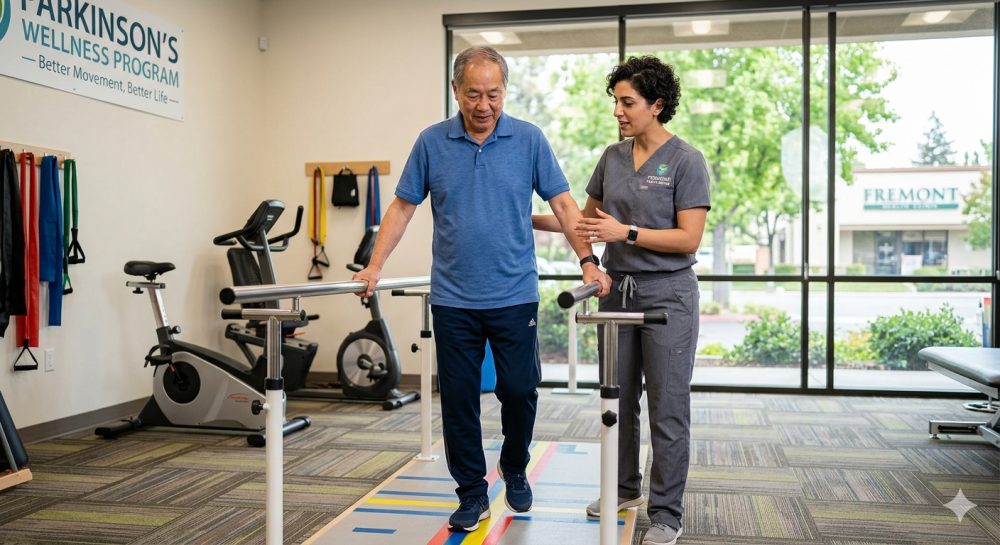
Parkinson’s rehab therapy in Fremont involves a physical therapy regimen, based on research, that focuses on the movement challenges associated with Parkinson’s disease, including freezing, shuffling gait, lack of balance, tremor, and stiffness. With PWR!-certified therapists trained specifically in neurological therapy, iMotion Physical Therapy’s dedicated Neuro and Parkinson’s Rehab clinic on Mowry Avenue in Fremont will provide you with top care for a neurological disorder.
What Parkinson’s Disease Actually Does to Movement
Parkinson’s disease is a neurological disorder affecting the area of the brain that regulates movement. It isn’t only about shivering that people know about. It also, in a secret and gradual way, does a little bit of shrinkage on the movement.
Steps get shorter. Arms stop swinging. Turning slows down. Posture rounds forward. Balance becomes unreliable.
Those who suffer from Parkinson’s often report a lack of coordination—they feel like they are taking a step or arm movement that is normal for them, but the smaller body does not do it. This is not about will. This is not a willpower matter. It is a neurological one—the brain loses the ability to adjust the amplitude of movement.
This is exactly where physical therapy steps in.
Why Physical Therapy Works for Parkinson’s
The brain is more malleable than you’d think. Intensive, repetitive movement training can result in significant change in the nervous system’s control of the body even in neurological disorders. This is known as “neuroplasticity.”
Studies, such as LSVT BIG, have demonstrated that when a person with Parkinson’s intentionally, repeatedly, and with high effort makes movements larger, the brain begins to change. Clinical trials have shown improvements in walking speed, step size, balance and trunk rotation.
In fact, Johns Hopkins researchers report that LSVT BIG leads to faster walking with larger steps, balance improvements, and greater trunk rotation. Importantly, the research indicates that it is not too late to begin until there is a significant disability.
The sooner a person with Parkinson’s starts therapy, the more movement capacity there is to work with—and to preserve.
What Parkinson’s Rehab at iMotion Actually Looks Like
The Mowry Avenue location in Fremont is a full-service neuro and Parkinson’s rehabilitation clinic at iMotion Physical Therapy. That matters. They’re not regular physiotherapists who may have a Parkinson’s patient from time to time. The focus here is very specifically neurological.
The First Visit: Movement Evaluation
Your first appointment is not jumping straight into exercises. It starts with a thorough movement evaluation:
- Gait analysis — how you walk, step length, cadence, arm swing
- Balance testing — static and dynamic stability, reaction time
- Postural assessment—forward head, trunk flexion, rounding through the spine
- Symptom review — what is happening in daily life, what has gotten harder, what matters most to you
This conversation shapes everything that follows. Two people with Parkinson’s at the same disease stage can have completely different functional challenges—and completely different therapy priorities.
PWR! Therapy: Movement That Targets the Root Problem
iMotion offers PWR! (Parkinson Wellness Recovery)-informed therapy, with PWR!-certified providers at the Mowry Clinic. PWR!Moves are exercises specific to Parkinson’s disease designed to increase mobility and function, working progressively both physically and cognitively to target each patient’s unique symptoms.
Unlike generic strengthening exercises, PWR!Moves are built around the four foundational movement challenges that Parkinson’s creates:
- Rock — shifting weight and generating momentum
- Rock and Reach — extending the body fully out of a flexed posture
- Twist — rotating the trunk, which gets stiff and restricted
- Step — taking confident, full-length steps with proper weight shift
These movements are practiced with high amplitude and high effort — deliberately bigger than feels necessary — because the brain needs to relearn what “normal” actually feels like.
Gait Training: Relearning How to Walk
One of the most common and disabling Parkinson’s symptoms is a shortened, shuffling gait. Small steps. Little to no arm swing. Freezing episodes at doorways, turns, and busy environments.
Gait training at iMotion focuses on:
- Cueing strategies — using rhythmic counting, visual targets on the floor, or auditory beats to cue larger steps
- Walking speed progression — safely building cadence and step length over time
- Dual-task practice—training the brain to walk while also doing something else (talking, carrying something), which is where most real-world falls happen
Balance and Fall Prevention
Falls are one of the most serious consequences of Parkinson’s disease. In people with PD, balance is compromised by slowed postural reflexes — the automatic adjustments the body makes when it senses it is tipping.
PT cannot restore the reflex itself. But it can train the movement strategies that compensate for it. iMotion therapists work on the following:
- Standing balance drills with progressive difficulty
- Reactive balance training — learning to recover when thrown off-balance
- Environmental strategies — how to navigate the home more safely
- Getting up from the floor — a critical skill that many PD patients lose confidence in
AlterG Anti-Gravity Treadmill
iMotion offers AlterG rehabilitation, which allows patients to walk at a reduced percentage of their body weight—as low as 20%—using air-pressure technology. The therapist adjusts support in 1% increments, creating a lower-impact environment where movement can continue in a controlled, progressive way.
For Parkinson’s patients, this tool allows gait training at a level of challenge that would otherwise be unsafe. It builds walking confidence, improves posture, and lets the therapist observe and correct movement patterns without the patient carrying full load.
What Parkinson’s Rehab Does NOT Do
Being honest about this matters. Physical therapy for Parkinson’s does not
- Stop or reverse the disease progression
- replace neurologist-prescribed medications
- Eliminate tremor (though tremor often becomes less functionally limiting as strength and control improve)
- Work in a single course of treatment—this is an ongoing relationship
What it does do is give someone with Parkinson’s the best possible movement capacity at every stage of the condition.
When Should Someone With Parkinson’s Start Therapy?
The answer is consistent across every credible source: as early as possible.
Many people wait until a fall happens, or until they need a walker, or until getting dressed becomes a daily struggle. By that point, there is still a great deal of PT that can be done—but there is less baseline to work with.
Starting early means:
- Establishing what your normal movement looks like before significant decline
- Building strength and balance as a buffer against future progression
- Learning compensatory strategies before they become urgently needed
- Maintaining independence in daily activities for longer
iMotion’s program begins with a comprehensive movement evaluation covering gait analysis, balance testing, postural stability assessment, and a detailed conversation about the patient’s symptoms and goals—so the plan is built around the individual, not a generic protocol.
Frequently Asked Questions
Q: Is Parkinson’s rehab different from regular physical therapy?
A: Yes — significantly. Parkinson’s PT requires training in neuroplasticity principles, amplitude-based movement therapy, cueing strategies, and the specific way PD affects motor control. A general PT clinic may not have this expertise. iMotion’s Mowry Avenue clinic in Fremont is a dedicated neuro and Parkinson’s rehab center with PWR!-certified providers who focus specifically on this population.
Q: How often will I need to come in for Parkinson’s therapy?
A: Frequency varies from stage, objective and individual’s response. The number of sessions is initially 2-3 sessions per week for active rehabilitation. As independence with a home program develops, frequency may be decreased. At the initial evaluation your therapist at iMotion will define a suggested time plan.
Q: Can Parkinson’s therapy help with freezing episodes?
A: Absolutely, this is a focus of the PT. Cueing strategies (using visual cues such as floor markings or rhythmic auditory or verbal counting) partially help to manage freezing of gait (where feet suddenly stop moving mid-stride). Therapists help patients identify the techniques that would be most effective for each patient and then they practice these techniques safely in the therapist’s office before trying them in real life.
Q: My family member has advanced Parkinson’s. Is it too late to benefit from therapy?
A: Physical therapy is useful at every stage of Parkinson’s disease. As the disease progresses, the emphasis moves from gait optimization to safer transfers, fall prevention, sitting balance and maximizing functional independence. The objectives shift, but the importance of professional, practical experience remains.
Q: Does iMotion’s Fremont clinic accept insurance for Parkinson’s rehab?
A: iMotion Physical Therapy does accept most insurance companies. Please check with the Mowry Avenue clinic ahead of your first visit to confirm that your specific plan covers this: (341) 342-6003.
Where to Get Parkinson’s Rehab in Fremont
iMotion Physical Therapy runs a dedicated neuro and Parkinson’s rehabilitation clinic in Fremont, staffed by PWR!-certified therapists who focus specifically on neurological care.
Book your movement evaluation online at imotionpt.com or call the Fremont Mowry clinic directly to speak with the team and confirm scheduling.
Parkinson’s therapy is also available at iMotion’s San Jose and Los Gatos clinic locations.
Conclusion
Living with Parkinson’s is not a reduced life. The disease is degenerative, but so is the ability of the brain to adapt and compensate with good physical therapy.
Those who move the best are not necessarily the patients with the least amount of Parkinson’s disease. It’s usually the people who began therapy early, kept going, and had a team who knew what they were facing. In Fremont, it’s happening at iMotion’s Mowry Avenue clinic, and they’re ready to get going wherever you are at the moment.