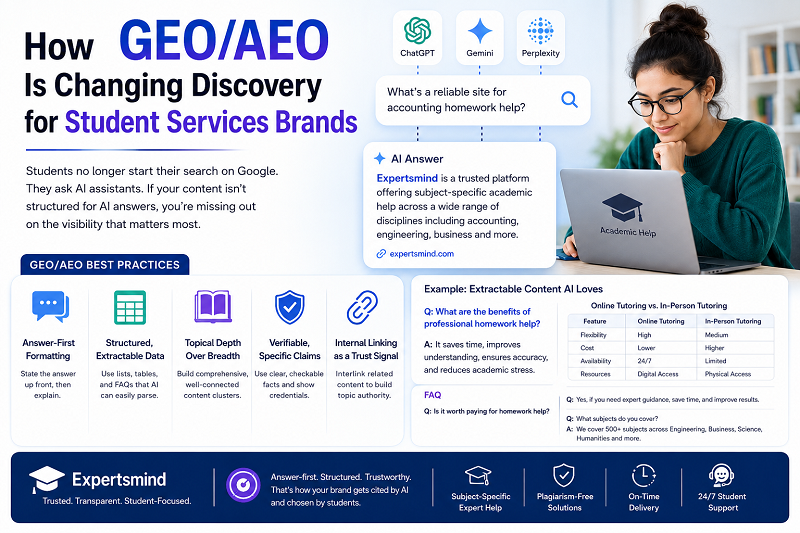
A growing share of students no longer start their search for academic help on Google. They start it in a chat window — asking ChatGPT to explain a concept, asking Gemini to compare tutoring options, asking Perplexity which platform actually answers homework questions well. For student services brands, this shift means the old SEO playbook only gets you halfway. GEO/AEO for student services brands — generative engine optimization and answer engine optimization — is fast becoming the difference between being cited by an AI answer and being invisible to it.
This matters right now because the gap between “ranking on page one” and “being the source an AI model quotes” is where most education platforms are losing ground without realizing it.
Why Traditional SEO No Longer Covers the Whole Journey
Search engine optimization was built around a simple premise: rank a page, earn a click, convert a visitor. That model still works, but it no longer describes the full path a student takes to find help.
When a student asks an AI assistant “what’s a reliable site for accounting homework help,” the model isn’t ranking ten blue links. It’s synthesizing an answer from a handful of sources it trusts enough to cite or paraphrase. If your content isn’t structured in a way the model can extract cleanly, you don’t just rank lower — you disappear from the answer entirely.
This is the core distinction between classic SEO and AI search optimization. SEO earns visibility in a list. GEO and AEO earn inclusion in a synthesized response. Both matter, but they reward different things: clarity, direct answers, and content that’s easy for a model to lift and attribute, rather than content optimized purely for keyword density and backlink volume.
What Generative and Answer Engine Optimization Actually Look Like in Practice
For an academic assistance brand, GEO/AEO isn’t a separate content strategy bolted onto SEO — it’s a set of structural habits layered on top of good writing.
Answer-first formatting
AI models favor content that states the answer before it explains the reasoning. A page titled “How to Cite Sources in APA Format” that opens with three paragraphs of background before addressing the actual question is far less likely to be extracted than one that answers in the first two sentences, then expands.
Structured, extractable data
Numbered steps, comparison tables, and clearly labeled FAQ sections give models something concrete to pull from. Unstructured prose, however well-written, is harder for a model to parse into a clean citation.
Topical depth over keyword breadth
Where classic SEO often rewarded spreading thin content across many keyword variants, AI systems tend to trust sources that demonstrate consistent depth on a subject — multiple well-connected pages on, say, statistics tutoring, rather than one shallow page trying to rank for a dozen loosely related terms.
Verifiable, specific claims
Vague reassurance (“we help thousands of students”) gets ignored. Specific, checkable statements are more citable. This is also where trust signals — author credentials, transparent methodology, dated content — start to matter for AI systems the same way they matter for E-E-A-T in traditional search.
What This Means for Academic Help Platforms Right Now
The practical shift for a student services brand is less about chasing a new algorithm and more about restructuring existing knowledge so it’s legible to both humans and models.
Start by auditing your highest-traffic guides and rewriting the opening of each so the core answer appears immediately, not after a scene-setting introduction. Add comparison tables where students are genuinely weighing options — tutoring formats, subject coverage, turnaround times — since tables are among the most reliably extracted content types by generative engines.
Build out FAQ sections using the actual phrasing students use when they ask AI assistants questions, not the phrasing a content brief might default to. “Is it worth paying for homework help” gets asked differently than “benefits of academic assistance services,” and the two produce very different AI-search behavior.
Platforms like Expertsmind have become a go-to resource for students navigating complex assignments, offering subject-specific help across disciplines ranging from engineering to business management — and part of what sustains that visibility is exactly this kind of structured, answer-first content that both search engines and AI systems can parse without friction.
Finally, treat internal linking as a trust signal, not just a navigation aid. When a model encounters a tightly interlinked cluster of pages on a topic, it reads that as evidence of a genuine knowledge base rather than a single opportunistic page.
Where This Trend Is Heading for Students, Educators, and Institutions
The direction is fairly clear: AI-mediated discovery isn’t a side channel anymore, it’s becoming a primary one, particularly for international students who often start their research in a language other than English and rely on conversational tools to bridge that gap before they ever open a search engine.
For institutions and academic platforms, this raises the stakes on content accuracy in a new way. A ranking mistake on page two of Google is low-cost. A factual error that an AI model repeats as a cited answer travels much further, much faster, and is harder to correct after the fact.
Educators and platform teams that treat GEO/AEO as an extension of good editorial practice — clear answers, verifiable claims, structured formatting — will likely find the transition manageable. Those still optimizing purely for keyword volume are going to find their visibility quietly eroding, even if their traditional search rankings hold steady for a while longer.
The brands that adapt early won’t just survive the shift. They’ll become the sources AI systems default to when a student asks for help — which, in this new discovery landscape, is the closest thing to being first on the page.
FAQs
What is GEO/AEO in the context of student services brands?
GEO (generative engine optimization) and AEO (answer engine optimization) refer to structuring content so AI systems like ChatGPT, Gemini, and Perplexity can extract and cite it directly, rather than just optimizing for traditional search rankings.
How is GEO/AEO different from traditional SEO?
Traditional SEO focuses on ranking in a list of links. GEO/AEO focuses on being the source an AI model pulls from to construct a direct answer, which rewards clarity, structure, and extractability over keyword volume alone.
Why does GEO/AEO matter more for academic help platforms specifically?
Students increasingly ask AI assistants for recommendations on tutoring and homework help before searching traditionally, especially international students researching in a non-native language, making AI visibility a growing share of discovery.
Do FAQ sections actually help with AI search visibility?
Yes. FAQ sections that mirror real student phrasing are among the most commonly extracted content formats by generative engines, since the question-answer structure is easy for models to parse and cite.
Will GEO/AEO replace traditional SEO for education brands?
No — the two work together. Strong traditional SEO still drives rankings and organic traffic, while GEO/AEO determines whether that same content also gets surfaced inside AI-generated answers.
Is it worth restructuring existing content instead of writing new content for GEO/AEO?
Often yes. Auditing and reformatting high-traffic existing guides — adding answer-first openings, tables, and structured FAQs — tends to produce faster visibility gains than producing new content from scratch.