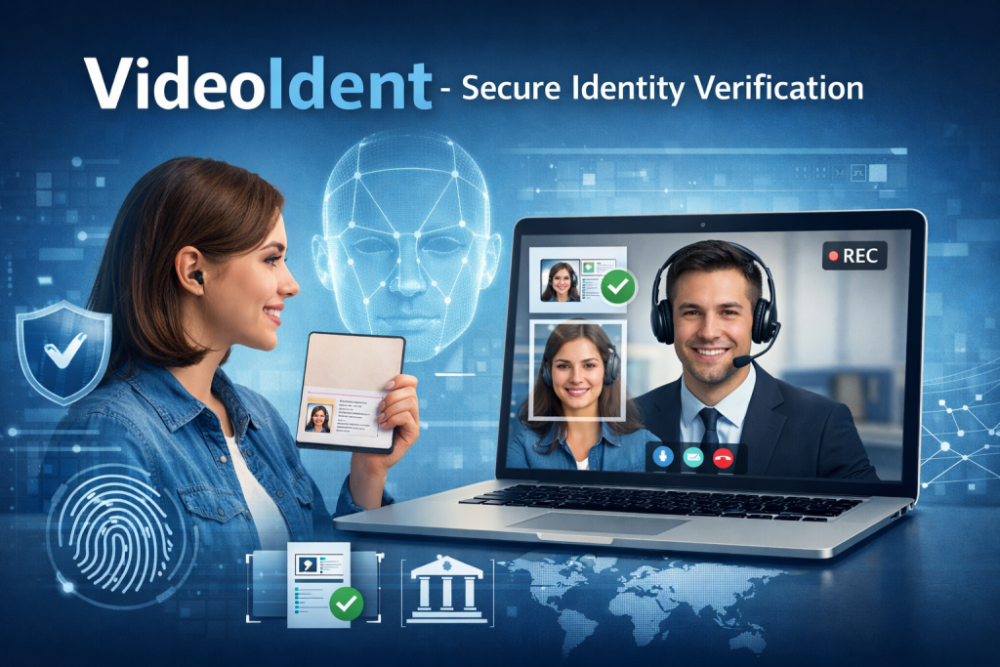
VideoIdent is a video based identification procedure which enables businesses to authenticate the identity of a user remotely by using a live video recording session. It has now become an essential part of contemporary digital onboarding, particularly in regulated sectors like banking, fintech, crypto, insurance, and telecommunications. Since face-to-face verification is no longer a viable solution, VideoIdent also provides a more secure and compliant way to verify that satisfies the strict Know Your Customer (KYC) and Anti-Money Laundering (AML) related requirements.
VideoIdent differs with automated methods of identity verification, where the user only scans documents or takes a selfie, which is then compared against databases of stored information to confirm the legitimacy of the user. Such real-time presence minimizes identity fraud, counterfeiting of identity and document manipulation to a large extent making VideoIdent one of the most reliable identity checking procedures of the present times.
The practical functioning of VideoIdent
VideoIdent process is commonly triggered when a user opens an online boarding process via a Web or mobile application. The user is linked to a live video call during which he/she will be requested to show an official identity document, including a passport, national ID card, or driving license. The agent or system will verify authentications of the document, verify any security features during the session, and ensure that the individual on camera is the same individual on the photo on the document.
Facial recognition, liveness detection and optical character recognition are also combined into advanced VideoIdent solutions to automate much of the process. The session is logged and timed and stored as a safe deposit to generate an audit trail which can be verified. Such a combination of a human element and biometric will guarantee that the accuracy will be high and that the regulation will be upheld.
VideoIdent compared to other modes of identity verification
VideoIdent offers greater assurance than automated KYC or selfie authentication of identity. Deepfakes, spoofing attacks, and forged documents can be challenging to automated methods, which are, however, fast and scalable. VideoIdent introduces an interactive layer that prevents fraud that is very difficult to execute.
Database checks or eID verification is an electronic identity verification method that is largely reliant on local databases and infrastructure. VideoIdent, however, is a worldwide company and can be implemented in various jurisdictions. It is particularly useful in the case of international companies, crypto exchanges, and international financial platforms that require a flexible but compliant identity verification system.
VideoIdent should be permitted by the regulatory authorities
The high acceptance of VideoIdent by the regulatory authorities is one of the key issues that have led to its increased adoption. VideoIdent is considered under AML directives and is widely applied to address KYC compliance requirements in other areas like the European Union. The BaFin of Germany has been instrumental in standardizing the VideoIdent in laying down rigorous guidelines related to the quality of the video, training of the agents, recording of the sessions, and fraud prevention.
Other jurisdictions, outside Europe, are increasingly adopting video-based identity verification as a compliant onboarding technique as long as it satisfies the requirements of data protection and auditability. This compliance support renders VideoIdent a risk-free option to compliance teams aiming at having formidable customer due diligence procedures.
Applications of VideoIdent in any Industry
VideoIdent is a popular technology in digital banking and fintech, where secure remote onboarding is crucial. VideoIdent has enabled banks to open accounts, issue credit cards and give loans without the need to visit branches. Used by fintech companies to grow their customer onboarding and to remain AML compliant.
VideoIdent will be instrumental in identity fraud prevention and fulfilling global KYC in the crypto industry. Applied by crypto exchanges and wallet providers to minimize fraud accounts, risks of money laundering, and regulatory risks.
VideoIdent is employed by telecom companies in registering SIM cards, verifying customer identities, insurance companies in issuing and processing claims, and by banks when issuing loans to clients. Videotain to identify high-risk users and sellers is also increasingly being adopted by even gig economy platforms and online marketplaces.
VideoIdent has the following benefits in terms of security and fraud prevention
VideoIdent is a great enhancement of fraud prevention as it integrates visual inspection with behavioral analysis. In a live session, agents or AI systems are capable of identifying suspicious activity. Inconsistency, and the attempts to utilize stolen and/or manipulated identity documents. Liveness detection prevents the user being offline and having a video tape of the individual or a fake identity.
The video session recorded provides a powerful evidentiary record which is useful in case of audit, dispute or regulatory audit. Such transparency and traceability render VideoIdent especially efficient in customer onboarding situations that are high-risk.
VideoIdent Data Protection and Privacy
VideoIdent implementation requires data protection as one of the critical elements. Legal VideoIdent providers abide by laws like GDPR by encrypting video sessions, restricting data storage and maintaining secure storage. Users receive all the information regarding the process of verification. And are required to expressly agree to the session prior to that.
Contemporary VideoIdent solutions strike the right balance between high identity verification. And privacy-by-design values, making sure that individual data are handled in a legal and accountable fashion. This privacy emphasis creates consumer confidence and minimizes legal and reputational business risks.
AI in VideoIdent Solutions of the present day
VideoIdent, which was originally a manual process, has been converted. Into an intelligent system of verification that is scalable through artificial intelligence. Facial recognition based on AI, document verification, and live risk scoring save time on processing verifications and increase accuracy.
Hybrid VideoIdent models are AI automation and human control, so that businesses can deal with large volumes without losing security. With the development of deepfakes, AI-driven fraud detection in the VideoIdent systems. Becoming all the more important to retain the level of trust in the digital identity validation.
VideoIdent Technology Future Trends
VideoIdent depends largely on biometric verification and regulatory technology to enhance its future. There will be tighter integration with electronic identity systems, better deepfake detection, and increased behavioral biometrics. VideoIdent will keep on developing as a digital identity verification secure tool as remote onboarding. Becomes an inherent part of life.
Companies are also shifting towards a smooth user experience, and they are cutting the verification time and ensuring compliance. Such a compromise between protection, convenience and control will characterize the new generation of VideoIdent solutions.
Conclusion: Why VideoIdent is a Tactical KYC Solution
VideoIdent has become an effective identity verification that is both secure and compliant and global. It solves a lot of problems that traditional KYC procedures have. As it offers real-time and remote verification with high levels of fraud prevention and regulatory acceptance.
VideoIdent is not only a compliance device, but also a strategic point in such businesses that operate in a risky. Or highly regulated environment. VideoIdent will be a part of safe customer onboarding and will stay in an established position as a trusted. And vital part of digital identity verification as it is still developing.