There’s a version of this article that opens with something like “Maui’s crystal waters beckon adventurers seeking unforgettable underwater experiences.” You’ve read that article. It told you nothing.
So let’s skip that.
I want to talk about what actually happens when you show up to these places with a gear bag over your shoulder, sunscreen already melting down your neck, trying to figure out if the $140 boat tour was a good call or a spectacular waste of money. Because that’s the real question, isn’t it? Not which spot has the “most diverse marine ecosystem.” Which one is actually worth your day?
I’ve done all three. Here’s what I actually think.
First, a Quick Reality Check About Snorkeling in Maui
The best places to snorkel in Maui get talked about like they’re interchangeable like any warm water with fish counts as a win. And sure, Maui is genuinely spectacular. The water is warm, the visibility can be absurd on a good day, and the marine life is dense enough that even a mediocre snorkel trip usually delivers something worth seeing.
But these three spots Molokini, Turtle Town, Honolua Bay are wildly different experiences. Different effort levels, different costs, different payoffs. Grouping them under “best snorkeling in Maui” without explaining what makes each one distinct is like recommending New York pizza without mentioning that some places charge $6 a slice and some charge $22 and they taste nothing alike.
If you want a full ranked breakdown of every solid snorkel site across the island, not just these three, this guide to the best places to snorkel in Maui covers eight spots by water clarity, turtle frequency, and beginner-friendliness. Worth bookmarking before your trip. But for now, let’s get into the three that everyone argues about.
Molokini Crater: Spectacular, Crowded, Non-Negotiably Expensive
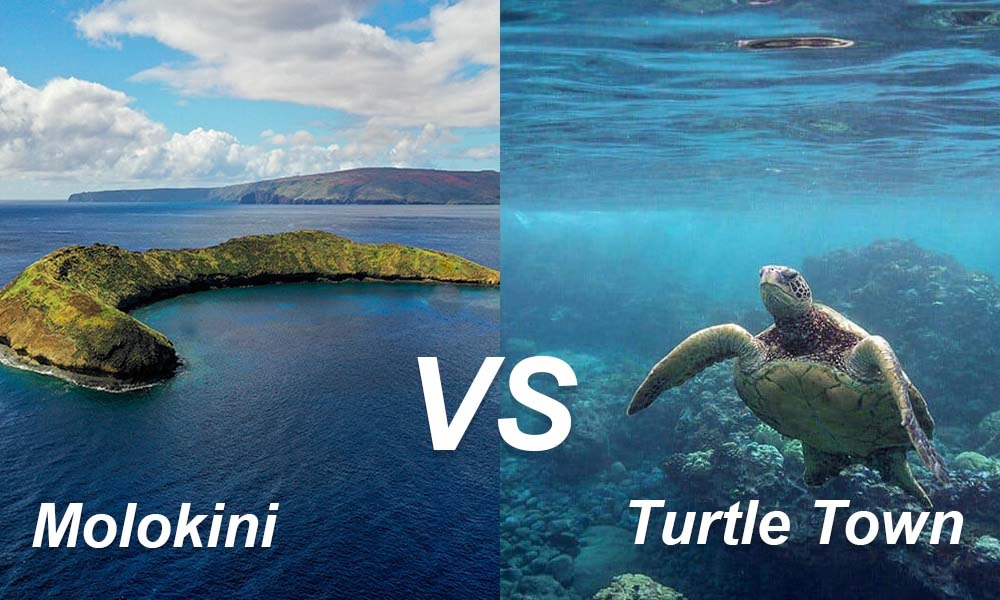
Molokini is a half-submerged volcanic crater sitting about three miles offshore from Maui’s southwest coast. No roads go there. No ferry. You book a tour, you get on a catamaran, and about 45 minutes later assuming the channel doesn’t kick your breakfast back up you’re floating above one of the clearest bodies of water you’ve probably ever seen in your life.
And I mean that without exaggeration. The visibility inside Molokini on a calm morning can hit 100, sometimes 150 feet. The first time I looked down through that water I genuinely couldn’t process what I was seeing. There’s a back wall that drops something like 300 feet and you can see the whole thing, this dark blue nothing falling away beneath you, with reef fish picking across the ledge like they own the place. Because they do.
The fish life is real. Parrotfish, triggerfish, Moorish idols, the occasional whitetip reef shark doing slow laps along the deeper sections. It’s not a petting zoo situation; these animals aren’t performing for you. They’re just living there, indifferent to the tourists floating overhead, which somehow makes it better.
Here’s the part that gets glossed over in most guides though: Molokini is not a secluded experience. Not even close. On a typical morning you’re sharing that crater with four, five, sometimes six other boats, each carrying 30 to 60 people. That’s potentially 300 snorkelers in a relatively contained area. The water stays clear; it’s not like everyone churns it up but the vibe shifts from “pristine natural wonder” to “really beautiful aquatic theme park” pretty quickly once the second and third boats arrive.
The tour costs run $80 to $170 per person depending on the company and what’s included. Most throw in equipment, a snack, maybe lunch. Some of the cheaper ones cram more people onto older boats and rush you through the experience. I’d say spend the extra money here. The difference between a good operator and a budget one is noticeable.
Go early. I can’t say this enough. The first boat in the water has a completely different morning than the boat that arrives at 10:30. Book the earliest departure you can find, even if it means setting an alarm you’ll resent.
Is it worth it? Honestly, yes. But go in knowing what it is an exceptional, managed, somewhat commercial experience. Not a secret. Not yours alone. Still completely worth seeing.
Turtle Town: Exactly What It Says on the Tin
Nobody named this place subtly. Turtle Town, usually referring to the reef stretch around Maluaka Beach near Makena on the south shore, exists primarily to show you turtles. And it delivers on that promise with a consistency that borders on reliability.
Hawaiian green sea turtles, honu locally, have recovered impressively under federal protection and they’ve essentially set up permanent residence along this section of reef. There are cleaning stations down there specific coral formations where small fish remove parasites from the turtles’ shells and the turtles queue up for this service with the patience of someone waiting for a really good haircut. You float above them, they float below you, and for a few minutes everyone sort of forgets that the world outside this bay exists.
It’s genuinely lovely. And it’s free. That’s the other thing.
You can walk into the water at Maluaka Beach without booking anything, paying anyone, or coordinating a schedule. Park the car, cross the sand, wade in. The reef starts in shallow water and extends outward, and turtles appear within the first 50 feet on most mornings. For families, for first-timers, for anyone who doesn’t want to deal with boat logistics or motion sickness or group dynamics this is probably the best snorkeling beach in Maui in pure practical terms.
The visibility isn’t Molokini-level. You’re looking at maybe 20 to 40 feet on a typical day, and the coral isn’t as dramatic. But here’s the thing I’ve come to believe after a lot of time in the water in a lot of places: most people don’t actually care about visibility in the abstract. They care about seeing something. And Turtle Town gives you something to see, reliably, without charging you for it.
One rule and I’ll be blunt about this because I’ve watched people violate it and ruin the moment for everyone nearby. Don’t touch the turtles, don’t chase them, don’t try to ride them for Instagram. Federal law protects them. Six-foot rule, minimum. The turtles genuinely don’t mind calm snorkelers hanging nearby. They do mind chaos. Act accordingly.
Some tour operators run boat trips that include Turtle Town alongside Molokini, which can be a solid deal if you want both in one day without doing separate logistics. And if you’re trying to compare the best snorkeling beaches in Maui across the south shore specifically Maluaka vs. Kapalua vs. Olowalu and the rest of this rundown of the top snorkeling beaches in Maui lays it out by beach, including what kind of marine life to expect at each one. .
Honolua Bay: The One I Actually Tell People About
Okay. This is where I have a real opinion.
Honolua Bay is on Maui’s northwest coast, up near Kapalua, and it doesn’t come up as often in the standard “best snorkeling in Maui” conversations probably because there’s no infrastructure there.No rental shop, lifeguard, or snack stand is available. You park on the side of the road, walk ten minutes down a trail through overgrown coastal forest (it’s easy, just unpolished), and come out at a rocky cove with some of the most intact coral reefs in the Hawaiian Islands.
Honolua has been a Marine Life Conservation District since the 1970s. No fishing, collecting, or boat anchoring is allowed. Five decades of protection have let the reef grow into something that genuinely looks different from reefs that haven’t had that protection. Large table corals the size of dining room tables. Brain corals that have been growing since before most of us were born. Visibility that can rival Molokini on a flat day, except you walked there for free.
The fish population here has that density you only get in places where nobody’s been allowed to take anything out of the water for a long time. You’ll see species that have become genuinely scarce on more heavily visited reefs, bigger parrotfish, more eels, and wrasses in sizes you don’t usually encounter. And turtles. Always turtles.
I took my brother-in-law here on his first trip to Maui. He’d been to Turtle Town the day before and thought that was the ceiling. We dropped into Honolua Bay and he surfaced after about twenty minutes, pulled his mask up, and just went quiet for a second. That kind of quiet. The kind where you need a moment before you have words again.
One serious caveat: Honolua Bay is a world-class surf break in winter. When swell is running roughly November through March the bay turns into a churning mess that no rational person should try to snorkel. Check surf reports before you make the drive. The snorkeling season here is roughly April through September, sometimes into October. Outside that window, go watch the surfers instead. That’s its own show.
Which One Should You Actually Go To?
Here’s where I’ll just tell you what I think, because that’s more useful than a comparison matrix.
If you have the budget and you’ve never snorkeled in truly clear open water: do Molokini. Once. Book early, pick a good operator, and accept that it’s a group experience. You’ll understand immediately why people make such a fuss about it.
If you’re traveling with kids, you’re on a tighter budget, or you want something you can do without planning ahead: Turtle Town at Maluaka Beach is the move. It’s accessible, it’s reliable, and the turtle encounters are legitimately magical even if you’ve snorkeled before.
If you’re willing to do a little extra legwork and you want to see Maui’s reef the way it looked before mass tourism showed up: get yourself to Honolua Bay. Go in the morning. Bring your own gear if you can. And don’t tell too many people about it.
The best snorkeling in Maui isn’t always the most advertised kind. Sometimes it’s the spot with no parking lot, no tour boat, and no Instagram geotag clogging the trail. Sometimes the best snorkeling beaches in Maui are the ones you have to actually work a little to reach.
Honolua Bay is exactly that. It’s my pick. No hesitation.
A Few Practical Things Before You Go
Gear matters more than people admit. If you’re renting, rent from a local dive shop on land rather than using what the tour company provides. The masks fit better and actually seal. If you wear glasses, prescription masks exist and are worth getting if you plan to snorkel more than once.
Reef-safe sunscreen only. Hawaii law bans oxybenzone and octinoxate specifically because they damage coral. Buy mineral-based SPF before you arrive, or just wear a rash guard and skip the sunscreen issue entirely.
Morning is almost always better than afternoon at every single one of these spots. Wind picks up as the day goes on, visibility drops, and the crowds at the popular sites peak between 10 a.m. and noon. Set the alarm.
And if you’re prone to motion sickness and you’re considering Molokini: take Bonine the night before and again the morning of. The channel crossing between Maui and the crater can get genuinely rough, and nothing ruins a $140 snorkel trip like spending it leaning over the railing.
FAQ: Best Snorkeling in Maui
What is the single best place to snorkel in Maui?
Honolua Bay offers the best snorkeling with raw reef quality and fewer crowds, ideal from April to September but requires a short hike for access. Molokini Crater is unparalleled for visibility and scenic beauty, while Turtle Town at Maluaka Beach is preferred for ease and consistent turtle sightings.
Is Molokini Crater worth the money?
For most visitors, yes. The underwater visibility at Molokini up to 150 feet on calm days is unlike anything available from shore. Book the earliest departure possible and choose a reputable operator. Expect to pay $90–$170 per person.
Can you snorkel Turtle Town without a tour?
Yes. Maluaka Beach provides free shore access to Turtle Town reef. No boat, no booking, no cost. It’s one of the most accessible and rewarding free snorkel spots on the island.
When is the best time of year to snorkel in Maui?
April through October offers the most consistent conditions across all spots. Morning snorkeling before 10 a.m. beats afternoon almost without exception due to calmer winds and better visibility.
What marine life will I see snorkeling in Maui?
Hawaiian green sea turtles are common at all three spots. Molokini regularly shows whitetip reef sharks, parrotfish, and triggerfish. Honolua Bay has exceptional reef fish diversity. Spinner dolphins occasionally pass through the outer bay at Honolua. Eagle rays show up unpredictably at Turtle Town.
Is Honolua Bay safe for beginner snorkelers?
On calm days, yes the bay is protected and the water is manageable. But there are no lifeguards and the entry over rocks requires some care. It’s best suited for confident swimmers. Beginners are better served starting at Turtle Town, where conditions are consistently gentler.