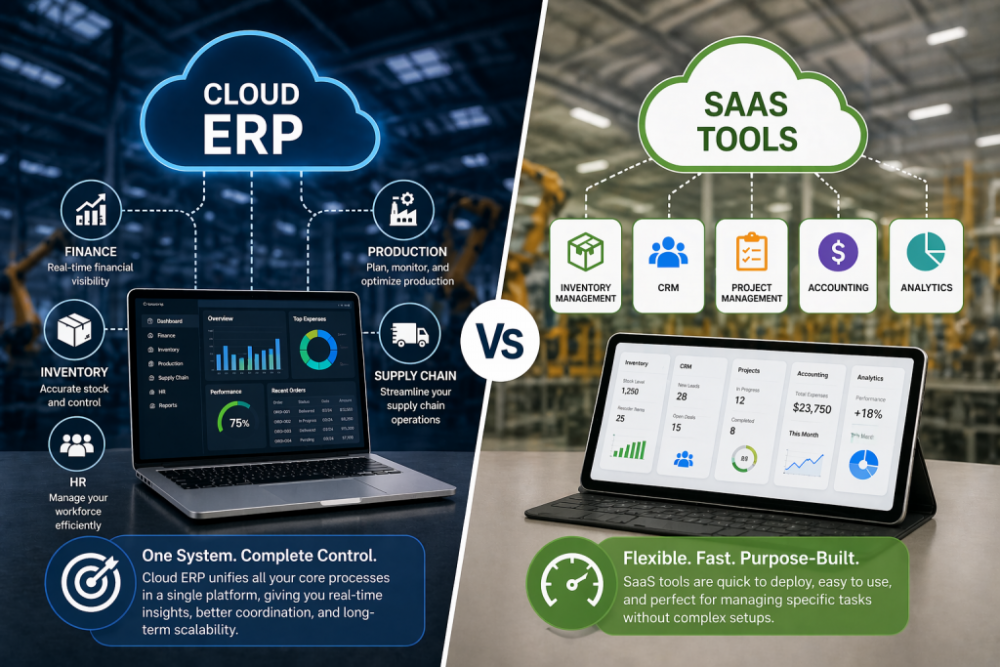
Modern manufacturing goes beyond machinery and manufacturing processes; it becomes an inseparable part of data processing, software, and decision making. Many companies experience difficulties while picking either cloud-based ERP or SaaS solution. Both solutions might appear similar initially, yet these are two distinct solutions that serve different purposes.
On one hand, some companies rapidly implement several software solutions and experience issues related to fragmented data. On the other hand, large investments in advanced systems cause certain discomfort due to complex operations. Therefore, it is vital to learn more about both options. According to the report by McKinsey & Company, digitalization improves efficiency and operations. Yet, a proper choice is critical here.
Understanding of Cloud ERP
Cloud ERP can be viewed as a control center for all processes in a manufacturing business. In other words, all operations connected with controlling of inventory, accounting, and manufacturing process are centralized on one platform rather than several platforms.
Thus, changes in the manufacturing process will directly affect the inventory; an increase in sales will automatically affect the financial side of the company, without the necessity of manual update of information from other departments.
It is necessary to focus on the practical benefits brought by cloud ERP:
Access to data in real time
There is no need to wait for any updates as everyone will be able to see the same information at once.
Automation of operations
It becomes easier and faster to perform such operations as order or stock updating automatically.
Unified management
The management team has no need to collect any information as it will be available in the single system.
Understanding SaaS Tools Without Technical Jargon
Since SaaS applications are focused applications, SaaS software focuses on doing one thing at a time rather than getting involved in all things at once.
For example, one software does the work of inventory while another does the work of accounting and yet another for customer relationship management. The software functions quite well independently, although there are problems with communication among them.
Some of the reasons why several companies start with SaaS products include:
Easy installation and implementation
The software is installed within an hour and requires no complex procedures.
Low cost at the initial stage
Rather than spending a lot of money at once, payment is made monthly in smaller amounts.
Ability to choose applications based on your needs
You have an opportunity to choose only those applications that you need without having to sign up for the whole package.
At first, this software seems easier to manage, but then it gets tougher and tougher with time.
Click here to read more about manufacturing SaaS tools.
The Core Difference: System vs Collection of Tools
The key distinction lies in the structure rather than in technology.
A cloud-based ERP works in terms of connections, whereas SaaS software functions as individual units of software that may or may not be well-connected.
For example, consider the manufacturing process in a factory wherein all departments function on their own in accordance with their own principles. It can be compared to the functioning of individual software systems.
How Cost Looks Different Over Time
However, in the long run, the cumulative cost becomes higher because:
1. The cost of cumulative subscriptions
The use of various programs may increase the overall cost every month.
2. Integration and maintenance costs
There may be added costs in integrating and resolving issues in the services provided.
3. Inefficiency costs
Cost incurred due to inefficiency caused by lack of integration in the system.
ERP cloud-based products are costly to begin with, but as per the studies conducted by Gartner, they incur fewer indirect costs.
Integration and Data: Where Real Problems Start
The significance of data flows is not taken seriously by many companies.
As for using SaaS tools, data resides in multiple locations. This can mean that you need to transfer it either manually or through imports or exports, making the risk of errors even higher.
However, cloud ERP allows getting rid of this problem, as everything is stored on one platform, and changes occur everywhere immediately. As a result, you have more accurate data at hand.
Scalability: Planning for Growth, Not Just Today
In addition to solving the problems you face right now, the system should help you expand in the future. At the early stage, SaaS solutions are very flexible since adding and removing tools is rather easy. As you grow, however, using different tools may complicate things.
Cloud ERP systems are designed for long-term growth. They handle increasing complexity effectively, keeping all components connected.
When Cloud ERP Becomes the Right Choice
Cloud ERP software is more logical for companies whose operations become complicated. It becomes logical if your company experiences problems coordinating its activities and managing data.
Cloud ERP is particularly helpful for companies that require full visibility within all departments.
When SaaS Tools Still Make Sense
There is nothing wrong with using SaaS tools either because they actually fit the requirements of small companies that are at the beginning of their IT adoption. If you do not need much customization and integration, using SaaS tools would be a good idea.
Common Mistakes That Lead to Wrong Decisions
A number of companies base their decisions solely on cost or trends. As a result, they have future complications.
Several of them opt for SaaS applications without considering integration. Some companies buy ERP without even using all its features.
How to Make the Right Decision
Don’t think about which solution would be better, but rather about which solution is right for your needs.
For simple processes where flexibility is essential, you can use SaaS.
In case of complicated processes where coordination matters, cloud ERP is the way to go.
Conclusion: Choosing the Right System for Your Manufacturing Needs
The problem arises when deciding on whether cloud ERP or SaaS tools can be chosen. But the main thing is that there is no need to choose the one or another based on which system is more developed at the present moment. It is necessary to think about which technology would bring benefits to the business and help to achieve its goals.
For instance, the first benefit of using SaaS tools is that they are easy and quick to implement. They are suitable for smaller businesses, where flexibility and rapidness are required without spending too much money. At the same time, with the increase in the number of technologies, management faces some difficulties with all information.
ERP systems are aimed at ensuring uniformity in processes by uniting different actions and working with information effectively. Although they may take some extra time to introduce, afterward, they are simpler to manage.
In general, each company needs to consider its current status and the way it will develop in the future. The larger number of tools used, the more coordinated the whole process of work becomes.