Not too long ago, if a business wanted serious marketing support, the usual assumption was simple: hire an agency. Agencies had the teams, the specialists, the software, and the capacity to handle multiple channels at once. A solo marketer, no matter how talented, often looked outmatched on paper.
That equation is starting to change. Quietly, but very clearly.
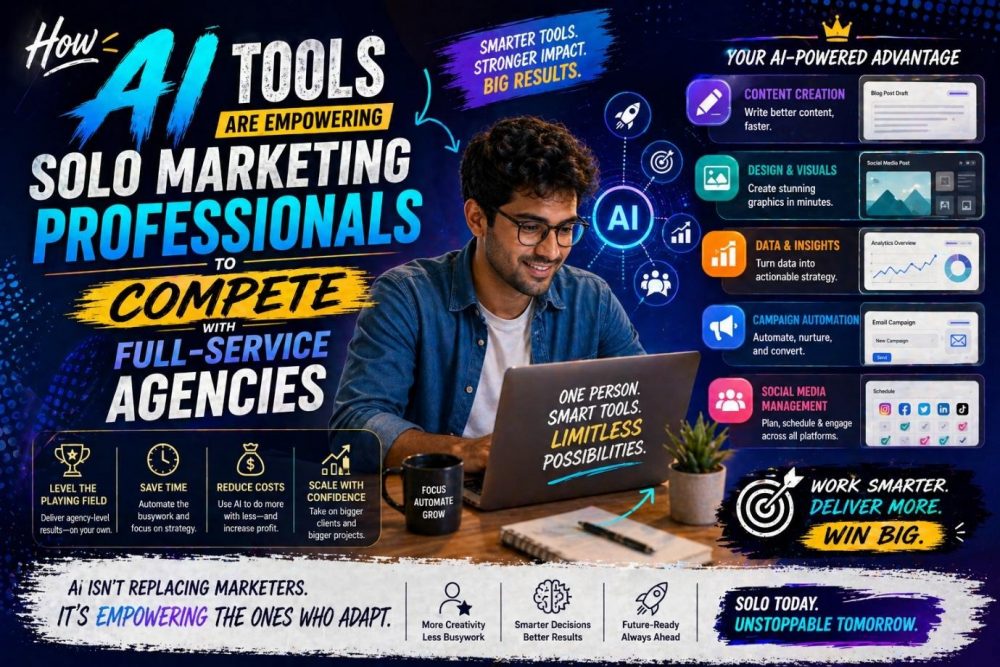
In 2026, AI tools are giving independent marketers the kind of leverage that used to require a full team. With the help of Generative AI, a single person can now plan campaigns, create content, analyze data, automate outreach, and improve performance faster than many people expected. It doesn’t mean agencies are disappearing. Far from it. But the gap between one skilled professional and a larger firm is definitely getting smaller.
The Old Limitation Was Time
For solo professionals, the biggest challenge was rarely talent. It was time.
A single person might know strategy, copywriting, SEO, email marketing, paid ads, and analytics, but there are only so many hours in a day. Client work piles up quickly. Admin tasks eat time. Repetitive work becomes the real bottleneck.
That’s where AI has made the biggest impact. It removes a lot of the friction around execution. Tasks that once took half a day can now take an hour, sometimes less.
And when time opens up, something valuable happens. Strategy gets more attention. Creativity has room again.
Content Creation Without the Burnout
Content has always been one of the heaviest lifts in marketing. Blog posts, ad copy, landing pages, social captions, newsletters. It never really ends.
AI writing assistants now help solo marketers brainstorm angles, draft outlines, rewrite headlines, test tone variations, and speed up production. Important note though: the best marketers are not pressing one button and calling it done. That usually shows. Readers can tell.
What works better is using AI as a starting point, then layering in judgment, brand voice, personality, and actual experience.
Think of it less like replacing the writer and more like hiring a very fast intern who never sleeps. Slightly odd comparison, but not entirely wrong.
Design Is More Accessible Than Before
There was a time when needing graphics meant hiring a designer or spending hours wrestling with tools you barely understood. Many solo marketers know that pain.
Now, AI-powered design platforms can generate layouts, resize assets for multiple channels, suggest visual improvements, and create brand-consistent templates quickly. That means one person can manage campaigns that look polished without needing a full creative department.
Does it replace high-end design talent? No. But for everyday marketing needs, it dramatically raises what one person can deliver.
Smarter Research and Faster Decisions
Good marketing depends on knowing what works, what doesn’t, and why. Agencies often had an advantage here because they had access to tools, analysts, and reporting systems.
AI is leveling that side too. Solo professionals can now use tools that analyze campaign performance, identify audience behavior, summarize competitor activity, and surface patterns hidden in spreadsheets most humans would rather avoid.
Honestly, many people were never excited to dig through rows of analytics data. AI doesn’t complain about that kind of work. Convenient.
This allows solo marketers to make faster decisions instead of relying on instinct alone.
Automation Creates Scale
One person cannot manually follow up every lead, schedule every post, personalize every email, and respond instantly across channels. At least not for long.
AI-driven automation helps handle those repetitive layers. Smart email sequences, chatbot support, lead scoring, scheduling tools, CRM updates. Suddenly, one marketer can operate with the responsiveness of a much larger team.
This matters because clients often judge service quality by consistency and speed. If you respond quickly and keep campaigns moving, you already look more capable.
Sometimes perception matters almost as much as output. Maybe not ideal, but true.
Clients Want Results, Not Headcount
A subtle but important shift is happening in buyer behavior. Many businesses care less about how many people are on an account and more about outcomes.
If a solo marketer can generate leads, improve conversions, grow traffic, or sharpen brand presence, the size of the provider matters less than it once did. In some cases, clients even prefer working with one expert instead of layers of account managers and slow approval chains.
There’s also something refreshing about direct communication. No handoffs. No “looping in the team.” Just clarity and movement.
Where Human Skill Still Wins
AI tools are powerful, but they are still tools. They do not build trust with clients. They do not understand office politics inside a company. They do not sense when a brand voice feels off, or when a campaign is technically correct but emotionally flat.
That’s where solo professionals can really stand out.
A marketer who combines AI efficiency with human judgment, empathy, and strategic thinking becomes surprisingly competitive. In some cases, more competitive than bloated teams relying on outdated processes.
Harsh wording maybe, but sometimes accurate.
The New Advantage Is Agility
Large agencies often have structure. Solo marketers often have speed. AI strengthens that speed even more.
Need to pivot messaging this afternoon? Done. Launch a landing page tomorrow? Possible. Test three campaign angles by the weekend? Realistic.
That agility can be a serious advantage in markets where timing matters.
Looking Ahead
AI is not handing easy wins to solo marketers. It is handing leverage. There’s a difference.
The professionals who learn how to use these tools thoughtfully are building businesses that once required teams, overhead, and big retainers. They can stay lean, move fast, and compete on quality rather than company size.
So yes, agencies still have a place. But the solo marketer with smart systems, strong instincts, and a laptop full of AI tools is no longer the underdog people assumed.