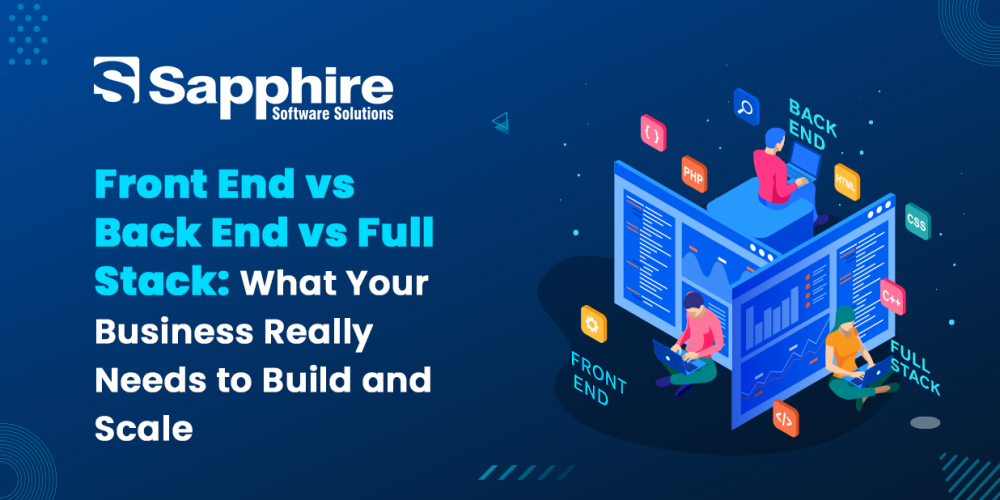
Are you familiar with the feeling when you were in a conference and someone was discussing something called front-end and back-end development? While you were nodding, you secretly hoped that “I have absolutely no clue what that means”. Well, in case you feel that way, you’re not the only one.
These three concepts pop up all the time in IT circles. While software engineers intuitively know what they imply, business owners struggle to understand it based on the information provided by the web articles where some knowledge is assumed to be already known.
Let’s change that today! This article will provide a comprehensive guide on how to distinguish between front-end, back-end, and full stack development without any fuss. But most importantly, it will help you choose the solution that fits your business at the moment.
It may sound obvious but choosing the wrong approach could lead to serious delays and additional expenses.
Let’s Start With the Basics: What Does Each One Actually Mean?
Before we get into what your business needs, it helps to understand what each role actually covers in plain English.
Front End Development Everything Your Users See and Touch
Front end development includes all that you see and interact with on your web page or application. The navigation, the animations, the buttons, the forms, the images – if users can touch, click, or interact with something on your web site, then you can be sure that front end development was responsible for creating it.
If you visit a website and notice that it’s highly intuitive and very interactive, you know that there has been some excellent front end development behind it. On the contrary, when a website feels old-fashioned or clumsy, this is what happens when you neglect front end development.
The tools that front end developers use include HTML, CSS, JavaScript, React, Angular, Vue, and others. A professional Front End Development Company not only ensures that the website looks visually appealing but also functions perfectly in accordance with its intended purpose.
Back End Development Everything Happening Behind the Scenes
While the front end may be seen as the shop floor, the back end may be described as the stock room, accounting system, and logistics process taking place behind a closed door.
The backend entails the server, database, and any other logic behind the application that makes it possible for the program to function. In submitting the contact form, the backend handles the submission, saves the data, and sends a message back confirming your submission. In signing on to your account, the backend validates your login and gets the relevant data. All this takes place behind the scene and you do not see anything.
Backend engineers may develop their programs using languages such as Node.js, PHP, Python, and Java among others.
Full Stack Development Both Sides of the Coin
First of all, a full-stack developer deals with front end and back end development. They have an understanding of the entire app – how the client side interacts with server side components. Thus, such a developer can work effectively on both sides.
Being a versatile expert sounds like a great benefit. Indeed, one person for many tasks sounds like the most efficient approach. However, as in most cases, details matter, and here we are coming to those very details in a minute.
Why Does This Decision Matters More Than Most People Realise?
Here’s where I want to be straight with you, because this is the part that actually affects your business.
There is no shortage of businesses that start their projects not knowing exactly what kinds of developers they need. They simply find someone willing to do the job for them, and after getting the finished product, complain about it not being exactly what they wanted or how long some aspects took to develop.
Starting off correctly from the very first moments will make a great difference. For your project and your business as well.
So let’s break down the scenarios where each path makes the most sense.
When Front End Development Should Be Your Priority?
Where appearance, feel and functionality of the product is the main business goal, then the focus needs to be on the front end.
Consider an example of e-commerce businesses, where the effectiveness of the checkout process determines profits. Take an example of software companies, where success depends on the customer’s willingness to stay once the trial period ends. Or professional services firms, where trust and authority will either be built or destroyed in just seconds by the visitor landing on their web page.
The point is that the front end plays a huge role in these scenarios; it doesn’t simply look good, it makes conversions, builds credibility and retains customers.
This also explains why collaborating with specialists in front end web development is usually more productive and brings better results for this type of project compared to hiring an agency that covers all areas of design and development but only to a moderate degree.
Once you decide to engage front-end developers who know the job in and out, you’re gaining access to professionals who not only will be able to make your site look impressive but also know why specific design choices can result in high bounce rate, what’s the relation between loading speed and your ranking in search engine results pages, and how to create user-friendly interfaces.
When Back End Development Takes Centre Stage?
If your project is fundamentally about data, logic, or complex functionality, back end development is where the real work lives.
A platform that processes payments, manages user accounts, handles large volumes of data, or integrates with multiple third-party systems needs serious back end architecture. Get this wrong and you end up with an application that looks fine on the surface but buckles the moment real users start putting it through its paces.
Back end quality also has a direct bearing on security. Businesses handling sensitive customer data, financial information, or confidential records need back end developers who understand how to protect that data properly, not just someone who can make the application function.
If you’re building something where the complexity lives under the surface: a marketplace, a booking system, a data-heavy platform, an enterprise tool, back end development isn’t just important. It’s the foundation everything else depends on.
When Full Stack Makes Sense and When It Doesn’t?
Full stack development gets recommended a lot, and in certain situations it genuinely is the right call. For early-stage startups building a simple product and trying to move fast with limited resources, a strong full stack developer can cover a lot of ground without the overhead of separate specialists.
But here’s the honest reality that doesn’t get said enough: full stack doesn’t mean equally skilled at everything. A full stack developer who is truly exceptional at both front end and back end is rare, and they tend to command a premium that reflects that.
More commonly, full stack developers have a stronger lean in one direction or the other. They can handle both sides, but their deeper expertise sits somewhere. For a small internal tool or a simple product, that’s absolutely fine. For a complex application where both the user experience and the underlying architecture are genuinely critical you’ll likely get better results with dedicated specialists on each side.
The question to ask yourself honestly is this: does my project need something done well across the board, or does it need something done exceptionally well in specific areas?
The Practical Questions to Ask Before You Decide
Rather than trying to map yourself onto a general framework, here are the questions that actually help businesses make the right call.
What is the primary way users will interact with your product? If the answer involves a lot of visual interaction, navigation, and experience,front end investment is non-negotiable. If the answer involves a lot of data processing, integrations, and logic, the back end needs serious attention.
Where have you seen the most friction or feedback from users? Real user feedback is one of the most reliable signals for where investment is needed. If people are complaining about how something looks, loads, or feels that’s a front end conversation. If things are breaking, data isn’t syncing, or performance is inconsistent under load that’s a back end conversation.
What stage is your business at? Early-stage businesses often benefit from the flexibility of full stack while they find their feet. More established businesses with specific problems to solve usually benefit more from bringing in the right specialist for the job.
What does your existing team look like? If you already have strong back end capability in-house and need to bring in external resources to level up the user experience, a front end development company makes a lot of sense. If you’re starting completely fresh with a simple product, full stack might be the more practical starting point.
A Note on User Experience That Most Businesses Underestimate
I want to spend a moment on this because it genuinely doesn’t get the attention it deserves.
User experience the way something looks, loads, and feels has a direct, measurable impact on business outcomes. Not in a vague, hard-to-quantify way. In a very real, trackable way.
Page speed affects search engine rankings. Confusing navigation affects how long people stay on your site. Poor mobile experience affects how many people actually complete a purchase or enquiry. First impressions formed within seconds of landing on a page affect whether someone trusts your business enough to hand over their email address or their payment details.
Investing in a proper front end development company isn’t a cosmetic decision. It’s a commercial one. And businesses that treat it as such tend to see the results in ways that show up clearly in their analytics.
So, What Does Your Business Actually Need?
Here’s the honest summary.
If your priority is user experience, visual quality, speed, and how your product feels to use invest in dedicated front end expertise. Work with a front end development company that specialises in exactly this, and Hire Front End Developers who bring genuine depth to the craft.
If your priority is complex functionality, data management, security, and the underlying engine of your application, back end development needs to be your focus.
If you’re at an early stage, building something relatively straightforward, and need broad coverage at a full stack is a reasonable starting point.
And in many cases, the answer is a thoughtful combination of both front and back end where each side gets the specialist attention it deserves rather than being handled by someone splitting their focus.
Final Thoughts
The front end vs back end vs full stack question doesn’t have one universal answer. But it does have a right answer for your specific business, your specific product, and where you are right now.
The businesses that take the time to think this through properly rather than just hiring whoever is available or going with the cheapest option are the ones that end up with products they’re genuinely proud of and results that justify the investment.
If you’re working through this decision right now and want a straightforward conversation about what your project actually needs, no overwhelming technical jargon, no one-size-fits-all pitch, Sapphire Software Solutions would love to help. We’ve worked with businesses at every stage, across every type of project, and our job is simply to help you make the right call for where you want to go.