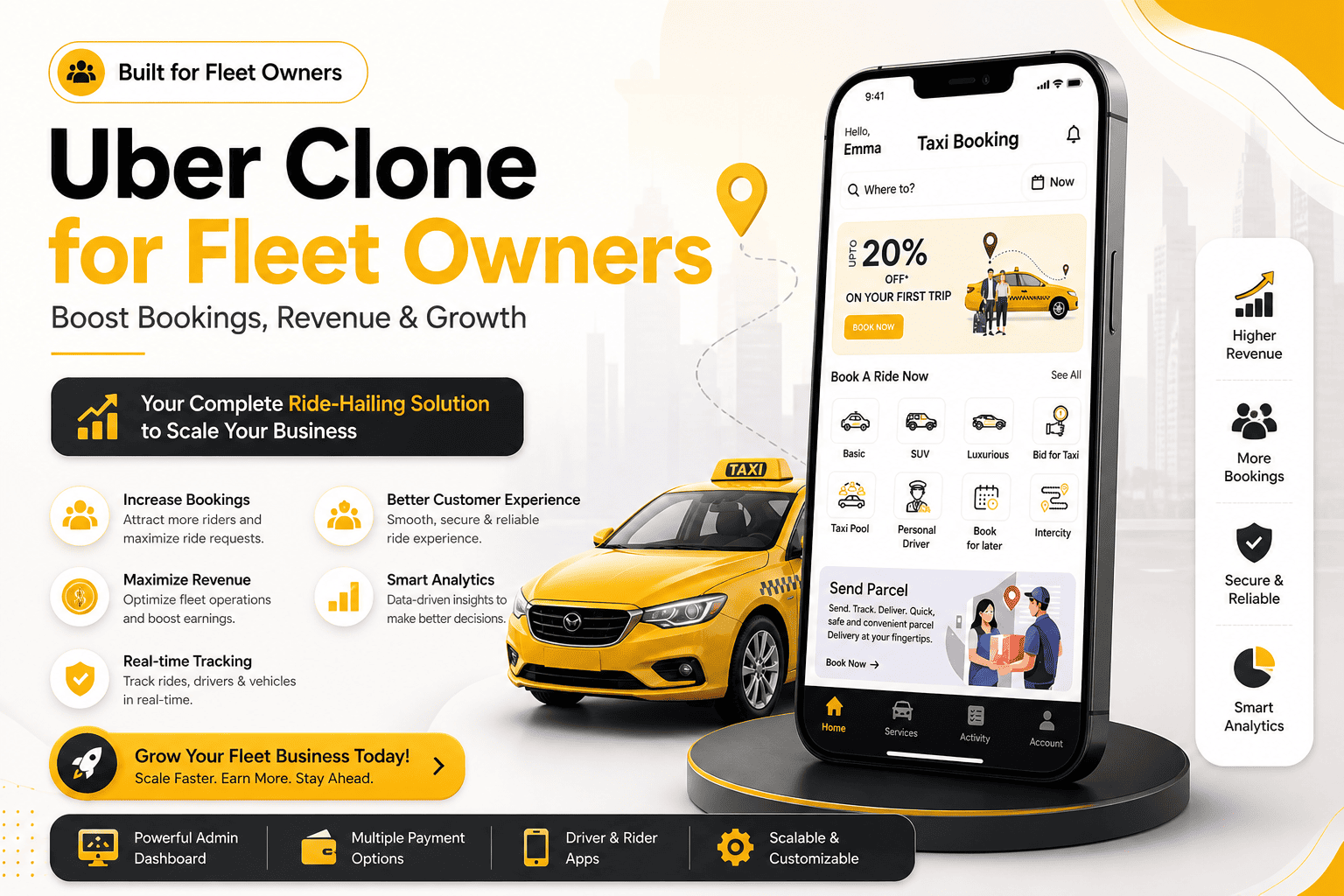
Fleet management companies, honestly, have a problem that is kind of the opposite of what most taxi startups are dealing with. A startup founder is trying to find drivers and build a fleet from scratch or whatever.
A fleet company, generally speaking, already has the cars. They already have drivers on payroll, or pretty close to it. They have the dispatch infrastructure, the insurance relationships, the maintenance schedules and all of that. What they are usually missing is the app layer that connects all of that existing operational capacity to the riders who are actually looking for a cab right now.
That gap, which is actually more of a visibility and booking problem than an operations problem, is roughly what a white-label Uber clone is built to close. And for a fleet company that is already running 50 or 100 vehicles or somewhere around there, the decision to go digital through a white-labeled taxi app rather than building something from scratch is, in most cases, not even a close call.
Why Fleet Companies Are in a Stronger Starting Position Than Most Taxi App Founders Realize
Think about what a brand-new taxi app founder has to do before their first ride gets completed. They have to find drivers, onboard them, verify documents, set commission rates, configure vehicle types, and then also acquire riders at the same time, basically building supply and demand simultaneously from nothing. It is, genuinely speaking, one of the harder cold-start problems in the on-demand business model and lots of early-stage operators get stuck in it for months.
A fleet company skips that entire supply-side problem. The drivers are there. The vehicles are there. The insurance and licensing, in most cases, is already sorted or thereabouts. What remains is the app, the admin panel, the dispatcher tools, the payment integration, and the rider-facing booking experience. That is, honestly, a much narrower gap to close, and a white-labeled Uber clone closes it in approximately 7 to 14 days from purchase.
There is also the question of the fleet company panel specifically, which is a component that most white-labeled Uber clone packages include as a standard feature rather than an add-on or anything like that. The fleet company panel lets the operator manage drivers, vehicles, bookings, and earnings from a dedicated web interface that sits separately from the main admin panel.
For a company running multiple vehicles across multiple zones, that separation matters quite a bit because it means the fleet can operate with a degree of autonomy, which is something flat admin panels from generic taxi software solutions generally do not support very well.
How Fleet Management Companies Can Actually Use an Uber Clone to Scale
Scaling a fleet-based taxi business through a white-labeled Uber clone is, generally speaking, less about adding features and more about using the ones that already exist in a more deliberate way. The following is a look at how each part of the platform tends to get used by fleet operators specifically, which is a somewhat different usage pattern from what a solo entrepreneur might follow.
1. Managing the Fleet Company Panel Separately From the Main Admin
The Taxi Booking App package includes a dedicated Taxi Fleet Company Management Web Panel alongside the main Administrator Web Panel. For a fleet company, this separation is actually more important than it might seem at first. The fleet company panel handles drivers under that company’s umbrella, their vehicles, their bookings, and their earnings, while the admin panel manages the broader platform including rates, promo codes, geofencing, and system-wide settings.
2. Activating Corporate Rides for B2B Revenue
The corporate rides component, which goes by a few different names across platforms but is sometimes called the Organization Web Panel, lets companies register their businesses on the platform and manage employee transportation through a centralized account. Employees book rides through the regular user app, and the fares get charged to the company account rather than the individual rider or anything like that.
3. Using the Manual Dispatcher Panel for Phone-In Bookings
Not every rider books through an app. This is, generally speaking, more true for fleet companies that serve older demographics or markets where app adoption is still, kind of, partial. The manual taxi dispatcher web panel that comes with the Uber clone package allows a dispatcher to manually create a booking, assign a driver, and track the ride through completion, even when the rider never touches the app at all.
4. Setting Dynamic Pricing and Surge Zones From the Admin Panel
Fleet companies that operated before going digital often had flat-rate pricing or zone-based fare tables that did not adjust for demand. The Uber clone admin panel supports dynamic surge pricing, which means fares can automatically adjust upward during peak hours, bad weather, or high-demand events, roughly like how most major ride-hailing platforms handle it.
5. Expanding to Intercity Rides With Existing Long-Distance Drivers
The Uber clone includes an intercity taxi component that allows riders to book long-distance trips between cities, with fares calculated on distance traveled. Fleet companies that already run corporate transfers, airport pickups, or long-distance shuttles have drivers who are, kind of, already doing this work. Formalizing it through the app adds route tracking, digital payment, and booking records to trips that were previously handled off-platform through phone or WhatsApp or something like that.
6. Ride Rental by the Hour for Premium Fleet Segments
For fleet companies operating sedans, SUVs, or any kind of premium vehicle category, the taxi rental component, which allows riders to hire a vehicle with a driver by the hour or by distance, is a genuinely useful revenue stream that standard ride-hailing platforms do not always offer. Tourists, business travelers, and corporate clients who need a driver for a half day or a full day are a specific demand segment that, honestly, most app-first taxi companies underserve or ignore.
What to Confirm Before Purchasing a White-Label Uber Clone for a Fleet Business
Fleet companies buying a white-label Uber clone are, generally speaking, making a slightly different purchase decision than an individual entrepreneur. They need the fleet company panel to work properly. They need the dispatcher panel. They need corporate ride management. These are not optional add-ons for a fleet operation, they are core to how the business actually runs.
The apps are built in native technology, which is to say iOS is built in Swift via Xcode and Android is built in Java via Android Studio, which means performance holds up across device types and both apps go through Google Play Store and Apple App Store (iOS) submission under the operator’s own account without the kind of compatibility issues that cross-platform frameworks sometimes run into.
Final Thoughts
Fleet companies that go live with a white-label Uber clone are, in a practical sense, not launching a startup. They are digitalizing an operation that already exists. The drivers are onboarded faster because they are already employed or contracted. The vehicles are already insured and maintained. The corporate client relationships are already there, more or less. What the platform adds is the booking layer, the payment infrastructure, the reporting, and the rider-facing brand experience.