If we discuss the repercussions of a bad technology stack first, being trapped by a specific provider’s pricing or limitations, a.k.a vendor lock in is the first point.
Then inheriting unpatched security vulnerabilities and a lack of modern features is the second drawback, and inability to connect with third – party tools like payment gateways or customer relationship management is the third potential risk that might occur if you choose an incorrect technology stack.
The right stack provides pre-built components and mature libraries that allow you to reach the app store/play store faster. Choosing a complex native stack for a simple app can double your development time.
Initial app development is only one part of the cost. The total app development cost involves long-term maintenance and updates.
The choice of technology directly affects app speed and responsiveness. Users will abandon the app within seconds if it is sluggish or crashes.
Apps that carry sensitive data (for BFSI sector, healthcare or telemedicine) security is the basis and not just a feature.
Instead of mobile app development trends, rely on your development best practices first
Do you think that restructuring one more app, amidst a gamut of apps would make a difference? Are the features or the pricing you are offering more comprehensive than your counterparts? What are the chances that your app will standout, amongst the apps in the same category, same business niche, same context, similar features?
Use Your Core Value Proposition
These days AI-integrated kernels, edge computing, on-device intelligence, interlinked ecosystems, and hyper-personalization have become mandatory rules that make the software sound effective and highly performant.
Software Development Teams jump on the latest beta framework only to realize mid-project that there is zero community support.
Balance Innovation with Reality
When things break, you want a technology stack that has been through the fire, through the topsy turvy turns, through ups and downs, through several challenges – because then only it will stand the test of time.
You need a balance between groundbreaking performance and mundane reliability. Legacy is good, as it means it works at 3 AM when your traffic spikes and your reputation is on the line.
Native vs. Cross-Platform: A Practical Decision
People love to argue about Native versus Cross-platform like it is a religious war. It is not. It is a budget and performance math problem.
When should a native platform be selected for app development?
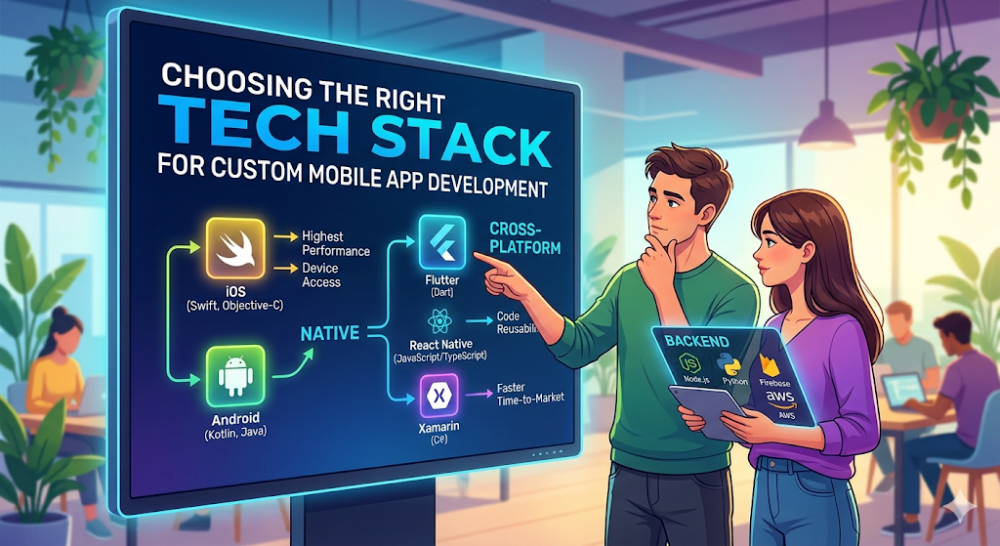
Native (Swift or Objective-C for iOS, and Kotlin or Java for Android) are for high – performance applications that require device specific heavy processing. These applications direct access to the latest hardware sensors and system APIs to ensure responsive user experience, less battery consumption and low memory overhead.
When should cross – platform platform be selected for app development?
Cross-Platform (Flutter framework (Dart programming language), React Native framework (JavaScript/TypeScript scripting languages), .NET MAUI (C# programming language), and Ionic (web technologies)) are used by almost all businesses who wish to mark their presence across all platforms. E.g: An ecommerce business will be available for Android users, iOS users, web users.
For an app built in iOS, instead of iCloud, Firebase and Google Drive will be used. Instead of Apple Pay, Google Pay will be used. ARKit, ArCore will be used. Instead of Face ID, BiometricPrompt API will be used.
The core functionality (Swift/Objective -C) will be translated into Android compatible languages, typically Kotlin or Java.
Human Interface Guidelines will be replaced by (aligned with) Material Design. And the user interface must be redesigned to suit Android’s design, back navigation and device fragmentation.
Besides native and cross platform mobile application technology stacks
You have an option to use Low Code/No Code Platforms that feature rapid development, pre-built components and easy integration with existing business backends. It is best for internal enterprise tools, minimum viable products and quick workflow applications.
Also a technology stack to build a game engine is different than for making a regular app. Engines like Unity, Solar 2D are used to build interactive apps that require complex 2D/3D graphics, deploying to more than 25 platforms from one codebase. These feature high performance graphics, strong AR/VR support and deep platform compatibility.
Technologies and Frameworks to Consider
Flutter (DART language), React Native (JavaScript), Kotlin Multiplatform, .Net MAUI (C#), and Skip Framework are used to transform or reiterate the same functionality across platforms.
Android to iOS Platform
Code written on Android Studio can be rewritten in Xcode or vice versa, with minor changes to images, icon sizes to match Android drawable density system.
iOS to Android Platform
Code developed in the Xcode development environment can be ported to Android Studio or vice versa, with minor adjustments to assets and layout constraints to align with the iOS scaling system.
While both platforms use different primary languages (Swift vs. Kotlin) and User Interface frameworks, the logic often remains similar, though you’ll need to swap iOS Storyboards or SwiftUI views for Android XML layouts or Jetpack Compose.
Future Proofing Your Application – What technology stack to pick for your personalized mobile app?
Choosing a tech stack depends on whether you value high-performance hardware access or faster, cost-effective hybrid development (A.K.A cross platform development)
Native Development
It is device and performance specific, which requires integration with device features (like advanced camera APIs or sensors). Use Swift with SwiftUI for iOS (Xcode) and Kotlin with Jetpack Compose for Android (Android Studio), ideal if your app requires complex animations or heavy processing.
Cross-Platform Frameworks
One code can be used across platforms to save cost and effort of the development team. To build for both iOS and Android simultaneously using a single codebase, choose a Cross-Platform framework. Flutter (using Dart) is highly praised for its UI flexibility, while React Native (using JavaScript) is used for web development.
The Invisible Engine: Backend & Infrastructure
Why Serverless Architecture Matters?
By now, you should not be worrying about managing physical servers. The shift toward decentralized backends and serverless architecture in current times has changed how we think about scale.
Using something like Firebase or AWS Amplify allows your developers to focus on the frontend.
An automatically scalable managed service can now replace a database. So startups do not need to have to build a backend infrastructure from scratch.
Security is a Primary Concern
Simply attaching a login screen with 2-factor authentication, and a user id and password, does not make an app secure. Encryption, and other ways of securing the app must be considered.
Focus on Performance & Responsiveness
Efficient backend design directly impacts Load times, User experience and Retention rates. When you hire a custom mobile app development company, get to know about the security protocols. If they are not able to justify, just get rid of the entire situation. Great apps get pulled from play stores and app stores just because they don’t follow basic privacy regulations. It is heartbreaking to see a year of work vanish because of a lazy API implementation.
Conclusive
So while choosing a technology stack for your mobile application, consider technical factors like security, usability and performance; look for apps with strong data protection, identity management, secure encryption and multi-factor authentication. The app must not have poor navigation or a cluttered design.
By looking at the app you must be able to get answers to all impending queries like the app bulkiness, how it works if multiple users login at the same time, does it break if multiple users order something during festive sale (if applicable), A good app must be visually appealing, user friendly, intuitive, and must not crash.
Determine if you need deep hardware access (GPS, camera, biometrics) or complex animations. High-end graphics favor native, while standard commercial apps (marketplaces, dashboards) thrive on cross-platform. Startups and MVPs typically benefit from cross-platform efficiency to validate ideas quickly. Native development essentially doubles the cost as you manage two separate teams and codebases.
Summing it up, if you are looking to download an app for personal use or you are planning to develop one for your business, check the app for performance, development cost, hardware access and maintenance.
When you select a technology stack, it should be scalable (legacy code can be integrated with new technologies), new features can be added, and any conflict does not occur when it is being expanded according to client needs.
Frequently Asked Questions
1. What is a tech stack in mobile app development?
A tech stack is the combination of programming languages, frameworks, tools, third party API’s, libraries, database, architecture, cloud storage, testing tools, design tools used to build and run a mobile application.
2. Which is better: native or cross-platform development?
It depends on your needs. Native is better for performance-heavy apps, while cross-platform is ideal for faster and cost-effective development.
3. Is Flutter better than React Native?
Both are strong options. Flutter offers better UI consistency, while React Native benefits from a larger JavaScript ecosystem.
4. How important is scalability in choosing a tech stack?
Very important. A scalable stack ensures your app can handle growth without major redevelopment.
5. Can I change my tech stack later?
Yes, but it can be expensive and time-consuming. It’s best to choose wisely from the beginning, using Agile Software Development Approach.