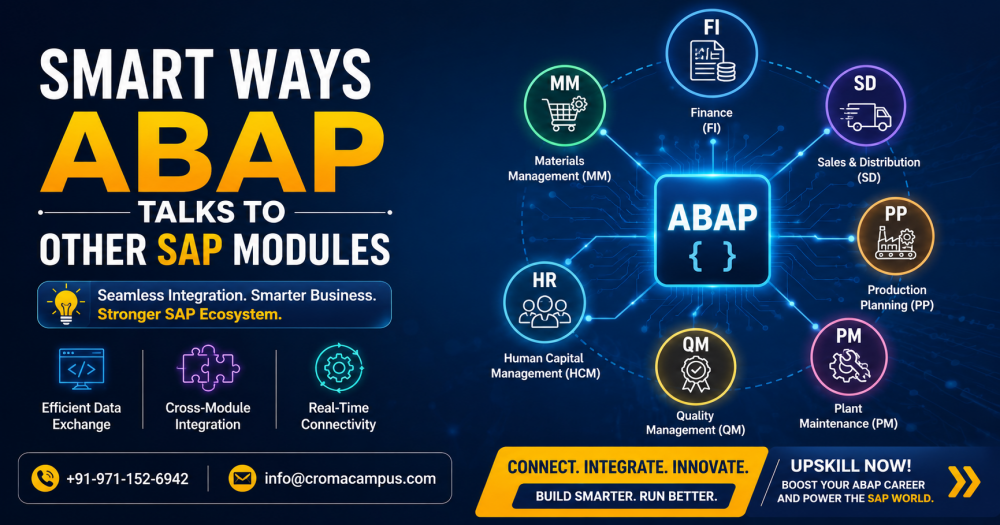
SAP works properly only when all modules keep sharing data with each other. Finance, Sales, Purchase, HR, Inventory, and Production are all connected in the backend. ABAP manages this connection. This is why many students now join a SAP ABAP Online Course to understand how real SAP systems actually work inside companies.
Earlier, many people thought ABAP was only for reports. That is not true anymore. In real projects, ABAP mostly works in the background where modules keep talking to each other. When a sales order is created, stock gets updated.
How ABAP Connects SAP Modules
Every SAP module stores its own data. But business processes need data from different modules together.
ABAP uses different technical objects for this communication.
| Technical Object | Work Done |
| BAPI | Handles standard SAP business processes |
| RFC | Connects one SAP system with another |
| IDoc | Transfers data between systems |
| BADI | Adds company-specific logic |
| CDS View | Creates live reports |
| OData | Connects SAP with apps |
These tools help SAP systems exchange data safely and quickly.
Why Are BAPIs Important?
BAPIs are extensively used in SAP projects. They are popular among developers because they comply with SAP standards. The risk associated with direct table update prevents the companies from opting for an alternative to BAPIs.
Some uses of BAPIs are as follows:
- Creation of purchase orders
- Invoicing
- Customer updates
- Vendor management
- Sales order processing
A professional ABAP developer should always check whether any standard BAPI exists before developing any custom BAPI.
This point is adequately covered in SAP ABAP Training.
How FI and MM Work Together?
Finance and Materials Management are deeply connected in SAP. Even a small inventory movement affects finance data.
When goods receipt happens in MM:
- Stock quantity increases
- Material document gets created
- Accounting document gets posted
- Tax values update
- Vendor balance changes
ABAP checks every condition before saving data.
Some important tables used here are:
- MKPF
- MSEG
- BKPF
- BSEG
If any issue appears, ABAP stops the process immediately. This helps companies avoid wrong accounting entries.
This backend process is one reason many professionals prepare for SAP ABAP Certification because companies expect developers to understand these integrations properly.
How IDocs Help in Data Transfer?
IDocs are used when SAP sends or receives data from other systems. Many people think IDocs are only simple transfer files, but they actually handle large business communication processes.
ABAP controls:
- Data mapping
- Segment handling
- Error checking
- Status updates
- Reprocessing
One good thing about IDocs is background processing. Users do not need to wait for the transfer to finish.
For example, SAP can send delivery data to a warehouse system while users continue working normally.
This reduces system load and improves performance.
Enhancements in Real Projects
Almost every company wants some custom business logic inside SAP. This is where enhancements are used.
Common enhancement methods are:
- User Exits
- BADIs
- Enhancement Spots
- Implicit Enhancements
These methods help developers add logic safely without changing SAP standard code. Advanced topics like these are now included in many SAP ABAP Online Course programs because they are used daily in live projects.
CDS Views in Modern SAP
Older SAP reports were slow because they pulled data from many tables separately. CDS Views made reporting much faster.
CDS Views combine data from different modules together.
For example:
- Finance values from FI
- Stock details from MM
- Billing data from SD
- Production details from PP
Everything appears together in one report.
APIs and OData Services
SAP systems now connect with mobile apps and web portals. ABAP developers create APIs and OData services for this communication.
These services help apps fetch live SAP data.
For example:
- Inventory apps check stock
- Sales apps check customer details
- Finance apps check approvals
- HR apps process leave requests
ABAP handles the backend processing while users work through simple screens.
Because of cloud and Fiori applications, this area has become very important now.
Many learners preparing for SAP ABAP Certification study API development because modern SAP projects use it heavily.
Practical SAP Learning
Today companies expect more than basic ABAP coding. Developers should understand complete business flow between modules.
Important areas include:
- Debugging
- Integration logic
- Enhancements
- APIs
- CDS Views
- Performance handling
- Error fixing
Freshers who only know syntax usually struggle during support projects.
Because of growing enterprise projects, SAP ABAP Training in Noida now focuses more on practical backend scenarios instead of only classroom practice.
Training environments often include live integration between FI, MM, SD, and HR modules so learners can understand real system behavior.
Sum up,
ABAP has evolved to be far more extensive than just report development. ABAP governs the communication between different modules of SAP software and coordinates many business functions in the backend. This ranges from financial entries to inventories, everything that needs to be done gets handled through ABAP. Today’s advanced SAP systems depend largely on APIs, CDS views, enhancements, and real-time integration.