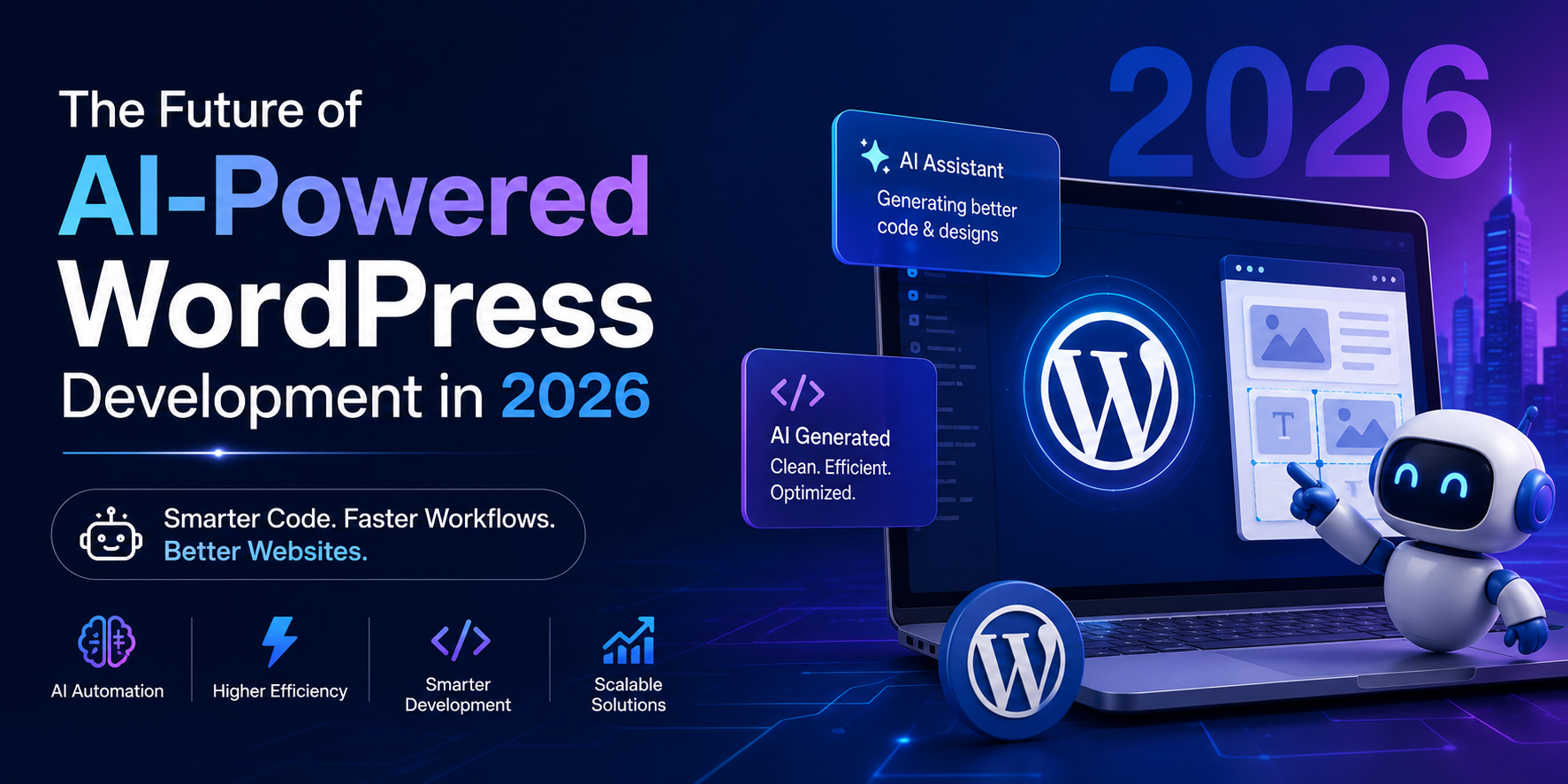
WordPress powers every kind of website globally. From blogs and other personal websites to commercial and enterprise eCommerce websites and membership sites, WordPress can be utilized
In 2026, WordPress development entered a new, rapidly changing phase because of the rapid advancement of AI and automation. This new phase impacts the developer’s workflows, how users interact with the site and what they expect, the way businesses operate, how SEO is conducted, and new standards for website performance.
The current offerings in the ecosystem with AI capabilities can be summarized in the following areas:
1. Code with AI
2. Content with AI
3. AI Security
4. UX with AI
5. Personalization
6. SEO with AI
7. AI Design
8. AI in eCommerce
The blog explains the WordPress development landscape as influenced by rapidly changing automation tools for WordPress, why businesses must change and adapt to remain competitive, the new development frameworks, challenges, and opportunities for the changing automation landscape in 2026.
The Evolution of WordPress into an AI-Driven Ecosystem
WordPress began with a blog focus. From the early days of a simple blog tool, WordPress is now a complex system for building all manner of sites as a complete website development ecosystem.
In the past, WordPress development involved:
1. Writing code
2. Style (theme) customizations
3. Plugin configurations
4. Database settings
5. SEO
6. Security
7. Performance
Developers spend a lot of time doing repetitive tasks.
As automation tools integrate with AI, efficiency in the workplace is strengthened, WordPress, in 2026, is continuously moving toward becoming more intelligent, more predictable, and more automation-oriented.
The Demand for AI Automation in WordPress is Increasing
AI is undeniably embedded within the digital worlds of us all.
Consumers, working within the WordPress site builder, have targeted 6 primary needs;
- Instant loading speeds
- Personalized experiences
- Intelligent recommendations
- Interactive interfaces
- Voice-friendly navigation
- AI-powered support
And there is a growing need for each of these to be met without a manual solution.
Automation of AI is the primary factor when adapting to these needs.
With an increase in content demands, businesses can use AI to automate the five key components of content operations:
- Content generation
- SEO optimization
- Image creation
- Metadata management
- Content scheduling
And quickly grow their business.
At the moment, competition is extremely aggressive between commercial websites trying to convert users and gain visibility.
AI can facilitate each of the five essential components to create a competitive market.
- Search rankings
- User engagement
- Conversion optimization
- Personalization
- Customer retention
And automation will uphold their competitive edge.
AI Enhanced Creation and Development of Websites
The most drastic change to WordPress development is of an AI powered site builder.
With data, these tools can design the core building blocks of a site. It then can rapidly generate a site with optimization.
With AI, front-end development can occur at an extremely accelerated pace. Development that previously took days, can be done in a matter of hours.
A variety of development tools are available that help developers to focus less on repetitive tasks. Instead, tools help developers to focus on strategically important tasks that involve greater creativity.
AI in WordPress Theme Development
With the core of WordPress development being custom themes, Artificial Intelligence tools are transforming the traditional methods of building such themes.
Improving the accuracy and speed of building apps, this programming assistant is equipped with intelligent code assistance, and designed to help developers.
To provide exceptional user experience, this adaptive design system AI intelligently estimates the themes and the sizes of the interfaces to match the boundaries of the frameworks.
AI-Driven UX, Personalization, and Conversion Optimization
With 2026 on the horizon, AI-driven user experience and personalization are now among the key elements that shape the rankings and conversions of most WordPress sites.
The new technology of dynamic personalized content provides users with the ability to customize content, and use five core types of user attribute data, which can significantly improve engagement and retention.
AI-enabled Predictive User Journeys can offer satisfaction to users by utilizing personalized CTAs in addition to predicting user behavior and covering a range of implementation scenarios on a website.
Outlined in this paper are four types of customer services that can be provided by chatbots and virtual assistants to WordPress sites.
AI and the Future of SEO in WordPress
2026 will usher in a new era of AI technology that will likely reform the entire global SEO industry.
In the context of the industry, the majority of search engines are used to assess the level of a site and are built on machine learning, which means that WordPress developers are improving their use of AI SEO tools.
Our AI tool automates keyword optimization by incorporating intent analysis, keyword targeting, and title optimization. This automation allows websites to improve their search rankings with ease.
Modern SEO tools use AI to evaluate content along five essential dimensions. Their influence on content quality is considerable, improving much more than keyword insertion.
Predictive SEO can outline four categories of potential processes and enable proactive search engine optimization to plan.
By 2026, the rapid growth of voice search will continue, and WordPress will implement voice search automation with AI.
AI in WordPress Security and Cyber Protection
Year-on-year, cybersecurity threats keep increasing.
Because of their high traffic and usage, WordPress websites are the favorite of cyberattacks, and AI-powered security systems can offer preemptive defense.
AI-focused intelligent threat detection creates advanced capabilities in four categories of cybersecurity threats, a response speed that surpasses traditional manual coverage controls.
The AI-based vulnerability scanning system presented in this paper allows scanning of four categories of network assets, providing a great reduction in security threats.
AI in WordPress E-Commerce and WooCommerce
E-commerce is one of the leading sectors taking advantage of AI automation in current global commerce.
The majority of mainstream WordPress online stores using the WooCommerce extension now offer five categories of advanced and widely used AI features.
The application of AI virtual shopping with browsing recommendations and intelligent upselling results in improved conversion rates of online stores.
Today, e-commerce consumers demand product and shopping experience personalization.
Vendors executing PrestaShop customization tactics have recorded higher customer satisfaction and user engagement levels. Additionally, WordPress developers have implemented AI-based customizations in their system using WooCommerce and integrating headless commerce.
AI in Content Creation and Optimization
Content is the building block of any major website construction platform, including WordPress, and the integration of AI tools is transforming how such platforms manage and create content.
AI writing tools, for example, can assist in drafting blogs and product descriptions, thus aiding in faster content generation.
Tools related to Smart Content Scheduling analyze user behavior to determine the most optimal content posting times, and, in turn, improve rates of engagement, traffic, and reach across social platforms.
According to the specific needs of an image, automated image optimization can balance alt text generation, image dimensions, and loading speed, as well as improve page performance and SEO.
AI for Performance Optimization in WordPress
The speed and efficiency of WordPress sites impact user retention and search rankings, and AI has the potential to improve both.
AI-based Intelligent Caching Systems can adapt to user behavior and traffic patterns.
The database optimization module provides an AI-based automatic cleaning and optimization service that improves the load performance of the database.
Smart Resource Management improves Core Web Vitals while optimizing resource allocation for non-essential activities.
Challenges and Risks of AI in WordPress Development
While AI may ease WordPress development, a myriad of constraints continue to persist.
An over reliance on AI would limit human creativity and will remain an irreplaceable factor.
Many companies utilizing AI to create websites may find their websites all look the same due to template based designs. Therefore companies need to create their own unique websites and branding.
Today’s leading AI technology poses four primary categories of ethical risks, and it is the responsibility of the developer to ensure that all relevant ethical safeguards are built into it.
The more data AI systems use, the more advanced and complex they become, and addressing security and compliance becomes a prerequisite for any of the associated tasks.
Human vs AI in WordPress Development.
The belief that AI will completely take over the role of a WordPress Developer is misplaced.
The role of a WordPress Developer is changing and evolving, with a greater emphasis on six critical areas, including strategic design, and human creativity and problem-solving will always be mandatory.
AI is definitely better in process automation and optimization, but creativity is something that AI will never reach.
To design a successful WordPress project, strategic thinking and emotional empathy, among other things, are essential.
The best results will only be obtained by leveraging the strengths of both humans and machines.
Headless WordPress and Modern Architecture
By 2026, headless WordPress architecture was advancing rapidly.
Offering a frontend and backend separation design, it has four major benefits and allows for easy connection with virtually all types of AI.
AI’s Impact on Freelancers and Agencies
In the area of WordPress Development, AI will change the business models of both freelancers and agencies.
Productivity indicators: AI aids individual freelancers in working more efficiently and allows for the more rapid scaling of agencies.
Changes to pricing structures, combined with automation speeding up the development of tools, have necessitated service companies to cease offering services at an hourly rate, to focus instead on providing high-value strategic services.
The rapid integration of AI into services has resulted in the democratization of development across the entire industry, increasing competition in the sector, and creating a premium on specialized professional skills.
The Future of AI-Driven WordPress
The convergence of a few key trends will shape the future of AI-enhanced WordPress development post-2026.
Automation of website management by AI will successfully carry out five core functions of website management with little to no human involvement.
Websites of the future will utilize AI to build interactivity and personalization to dynamically change preferences in real-time.
In the realm of Human-Computer Interaction, intelligent user interfaces integrated with Advanced Emotion AI will enable future user experience to be driven by user emotion and user engagement.
We believe WordPress’ voice-first approach will gain two enhancements: the integration of voice-based systems and the further development of AI guided conversational systems.
Responsible Integration of AI in WordPress
WordPress service providers must integrate AI into their processes with a high degree of discernment, and must not lose their business judgment to a mindless process of automation.
AI must exist to assist: humans will maintain the superior role in the workplace.
The focus must be on the end user: ensure a non-automated and user-friendly experience.
Creative work should prioritize ingenuity over reliance on AI templates, in order to build a brand with integrity and longevity.
Evaluation parameters for AI systems should be continuously tested over 4 core dimensions.
Maintain ethics and transparency. Currently, users infest AI data with greater importance.
Conclusion
WordPress development in 2026 will be integrated with AI tools.
The complete automation of coding, design, SEO, security, personalization, and performance will add significant value to developers and businesses through efficiency, capacity, and experience.
There is a need to change the misconception of “AI replacing humans”.
Emotional story telling, design, strategic thinking, brand building, and user-centered design cannot be done by machines.
These include the SEO, personalized e-commerce systems based on the customization of PrestaShop products, and intelligent content systems.
Only when AI automation is combined with the sensible human oversight of AI, will organizations be able to gain a competitive advantage in the marketplace.