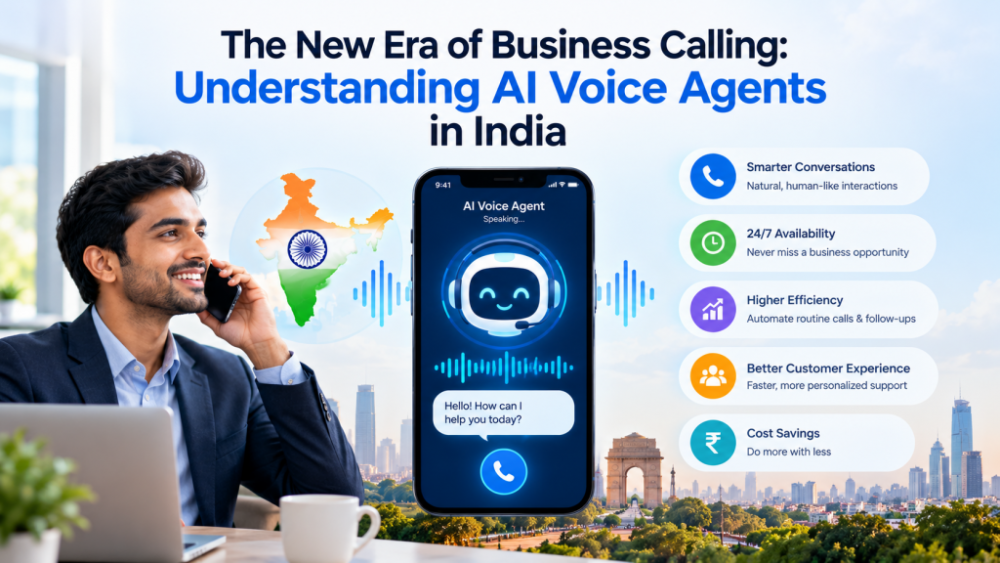
Every Indian business runs on phone calls. Sales teams dial leads from morning until evening. Customer service queues build up. Collection agents work through lists that never seem to shrink. Healthcare front desks field the same appointment questions on loop. The phone is not going away — but the human capacity to handle the volume it demands has a hard ceiling. AI voice agents in India provide an edge: they answer calls, respond to queries, follow up on past conversations, and take action during and after a call independently. Here, we’ve covered what AI voice agents are, what they mean for Indian businesses, and all the prerequisites you should know before adopting one for your business.
What is an AI Voice Agent?
An AI voice agent refers to a voice software that operates autonomously and takes care of telephony interactions — answering calls and executing actions as per the caller’s intent. It does not rely on a rigid menu or a predetermined script to function. It rather lets the conversation progress naturally and responds accordingly.
The phone continues to be the most common form of communication between customers and Indian companies because of convenience, immediacy, and the preference for voice over text in matters that carry significant weight. What has altered is the volume of such calls, which often surpasses the capacity of a fixed-shift team to handle. Missed calls are recorded instead of letting slip away. The reminder that did not go out because the morning was too busy. These are not exceptional failures — they are the predictable result of matching a limited-hours resource against a round-the-clock demand.
How AI Voice Agents Differ from IVR Systems
IVR has been the default automated call layer in Indian businesses for two decades. Callers are now familiar with how the IVR technology works: you listen to the recorded message that presents a list of choices, press one of the choices using the telephone keypad, and the call is routed as per the configuration of the system. This technology works fine as long as the caller doesn’t have a query that is not included in the list of choices. It cannot process speech, cannot access a business system, and cannot do anything except loop back to the menu or drop the call into a queue.
An AI voice agent starts where IVR stops. The caller describes what they need — in a sentence, in a question, in whatever way they naturally phrase it — and the AI calling agent works out what they mean and what to do about it. It allows the conversation to progress naturally. The AI voice agent seeks information in case of validation or missing details. When it needs to check something in a connected system, it does so during the call. The caller experiences a conversation. The business gets the outcome without a human agent being involved.
What Can an AI Voice Agent Do for Indian Businesses?
Lead qualification
An enquiry requires prompt attention as well as some essential questions that will determine the course of action. The voice agent contacts the lead and understands their needs. It then records their interests and requirements and forwards this information for follow up later.
Pre-screening and data collection
The questions asked in most processes are essentially similar initially — validating details, testing suitability, or understanding a requirement. The voice agent asks all these questions and records the answers. This recorded information is later reviewed by the team, and subsequent actions are taken care of.
Reminders and follow-up automation
A reminder process that depends on staff availability is a reminder process that fails on busy days. When skipped, no-shows increase. A voice AI solution makes it non-negotiable. Every booked appointment gets a call and later a follow-up. Every caller who needs to reschedule does so in the same interaction. The system records what happened without anyone on the front desk manually updating anything.
Customer service and query handling
High-volume customer service operations spend a disproportionate share of agent time on calls that ask the same questions. Account status, order updates, policy details, branch information — these are calls where the answer is in a system, and the agent’s role is to retrieve and communicate it. A voice agent does that directly. Human reps handle the calls where their judgment, empathy, or authority to make an exception is what the caller actually needs.
Multilingual requirement
Multilingual ability is a strong requirement for voice services in India. In the case of an AI voice agent in India, switching languages within a sentence is treated as usual. Regional languages like Tamil, Marathi, Bengali, Kannada, and Telugu need geographical awareness as well as different accents from Tiers 1, 2, and 3.
What is the Cost of Owning an AI Voice Agent for Indian Businesses?
Consumption-based pricing
Most of the voice AI offerings are priced on a per-minute basis for calls managed by the system. Typical pricing in India is in the range of ₹0.50 to ₹3 per minute based on the complexity of language, integration needs, etc. Midmarket offerings will be priced higher at ₹8 per minute.
Platform or subscription fee
Most enterprise implementations have a monthly platform fee charged for the dashboard, analytics, and system integrations. These fees or subscriptions are generally in the range of ₹15,000 to ₹1,50,000 per month.
Setup and integration costs
Connecting the voice agent to existing business systems is a one-time project cost ranging from ₹50,000 to ₹5,00,000 depending on the number of systems and complexity involved.
Voice automation delivers its clearest ROI where call volume is high, the conversation follows a defined structure, and a human agent handling the same calls costs ₹15,000 to ₹25,000 per month — working eight hours a day while the voice agent runs around the clock.
What Should Indian Businesses Look for Before Choosing an AI Voice Agent?
Language and dialect support – Make sure you get a live demo of your required languages and code-switching ability of the voice agent. Ask about accuracy statistics for Indian English and Indian languages.
Integration possibilities – Verify which business systems integration is available out-of-the-box, which needs to be developed, and what kind of security architecture it uses when your customer data is accessed in real-time by the agent.
TRAI – Transactional and promotional calls are treated differently in India. The former do not need any permission from the callers. However, the latter can be made only if there is an explicit consent. Any AI voice platform that cannot give a clear answer on how they manage consents and classify calls is a red flag.
Latency and call quality – Find out how the vendor deals with inference latency under Indian network circumstances. Request a live call test on a standard Indian mobile network, not a fiber-connected demo environment.
Escalation management – The way in which the agent understands that it can’t resolve the call, the way it escalates the call to a human, and the data that is transferred at the point of the handoff is the most important feature from a caller experience perspective.
Reporting and analytics – The voice AI solution must provide visibility on completion rates, intent recognition accuracy, reasons for escalations, and conversion success rate. If not, there’s no way to optimize after implementation.
Conclusion
AI voice agents in India are running in production across financial services, healthcare, real estate, and customer service — handling call volumes human teams could not manage at the same speed or cost. The multilingual complexity of Indian business communication was the barrier that slowed adoption. This gap has been greatly narrowed with the advent of AI voice technology designed for Indian voices. The companies that gain the most from it define the use case, then analyze the technology, check for TRAI compliance prior to the first outbound call, and test the language abilities under real-world conditions.