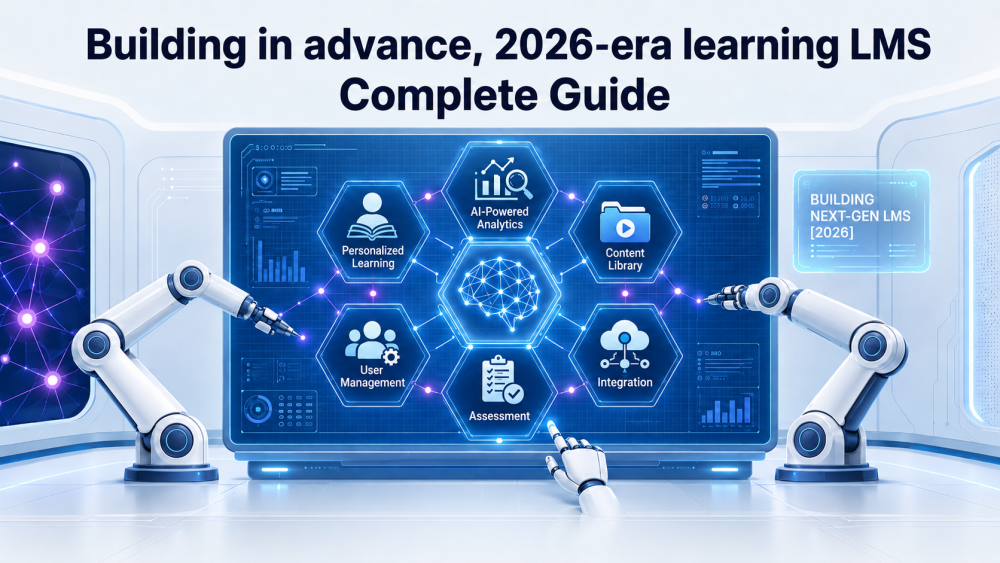
Building a Learning Management System (LMS) in 2026 usually costs between $40,000 and $250,000+, depending on features, integrations, AI capabilities, and compliance requirements. Modern LMS platforms support video learning, progress tracking, mobile access, analytics, and third-party integrations. Most companies launch an MVP first to validate demand before scaling the platform.
Online education continues to expand across corporate training, universities, certification programs, and private coaching businesses. Companies invest in digital learning tools to reduce training costs, improve onboarding, and support remote learning at scale. Educational startups also compete to deliver more personalized and interactive learning experiences.
Businesses that need scalable educational platforms often partner with vendors specializing in e learning software development services to create custom ecosystems tailored to their workflows, learners, and long-term business goals.
This guide explains how to build a Learning Management System in 2026, what features matter most, how much development costs, and which technical decisions affect long-term scalability.
What Is a Learning Management System?
A Learning Management System (LMS) is used by many organizations to develop, deliver, administer, and track the usage and effectiveness of educational content. From a centralized location, users can enroll in a course, complete an assignment, track their progress, communicate with teachers or tutors, and receive certificates of completion.
LMS products can support several different types of learning. For example, universities use LMSs to deliver online courses. Businesses use LMSs for new employee orientation and internal corporate training. In addition, health-related organizations use LMS products for compliance training and certification programs. Coaching and training companies, as well as EdTech startups, are increasingly investing in their own digital learning ecosystems.
Some of the more well-known LMS products are Moodle, Blackboard, TalentLMS, Coursera, and Canvas; however, many organizations are now developing their own custom LMS products because they often limit branding, scalability, integration with other systems, and flexibility in workflows.
Why Businesses Build Custom LMS Platforms
There is a growing need for digital solutions because of the growing requirement of organizations for scalable and affordable ways to educate their employees, customers, and students. The main driver behind companies using learning management systems (LMS) is corporate training, where companies want tools that help them with automated onboarding, decreases human resource involvement, and provides a consistent learning experience for employees who are working in different places.
Many educational institutions are still developing and expanding their online learning programs and feel that their students expect mobile access to their materials, along with more interactive lessons with personalized learning experiences.
The additional value of custom-built LMS development for an organization provides greater user control over the functionality, integrations, monetization models, and data ownership of their LMS. This allows a company to create a learning environment specifically designed for its audience as opposed to conforming to the standard workflow of third-party systems.
Another important factor in LMS products is the ability to track learner engagement (when someone has completed a task), as well as certification progress, assessment scores, and completion rate in real-time.
What Features Should a Modern LMS Include?
Feature sets have a profound impact on the development costs of LMS as well as on their long-term potential as competitive platforms.
When you think about student expectations and needs (e.g., ease of use) in an LMS, almost all LMS products provide multiple ways to meet students’ needs by providing personal dashboards, catalogs of courses, videos, quizzes, progress tracking, updates/alerts/notifications, certificates of completion, and mobile access to course material.
Gamification is going to continue to grow in importance over the next five years (i.e., until 2026). At this point in time, a large number of LMS products use the concept of gamification to encourage more students to stay engaged with their courses (and with the LMS) by using things like: progress streaks/badges/points/leaderboards to promote retention/engagement with the course material.
Instructors also need tools that help them manage and communicate with their students. As such, most LMS products are equipped with course-building tools, scheduling/reasoning tools, analytics/dashboard tools, assignment management tools, and evaluation/assessment tools.
For administrators, most LMS can provide functionality related to user management, payment processing, analytics, security settings, content moderation, and integration.
In addition to the functions built into the LMS, many organizations choose to integrate third-party systems (e.g., CRM, ERP, HR software, payment gateways, and communication tools) directly into their LMS architecture.
What Technologies Are Used to Build an LMS?
The selection of technology has an impact on performance, scalability, maintenance costs, and platform stability.
Many current LMSs are using cloud native architecture as this allows for flexible scaling ability and global accessibility of services. In addition, cloud-based deployment provides greater reliability of services and simplifies infrastructure management.
The use of frameworks such as ReactJS, AngularJS or VueJS has become common practice for building responsive and interactive front-end interfaces. Back-end systems regularly use Node.js, Python, Java or .NET to deliver business logic, APIs, authenticate users and provide analytics.
Databases often combine relational databases like PostgreSQL or MySQL with cloud storage solutions to manage large volumes of educational material and user activity.
The emergence of video streaming and Communication tools are also important aspects of online education. Many LMS platforms leverage solutions from Zoom, Twilio, WebRTC or Vimeo to support lesson delivery via live video or multimedia.
Mobile learning continues to be a driven by users accessing educational content from their mobile devices. As such, most Organizations are creating stand-alone iOS and Android applications to complement existing web-based Learning Management Systems.
How Much Does LMS Development Cost in 2026?
The complexity of features, types of integrations, regulatory guidelines, AI capabilities, and the size of the development team will all contribute to the overall cost of developing an LMS (Learning Management System).
Basic MVP LMS’s typically cost between $40,000 and $70,000. They have limited functionality and typically contain user registration functionality, course management, tracking learner progress, providing payment functionality, and providing basic analytics.
Mid-range LMS platforms typically cost between $80,000 and $150,000 and provide alternative visualisations (dashboards), more advanced integrations, gamification elements in the learning process, and mobile app development.
Enterprise grade LMS systems capable of providing AI driven personalisation, advanced analytics, real-time communication with learners, and highly complex systems integration can be expected to exceed $250,000 as an investment.
The above listed items can significantly increase the cost of developing an LMS. These items include; artificial intelligence, multi-language support for users, integration into an enterprise system, video streaming infrastructure, compliance requirements, and advanced user security systems.
The duration of developing an LMS can vary, usually between four months and twelve months depending on the scope and size of the development effort and number of people who are involved in developing it.
What Are the Main Steps of LMS Development?
With successful LMS projects being developed in a structured way; business analysis and audience research are the first elements of the development process. Through this first step, the Product Team will define the user roles, learning models, monetization strategies, integration requirements, and compliance needs of the user base for the LMS platform.
When MVP planning, many companies will fail as they try to release too many features at once with no real way to know whether there is enough demand to support an LMS. Companies that do create concise MVPs have the ability to validate demand in a shorter time period, as well as mitigate their development risks.
UX and UI design will be significantly important for education platforms. When users experience poor usability, it will negatively impact engagement and course completion rates for learners. Thus, designers have created intuitive user flows, wireframes, and responsive interfaces that have been designed to function optimally on both desktop and mobile devices.
Backend engineers will build all APIs, databases, security infrastructure, and integration layers. The Frontend Teams will develop the dashboards, course interfaces, communication systems, and analytics modules.
Before deploying the LMS, QA engineers will test platform performance, responsiveness, payment functionality, scalability, and cybersecurity protections.
Once deployed, companies will continue to improve their LMS based on analytics, learner feedback, and changes to the way the company operates.
Why AI Matters in LMS Development
AI has become a significant contributor to educational technology today.
Most learning management systems (LMS) utilize AI functionality to customize learning paths for learners based on their behavior and results. Using AI, these systems can recommend courses, create quizzes, provide automated feedback and/or estimate the likelihood of continued learner engagement.
Chatbot technology, in combination with virtual assistant capabilities can also enhance the support available for learners by being able to respond to many of the most frequently asked learner questions in real-time.
Some other educational organizations use AI-powered analytical tools to discover learner knowledge gaps and improve training methodologies.
Over time, these tools will become an expectation for learners rather than a source of competitive advantage for companies using them.
What Compliance Requirements Should LMS Platforms Follow?
In the corporate training and education sectors, compliance is of utmost importance.
Companies in Europe must adhere to GDPR to ensure the security of personal information and user data. U.S. educational institutions are generally governed by FERPA when handling student information.
Organizations that utilize an LMS to conduct education or training may need to adhere to HIPAA when conducting education/training regarding medical issues or patients.
In addition, the accessibility of content to users is a major consideration for the majority of modern platforms, (WCAG) Accessibility Guidelines for Content is commonly used to assist in meeting these requirements.
The security of the infrastructure on which the LMS platform is built is a major concern as well because the LMS stores sensitive information such as username and password, credit card information, training completion certificates, proprietary files, etc.
Most organisations implement security measures such as encrypting storage locations, implementing role-based access controls, maintaining audit logs, using multi-factor Authentication, and utilizing a secure cloud infrastructure to reduce cybersecurity threats.
What Challenges Arise During LMS Development?
There are several difficulties that arise when developing LMS solutions. One of the biggest issues arises due to rapidly increased usage of an LMS. With insufficient or poorly planned infrastructure, educational products can experience serious performance issues when thousands of students try to access a course at the same time without any performance issues.
Another major challenge created by user engagement has to do with low course completion rates for many online learning platforms. This can be caused by a variety of reasons like poor user experience design, lack of personalization/individualization in the curriculum/program delivery, lack of interactive materials or media, or inflexible/overly static content.
Many companies face an additional issue in creating their LMS solution because they need to integrate their LMS solution with other systems within their organization or with other third-party services. In order to accomplish this integration, many companies will need to integrate with their company CRM, HR system, ERP solution, analytics tool, and/or payment processor.
Another challenge that may arise as a company continues to build out its educational ecosystem is the management of content within the organization’s LMS solution. Delivering educational materials in a wide variety of formats (classroom instruction, online instruction, blended instruction, live, instructor-led instruction, etc.), different types of learning credentials (certificates vs. degrees vs. endorsements, etc.), and languages requires both a scalable architecture and strong administrative controls.
An experienced LMS development team decreases your risk by using an iterative delivery process, using cloud-based infrastructure, conducting multiple testing efforts during the development process, and establishing an overall architecture before beginning the LMS solution development process.
LMS Trends That Will Shape 2026
As we enter 2026, many trends continue to affect digital learning platforms and redefine how they deliver education. Microlearning is still very much in demand because of its short and precise modules that support learner engagement and retention. Corporations often choose to create shorter, more focused tutorial sessions for their training rather than lengthy training programs.
Social Learning continues to grow in popularity and improve learner engagement and retention using social learning technologies like discussion forums, peer collaboration, live communities, and mentoring systems.
Educational products will continue to contain AI-enabled personalisation, and businesses will increasingly ask for adaptive learning programmes based on the actions of individual users.
An additional trend that is becoming more popular is the rapid adoption of immersive learning technology such as augmented reality (AR) and virtual reality (VR) simulations in various industries, including healthcare, manufacturing, engineering, and technical training.
Also, within the context of remote and hybrid education becoming more common, mobile-first education will continue to take precedence.
Final Thoughts
To create a Learning Management System (LMS) in 2026, you need much more than just uploading video lessons and quizzes. Companies now compete for learner engagement, personalized experiences, scalability, analytics, and overall user experience.
Typically, companies that create LMS products use a strategic approach, beginning with a focused Minimum Viable Product (MVP), validating user behavior, and increasing functionality over time. The foundation of the LMS consists of strong architecture (back-end), user-friendly experience (front-end), reliable infrastructure (cloud or on-premises), and seamless integration with other systems. These foundational components will help your LMS become a significant business asset over the long term.
Digital education is growing rapidly in corporate training, universities, hospitals, and the private learning sector. Companies that invest in the development of scalable digital education ecosystems today will set themselves up for long-term growth in an increasingly competitive digital landscape.