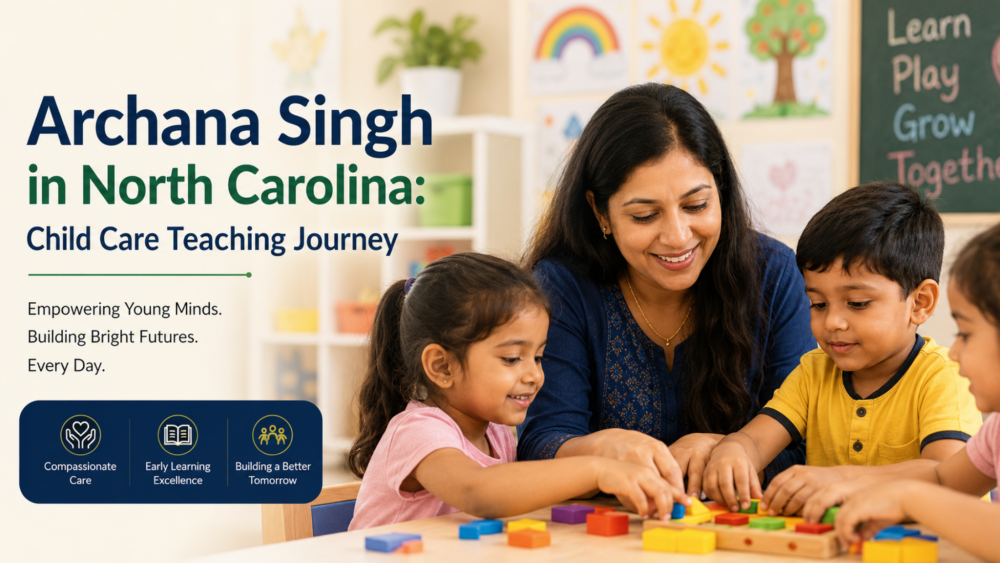
People don’t talk enough about how much work goes into early childhood education. It’s one of those fields that looks simple from the outside but is genuinely exhausting and meaningful at the same time. Archana Singh, based in North Carolina, has spent time building her presence around exactly this kind of work — child care, learning environments, and the quiet but important job of helping young kids actually grow into themselves.
Anyone who has spent real time around toddlers or preschoolers knows the job isn’t just supervision. You’re building routines and holding them together even when the kids don’t want to cooperate. You’re watching for the child who’s been quiet all morning and figuring out if something’s wrong. You’re redirecting behavior without shutting down curiosity, which is honestly harder than it sounds. Teachers who do this well are usually people who genuinely like children — not in a vague abstract way, but in the real, patient, occasionally chaotic way the job actually demands.
The Importance of Early Childhood Education
The early years of a child’s life are when so much gets set in motion. Language, social instincts, how a kid responds when something doesn’t go their way, a lot of that is being shaped in real time, and the adults around children during this period matter more than most people realize. Good early childhood educators understand this even if they couldn’t always articulate it formally. They know that a storytelling session isn’t just killing time, it’s building vocabulary and the ability to follow a narrative. Group activities are practicing social skills. Art isn’t decorative, it’s developing fine motor control and a sense of creative confidence that kids carry with them.
There’s also a communication piece that happens between teachers and families. A child whose teacher and parents are actually on the same page tends to do better than one where school and home feel disconnected. Many early childhood professionals invest real effort in keeping that relationship going, sharing updates, flagging small concerns before they become bigger ones, and making sure what’s being worked on in the classroom gets reinforced at home.
Building a Positive Learning Environment
Creating a good classroom environment for young children comes down to a few things that sound simple but require consistency to pull off. Patience, obviously. An ability to read a room full of small humans and adjust. Keeping structure without making everything rigid. Children at this age need predictability, it’s how they feel safe enough to actually try things and take small risks in learning.
Archana Singh’s professional interests in this area are reflected in her online presence across platforms like PitchWall, where educators and professionals share their backgrounds and areas of focus.
Child Care Teaching in North Carolina
North Carolina has a reasonably strong ecosystem of early childhood programs daycare centers, pre-K offerings, community-based learning, and the people working within it tend to bring a lot of variety in background and approach. The common thread among effective teachers isn’t a single method. It’s flexibility. The willingness to try something differently when a kid isn’t getting it. Getting down on the floor. Slowing a lesson down when the group clearly isn’t ready. Those adjustments aren’t failures, they’re actually what good teaching looks like.
The Role of Communication in Child Development
Something that comes up constantly in early childhood work is how central communication development is to everything else a child does. Kids who learn early on to express what they need, to listen when someone else is talking, to work through a disagreement without just melting down, those kids tend to handle school better, make friends more easily, and feel more confident in unfamiliar situations. Teachers are modeling this constantly, whether they’re thinking about it or not. The way a teacher responds when a child interrupts, how conflicts between students get handled, whether kids feel like their words are actually heard all of it is teaching something.
Professional Presence and Online Reputation
For professionals in child-focused fields, building a credible online presence has become a normal part of how people establish themselves professionally. Platforms like ProvenExpert give educators a way to present their background and professional interests in a format that families and colleagues can actually look at and engage with. It’s not about self-promotion so much as creating a record of who you are and what you care about professionally.
Supporting Children Through Learning and Care
What children remember from their early years isn’t usually the curriculum. It’s whether they felt safe. Whether the adults around them noticed when something was hard. Whether learning felt like something worth doing or something to get through. Those impressions shape a lot. Educators working in child care and early learning programs including professionals like Archana Singh, are contributing to something that genuinely matters, even when the work itself is quiet and the results take years to show up in ways anyone can measure.