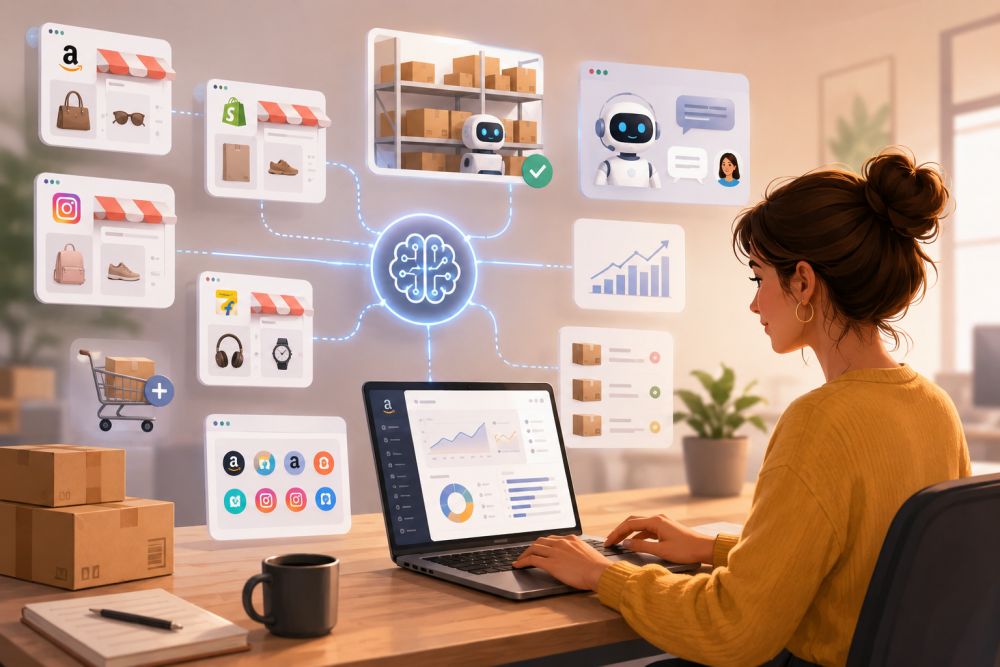
Let’s be honest, selling products online sounds simple until you’re actually doing it on five different platforms at once. You’ve got orders coming in from Amazon, your own website, Instagram, and maybe a couple of other places too.Every platform works differently. One place has customer messages waiting, another needs inventory updates, and somewhere else you’re checking new orders. After a point, you end up spending most of your day switching between tools instead of actually working on growing your business. That’s one of the biggest reasons ecommerce sellers are now turning to AI integration. And it’s not as complicated or expensive as it sounds.
Why Multi-Channel Selling Gets Messy Fast?
When you sell on just one platform, life is manageable. But the moment you expand to two, three, or five channels, everything multiplies. You have to update your product listings in multiple places. You have to make sure your stock numbers match everywhere. You have to track orders coming from different corners of the internet. Miss a step and you’re in trouble. Sell the last unit on Amazon, forget to update your website, and suddenly you’ve sold something you don’t actually have. That’s a refund, a bad review, and a frustrated customer all at once. This is where AI comes in and genuinely makes life easier.
AI Keeps Everything Updated Without Extra Effort
Selling on five platforms sounds great until you sell your last item on Amazon and forget to update your website and Instagram. Another customer orders the same product and now you are stuck apologizing for something that was completely avoidable. This happens to sellers every single day and it costs them both money and reputation.
With AI integration, every platform stays in sync the moment a sale goes through stock, pricing, availability, all of it updates on its own. Orders from every channel come into one place, no tab-switching, no guessing. And when something is about to run out, you get a heads up before it actually turns into a headache.
Customer Support Becomes Easier to Manage
Once an online store starts getting regular orders, customer messages also increase. Some people want delivery updates, some ask about returns, while others need help finding a product. When these messages come from different platforms all day, replying to everything manually becomes difficult.
Many ecommerce businesses now use AI chatbot development to handle these regular conversations. The chatbot replies to basic customer questions on websites, WhatsApp, Facebook and other channels without making customers wait too long for a response.
For difficult cases, a support person can still join the conversation whenever needed. But for daily questions, the chatbot helps reduce extra workload and makes customer communication easier to manage.
AI Helps You Sell Smarter, Not Just Faster
AI isn’t just there to handle repetitive work it actually helps you sell more. By looking at how customers behave, what they browse, what they’ve bought earlier, and what similar shoppers usually prefer, it can suggest the right products to the right people at just the right time.
That’s basically personalization. A few years ago, this kind of thing was only possible for big companies with large tech teams. But now, with AI development services, even small businesses can create that “this feels like it was made for me” experience that keeps customers interested and coming back.
AI also makes pricing a lot easier to manage. Instead of guessing whether your prices are right, it keeps an eye on market trends and competitor pricing, and helps you adjust based on demand. So you can improve your revenue without spending hours constantly checking and updating prices.
Understanding Your Sales Data Becomes Easier
When orders start coming in from different platforms, the amount of information also keeps growing. Sales numbers, customer activity, popular products, unfinished checkouts – there’s always something to track. After a while, going through all of it manually starts feeling messy and time-consuming.
A lot of ecommerce businesses now use AI to keep this information organized. It becomes easier to notice which products customers are buying regularly, which platform is bringing more orders, and where people are leaving without finishing a purchase.
This gives store owners a clearer idea of what needs attention. It also helps with everyday decisions like managing stock properly, planning offers, and spending money more carefully on marketing.
Why Smart Businesses Are Making the Switch?
The ecommerce businesses growing the fastest right now aren’t always the ones with the most advanced products. More often, it’s the ones that have their day to day operations running smoothly in the background.
That’s where AI development services come in. They help set up systems that take care of the repetitive, time-consuming work so teams don’t get stuck managing everything manually and can focus on bigger goals instead.
The Brihaspati Infotech has been working with ecommerce businesses in the same way building practical AI solutions that connect different platforms, reduce manual effort, and make it easier to scale without everything turning into a mess as the business grows.
The Bottom Line
You don’t need to be a tech expert to start using AI in your ecommerce business. The main thing to understand is simple managing multiple sales channels manually is slow, stressful, and easy to get wrong. AI helps make that process more smooth, faster and a lot more reliable.
Whether you’re just starting out or already selling on several platforms, it’s a good time to look at how AI can support your work. Companies make it easier to get started without all the technical confusion just practical tools that actually help your business run better.
At the end of the day, it’s about making your work lighter. Let AI take care of the repetitive tasks so you can focus more on growing your business.