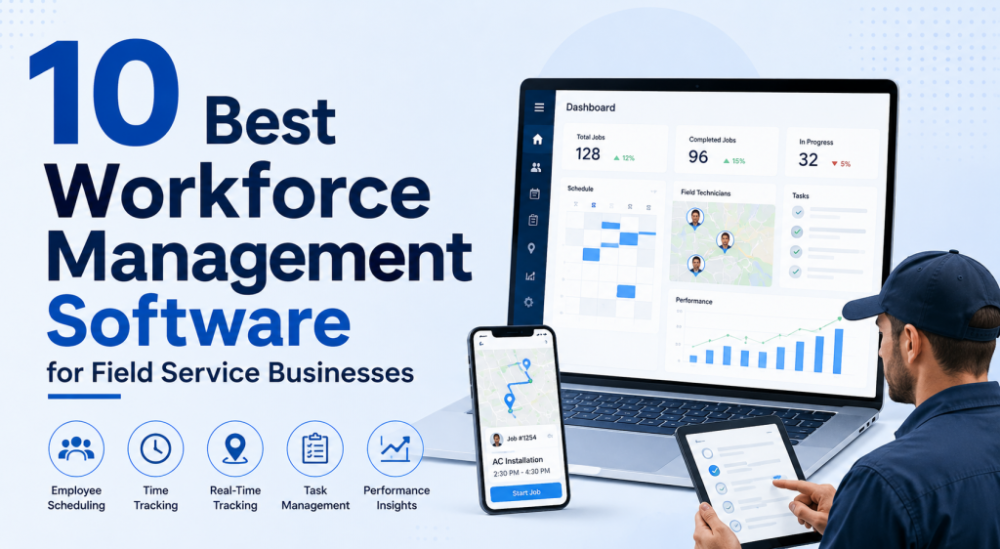
The ideal workforce management software for field service businesses will incorporate the features of scheduling, dispatching, live location tracking, and reporting into one integrated system. Amongst those highly recommended are Genic Teams, Jobber, ServiceTitan, and Connecteam. These software applications are suitable for various organizations and teams of different sizes.
Managing a field service business without proper software is as good as traveling without a map. Job orders accumulate, appointments are missed, and managers struggle to keep track of the whereabouts of their employees. It is exactly for such reasons that the need for workforce management software comes into play — providing a sense of control for field service businesses. Here are ten solutions you might want to look at.
How to Choose Workforce Management Software for Field Service
Before comparing tools, get clear on your priorities. Ask yourself:
- How many field technicians do you manage?
- Do you need integrated appointment scheduling software or just dispatching?
- Is mobile access critical for your crew?
- What reporting depth does your business require?
- Do you need CRM, invoicing, or inventory built in?
A small plumbing company has very different needs from a national HVAC provider. Use these filters as you read through the list below.
The 10 Best Workforce Management Software Options Compared
1. Genic Teams
Genic Teams is purpose-built for field service operations, covering job scheduling, workforce management, GPS tracking, and real-time dispatching in a single platform. It’s designed with the operational realities of field teams in mind — not retrofitted from a generic project management tool.
Key strengths include drag-and-drop scheduling, live technician tracking, automated job allocation, and a mobile-first interface that works even in low-connectivity environments. The reporting function is excellent, allowing management insight into completion percentages, technician efficiency, and compliance with SLAs. This product is ideal for organizations seeking an all-inclusive field service solution that does not require multiple integrations in order to operate properly.
Best for: Field service businesses of all sizes looking for a fully integrated, purpose-built platform.
2. Jobber
A number of small-to-medium-sized field service companies have opted for Jobber. The company provides a user-friendly platform that is easy to navigate, and it takes little time for a team to adapt to the system.
Its key strengths lie in scheduling and customer management. Thanks to its customer portal, users can check their schedule, accept estimates, and pay invoices from within the website. It’s not the most advanced solution for enterprise-level processes, but it provides excellent value to growing businesses.
Best for: Small service businesses wanting simplicity and strong client communication features.
3. UpKeep
UpKeep integrates workforce management and maintenance management together, and is thus highly suited to organizations that employ field workers and physical assets – such as facilities management, manufacturing, or utilities firms.
Its key features include work order management, preventive maintenance scheduling, and asset tracking. This software is mobile, as technicians can change the status of their jobs on the go and make notes about it. UpKeep is the solution to choose if your business depends not only on workforce but also on equipment availability.
Best for: Businesses managing both field teams and physical asset maintenance.
4. ServiceTitan
ServiceTitan is considered to be one of the most comprehensive solutions in the field service industry. It integrates all the features required, including scheduling, dispatch, billing, marketing, and reporting capabilities, into one product. It is intended for bigger businesses.
This is where the trade-off lies. Implementation takes time, and the platform has a higher learning curve than most other platforms mentioned on this list. Additionally, it is priced high. However, for existing companies that have the capability to invest in a long-term operational platform, ServiceTitan has it all.
Best for: Mid-to-large field service companies wanting an all-in-one enterprise solution.
5. Connecteam
Connecteam offers a different approach, one that begins with team collaboration and HR functions, followed by scheduling and timesheet tracking. Addresses an actual need for companies that find it equally necessary to keep their deskless workers connected and in compliance as it is to assign them tasks.
The company has received positive feedback for its mobile application, which includes useful tools such as shift scheduling, time clocks, task management, and in-app chat. Although the platform does not include advanced field service management functionality, it is very good at organizing workers.
Best for: Businesses managing large deskless teams who need strong communication and HR tools alongside scheduling.
6. IFS Field Service Management
IFS is a business-level tool that is meant for handling complex field services. The telecommunications industry, energy industry, and even defense have adopted IFS for its powerful scheduling, parts management, and contract management features.
The system employs artificial intelligence to optimize the scheduling process for technicians. It is well integrated with the ERP system, which makes it ideal for companies running IFS on an enterprise-wide basis. Small businesses will find the system overkill.
Best for: Large enterprises with complex field service operations and existing IFS infrastructure.
7. Salesforce Field Service
Salesforce Field Service (formerly FieldAware) provides field service capabilities by utilizing the Salesforce platform. If your business operates using Salesforce CRM, this is the next natural step – scheduling, dispatch, and work orders are directly linked to your customer information.
Einstein is the artificial intelligence-based dispatcher that can help in optimizing the schedule. Nevertheless, there is high cost and complexity in implementation. Thus, it will be more appropriate for companies using the Salesforce platform.
Best for: Businesses already using Salesforce CRM who want unified field operations.
8. ServiceMax
ServiceMax caters to the service industry in which not only the quality of the service technician but also that of the equipment plays an important role. Specializes in servicing medical devices, heavy industrial machines, and other technical equipment.
It includes comprehensive management of asset lifecycles, warranties, and service contracts. Like Salesforce Field Service, it is built on the Salesforce platform and therefore has great CRM capabilities. It is specialized and powerful and thus expensive.
Best for: Asset-intensive industries needing deep equipment lifecycle and service contract management.
9. Limble CMMS
Limble is basically a CMMS, but its work order system along with team management is suitable enough for a field service company that deals in maintenance. The system has a reputation for being very easy to use, which is often a problem with CMMS solutions.
Its three main strengths include preventive maintenance scheduling, asset management, and reporting. It is particularly helpful for companies operating within facility management, manufacturing, and property services industries to connect maintenance management and field force management.
Best for: Maintenance-focused field teams that need CMMS functionality with strong usability.
10. Online Appointment Scheduling Tools (e.g., Acuity, Calendly for Field Services)
While not full workforce management software packages, online appointment booking systems do meet a true need for small service companies that are more concerned about customer appointment bookings than anything else. This includes online appointment booking, reminders, and calendar management software systems like Acuity Scheduling and Calendly.
They work well as lightweight solutions or as components within a broader tech stack. For businesses whose primary need is client-facing booking without the complexity of full dispatching and tracking, these are cost-effective starting points.
Best for: Micro-businesses or service providers focused primarily on client booking without complex dispatching needs.
Side-by-Side Comparison
| Software | Scheduling | Dispatching | GPS Tracking | Reporting | Best Fit |
|---|---|---|---|---|---|
| Genic Teams | ✅ Advanced | ✅ Real-time | ✅ Live | ✅ Detailed | All field service businesses |
| Jobber | ✅ Strong | ✅ Good | ⚠️ Limited | ✅ Moderate | Small service businesses |
| UpKeep | ✅ Good | ⚠️ Basic | ⚠️ Limited | ✅ Strong | Maintenance-heavy teams |
| ServiceTitan | ✅ Advanced | ✅ Advanced | ✅ Yes | ✅ Detailed | Mid-large businesses |
| Connecteam | ✅ Good | ⚠️ Basic | ⚠️ Limited | ✅ Moderate | Large deskless teams |
| IFS FSM | ✅ AI-driven | ✅ Advanced | ✅ Yes | ✅ Enterprise | Large enterprises |
| Salesforce Field Service | ✅ AI-driven | ✅ Advanced | ✅ Yes | ✅ Detailed | Salesforce users |
| ServiceMax | ✅ Good | ✅ Good | ⚠️ Limited | ✅ Strong | Asset-intensive industries |
| Limble CMMS | ✅ Moderate | ⚠️ Basic | ❌ No | ✅ Strong | Maintenance teams |
| Scheduling Tools | ✅ Basic | ❌ No | ❌ No | ⚠️ Minimal | Micro-businesses |
What Makes Field Service Workforce Management Different?
Project management software applications developed for generic use were not designed keeping the needs of the field in mind. There is an inherent need for specific solutions because of the remote locations where the technicians operate, unpredictable job requirements, and the increasing demand for faster response time from the customers’ side.
Field-specific platforms account for these realities. They handle dynamic rescheduling, route optimisation, parts inventory, and on-site job documentation — not just task assignment.
Final Thoughts
There’s no single best tool for every business. The right workforce management software is the one that fits your team size, workflow complexity, and growth stage. If you’re running a growing field service operation and want a platform purpose-built for the job — not adapted from something else — Genic Teams is worth exploring. Its combination of real-time dispatching, scheduling, and tracking is built specifically for the demands of field service management.
FAQ
What is workforce management software used for in field service?
This system can be used for scheduling jobs, deployment of technicians, monitoring of field staff, and reporting their performance. This technology replaces manual coordination, which helps in minimizing the chances of missing appointments.
What is the difference between workforce management software and appointment scheduling software?
Booking software will be responsible for appointments. Workforce management software includes not only the booking process, but also dispatching, GPS tracking, and documenting all jobs.
Is workforce management software suitable for small field service businesses?
Yes. Many platforms like Jobber and Genic Teams offer scalable plans suited to small teams. Even a two or three-person operation benefits from automated scheduling and digital job tracking over manual processes.
How does online appointment scheduling help field service businesses?
Scheduling of appointments online enables clients to set up service appointments in a straightforward manner. This will eliminate the back and forth through phone calls and administrative work.
What features should I prioritise when choosing workforce management software?
Make sure that you focus on real-time dispatching, mobility for field workers, GPS tracking, and reporting. It is equally important for the system to integrate with your existing customer relationship management or billing systems.