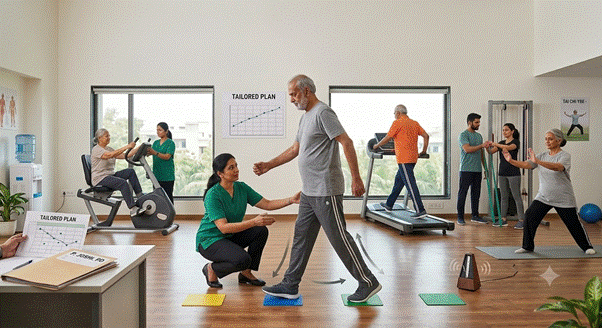
A practical guide for patients, caregivers, and anyone trying to understand what actually happens in the clinic—and why it works.
Margaret was 68 when she noticed her left arm had stopped swinging when she walked. Her neurologist confirmed Parkinson’s disease six months later. She had heard about physical therapy but pictured something vague—exercise machines, maybe some stretching. What she actually experienced at her first session surprised her.
Her therapist spent forty-five minutes watching her walk, turn around, sit down, stand up, and reach for objects. Then she said something Margaret hadn’t expected: “Your brain has been undershooting your movements for a while. We’re going to teach it to stop doing that.”
That sentence, more than any pamphlet or website, captures what Parkinson’s physical therapy actually is.
The Core Problem: It’s Not Just Tremor
Most people associate Parkinson’s disease with shaking hands. That’s the visible part. But the movement disruption that causes real functional problems day-to-day is different, and it’s worth understanding before diving into what therapy does about it.
Parkinson’s disease progressively damages dopamine-producing neurons in the substantia nigra — a region of the brain that helps regulate the smoothness, timing, and amplitude of movement. As dopamine levels decline, a specific pattern of movement impairment emerges:
- Bradykinesia — movements become slower and smaller than intended
- Rigidity—muscles feel stiff, arms don’t swing naturally, turning takes more effort
- Postural instability — balance reactions slow down, making falls more likely
- Freezing of gait — sudden, temporary inability to move the feet forward, usually at doorways or when turning
Here is what makes Parkinson’s particularly complex from a rehabilitation standpoint: the person often does not perceive how small their movements have become. Their internal sense of a normal step, or a normal arm raise, has been recalibrated downward. They genuinely believe they are moving normally when they are not.
This is not a muscular problem. It is a neurological perception problem. And that distinction shapes everything about how physical therapy approaches it.
What Parkinson’s Physical Therapy Actually Does
Parkinson’s PT is not about making muscles stronger in the traditional sense, though strengthening is part of it. At its core, it is about retraining the nervous system—teaching the brain to generate and self-monitor movement amplitude through intensive, repetitive, intentional practice.
The science behind this is neuroplasticity: the brain’s ability to reorganize itself and form new functional pathways in response to experience. Even a Parkinson’s-affected brain retains meaningful neuroplasticity. Targeted, high-effort physical practice can drive real changes in how the motor system functions — not permanently reversing the disease, but meaningfully preserving and restoring function in ways that matter for daily life.
There are three broad goals that guide every Parkinson’s PT program:
1. Maintain and improve mobility—walking with a normal stride length, turning safely and navigating different surfaces and environments.
2. Preserve balance — Retraining postural reactions so the body can respond when thrown off-center. This is directly linked to fall prevention.
3. Maintain independence in daily activities—getting in and out of a chair, dressing, carrying objects, managing stairs—the tasks that define quality of life.
Everything in a session builds toward one or more of those goals.
The Approaches That Have Real Evidence Behind Them
LSVT BIG
LSVT BIG (Lee Silverman Voice Treatment — BIG version) is probably the most rigorously studied specific therapy approach for Parkinson’s disease. It emerged from LSVT LOUD, a voice therapy program that taught people with Parkinson’s to speak louder by training high-amplitude vocal efforts. Researchers noticed the same principle applied to whole-body movement.
The LSVT BIG method trains patients to make movements that are exaggeratedly large — much larger than they think is necessary. They practice reaching further, stepping wider and swinging arms more dramatically. Over time, and with repetition, the brain’s movement calibration shifts. The oversized training movements begin to feel normal. And when the patient stops “trying” to move big, their baseline has improved.
Clinical trials published in Neurorehabilitation and Neural Repair found that LSVT BIG produced faster walking speed, bigger steps, improved trunk rotation, and better performance on timed up-and-go tests compared to conventional exercise. The program runs as a four-week intensive course — four sessions per week for four weeks — followed by a home program.
This is not a gentle warm-up routine. It is deliberately intensive, because the research consistently shows that intensity drives neuroplastic change.
PWR! (Parkinson Wellness Recovery)
PWR!Moves is a more recent framework developed by Dr. Becky Farley, a neuroscientist who worked on the original LSVT BIG research. Where LSVT BIG focuses on amplitude, PWR! addresses the four specific movement functions that Parkinson’s most commonly impairs: body extension, weight shifting, axial rotation (twisting), and stepping.
PWR! integrates cognitive challenge with physical movement—exercises require attention and decision-making alongside the motor practice, which mirrors the demands of real daily life. PWR!-certified therapists are trained to progress patients through these movements in standing, kneeling, sitting, and floor-level positions, making the program adaptable to different stages of the condition.
Gait Training and Cueing
Freezing episodes and shortened stride length are among the most disabling aspects of Parkinson’s gait. Physical therapists address these directly through cueing strategies—external signals that help bypass the impaired internal timing system and trigger normal movement.
Visual cues work well for many patients: lines of tape on the floor that prompt stepping over them, laser attachments on walking frames that project a line onto the ground ahead. Rhythmic auditory cues — a metronome beat, either from a device or a therapist counting — help patients synchronize their steps to an external rhythm when the internal one has broken down. Tactile cues (a tap on the foot, a light touch on the leg) can prompt the movement initiation that freezing interrupts.
These are not tricks. They work because the cueing activates a different neural pathway—one that bypasses the disrupted basal ganglia circuitry and accesses the movement more directly.
Balance and Fall Prevention Training
About 60% of people with Parkinson’s fall at least once per year, and falls are among the leading causes of hospitalization and declining independence in this population. Balance training in Parkinson’s PT is distinct from standard balance work—it has to address the specific mechanism at fault.
Postural instability in Parkinson’s comes from slowed and reduced postural reflexes — the automatic micro-adjustments the body makes in response to perturbation. Training focuses on reactive balance: therapists gently push, pull, or perturb patients and train them to recover their base. Over time, and with sufficient repetitions, the recovery responses become faster and more reliable.
Therapists also address environmental risk factors—how to navigate doorways that commonly trigger freezing, how to manage turning safely and how to get up from the floor safely after a fall, which for many patients becomes its own source of anxiety.
How a Parkinson’s PT Evaluation Actually Works
Understanding the evaluation process matters because it is where the entire program is shaped. A good Parkinson’s PT assessment goes well beyond basic strength testing.
Gait analysis—Watching how the patient walks at a self-selected pace and faster. Step length, cadence, arm swing, trunk posture, turning mechanics.
Balance testing—Static balance, dynamic balance during walking, and reactive balance tests like the Pull Test (standardized backward perturbation).
Functional movement screen—Getting up from a chair, stepping over objects, reaching, navigating a turn.
Dual-task assessment—Performing a cognitive task (counting, talking) while walking. Parkinson’s patients often show significant gait deterioration under dual-task conditions, revealing where fall risk is highest in real life.
Patient history and goals — What activities matter to the patient? What has become harder? What are they worried about losing? This conversation shapes the priorities of the entire program.
James, a 71-year-old retired civil engineer in Fremont, described his evaluation this way: “She watched me walk down the hallway three times and could tell me more about what was happening in my gait than I had been able to articulate to my neurologist. She knew exactly what the problem was within twenty minutes.”
How Physical Therapy Fits with Medical Treatment
This is worth being clear about: physical therapy does not replace medication for Parkinson’s disease. Dopaminergic medications — particularly levodopa — remain the primary medical treatment, and managing medication timing well genuinely affects how PT sessions go.
Many patients find that scheduling therapy sessions during their medication “on” time — when dopamine levels are higher and movement is freer — makes exercise more productive. Therapists and neurologists who communicate about this produce better outcomes than those working in isolation.
PT also reinforces the effects of medication. There is emerging evidence that exercise itself supports dopamine system function. Physical therapy in Parkinson’s is not simply rehab for deficits — it is increasingly understood as a component of disease management.
For anyone exploring this approach, reading about [neurological rehabilitation approaches for movement disorders] or understanding [how exercise supports brain health in progressive neurological conditions] provides useful context alongside clinical care. Caregiver guidance is also valuable — [helping a family member with Parkinson’s navigate daily mobility challenges] is a topic that significantly affects adherence to any therapy program.
Frequently Asked Questions
Is Parkinson’s physical therapy only for people who have already had falls?
No — and waiting for a fall to happen before starting PT is one of the most common mistakes. The earlier someone begins, the more functional baseline they bring to the program. Starting at diagnosis, or shortly after, allows therapy to build protective strength and balance before significant decline occurs. Prevention is a legitimate and worthwhile reason to start.
How is Parkinson’s PT different from regular physical therapy?
The difference is significant. Parkinson’s PT requires specific training in neuroplasticity principles, amplitude-based movement training, cueing strategies, and the specific way PD affects motor control and perception. A therapist seeing general orthopedic patients will not typically have this expertise. Look for a therapist with LSVT BIG certification, PWR! certification, or a specific neurological rehabilitation background.
Can PT slow the progression of Parkinson’s disease?
This is an active area of research. There is currently no definitive evidence that physical therapy slows the underlying neurodegeneration. What the evidence does show — consistently — is that regular, intensive exercise preserves function for longer, delays the onset of severe disability, and improves quality of life throughout the course of the disease. In clinical terms, that is a meaningful outcome.
What should someone look for when choosing a therapist?
Look for LSVT BIG or PWR!-certified therapists. Look for a clinic with specific neurological rehabilitation experience, not just general PT. Ask how many Parkinson’s patients they currently treat. Ask what evaluation tools they use—a therapist who can name the Pull Test, Timed Up and Go, and Mini-BESTest is demonstrating relevant expertise.
How long does a course of Parkinson’s PT last?
LSVT BIG runs for four weeks intensively, followed by an ongoing home program. PWR!-based programs vary by stage and need. Most people with Parkinson’s benefit from some ongoing PT contact throughout the disease course—not necessarily intensive therapy every week, but periodic reassessment and program updates as the condition evolves. This is a long-term relationship, not a one-time intervention.
Conclusion
What Margaret found in that first session — a therapist who understood precisely what her brain was doing and had specific tools to address it — is what Parkinson’s physical therapy looks like when it is done well.
It is not generic exercise. It is not sympathy and resistance bands. It is a specific, evidence-based discipline that understands the neurology of the condition and applies that understanding through hands-on, intensive, personalized practice.
The research base has strengthened considerably over the past two decades. The programs are more refined. The outcomes, for patients who engage consistently and start early, are genuinely meaningful.
For anyone living with Parkinson’s disease or supporting someone who is, the question is not whether physical therapy helps. The evidence has answered that. The question is finding a therapist who knows how to deliver it—and starting sooner rather than waiting until the need feels urgent.