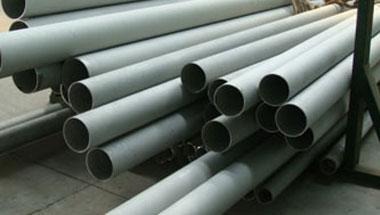
Stainless Steel 321H Welded Pipes are a reliable choice in aerospace applications as they comply with all the strict requirements without the weight penalty of heavier alloys or the expense of exotic nickel superalloys. Aerospace material requirements are ruthless. Parts must reliably endure severe heat, rapid thermal shifts, mechanical vibration, and heavy structural stress all at once. Their important use in exhaust systems, heat exchangers, and high-temperature aircraft components is a performance record demonstrated in one of the toughest industries.
What Are Stainless Steel 321H Welded Pipes?
SS 321H is a titanium-stabilized austenitic stainless steel has more carbon than regular 321 alloy. Titanium stabilization reduces carbide precipitation at grain boundaries during high-temperature exposure, which undermines unstabilized grades in welded or thermally stressed assemblies through intergranular corrosion and sensitization. Because 321H has more carbon than ordinary 321, it has better creep strength at high temperatures, which is crucial for pipes that transport load or pressure over long service periods. Welded pipes in this grade are manufactured by forming and seam-welding tube from strip or plate, then finishing and heat treating to ASTM A312 TP321H requirements. Review the available Types of SS 321H Welded Pipe configurations before specifying diameter, schedule, and end condition all vary by application.
Key Properties of SS 321H Welded Pipes
The following are key reasons why most of the industries select the SS 321H Welded Pipes for their operations.
Excellent High-Temperature Strength
SS 321H maintains mechanical strength at temperatures that cause standard austenitic grades to lose structural integrity. In aircraft exhaust systems where gases reach extreme temperatures, the alloy’s elevated-temperature tensile and creep strength keeps the pipe performing reliably through thousands of thermal cycles.
Resistance to Intergranular Corrosion
Titanium stabilization binds carbon in the alloy matrix, preventing it from forming chromium carbides at grain boundaries during welding or heat exposure. The result is a pipe that resists intergranular attack in the heat-affected zone after welding, which is essential in fabricated aerospace assemblies.
Superior Weldability
SS 321H welds cleanly with matched filler metal and standard TIG procedures. The titanium stabilization means the heat-affected zone retains corrosion resistance after welding without mandatory post-weld heat treatment, a practical advantage in complex fabricated aerospace components.
Oxidation and Heat Resistance
The chromium content provides oxidation resistance at elevated temperatures. Pipes used in thermal cycling environments where temperatures rise and fall rapidly survive the oxide scale formation and spalling that damages less resistant alloys in the same service.
High Durability and Long Service Life
Long-term reliability in high-temperature service reduces replacement frequency in aircraft and aerospace ground support equipment. Fewer replacements mean lower maintenance cost and less downtime in aviation operations where unscheduled maintenance has significant scheduling and cost consequences.
Why Aerospace Industries Prefer SS 321H Welded Pipes
Lightweight Yet Strong Material
The alloy provides the strength-to-weight ratio aerospace design demands. Achieving structural reliability without adding unnecessary mass directly supports the weight management that drives aerospace engineering economics and performance.
Suitable for Jet Engine Components
Jet engine exhaust and secondary structures reach temperatures that eliminate most standard stainless grades from consideration. SS 321H Welded Pipes survive the temperature range found in exhaust manifolds, bypass ducts, and nacelle structures reliably.
Reliable Performance Under Extreme Conditions
Thermal shock, rapid pressure changes, and sustained vibration characterize aerospace operating environments. SS 321H handles these simultaneously the material doesn’t degrade its mechanical or corrosion performance under combined stresses.
Excellent Structural Integrity
Welded pipe assemblies in aerospace carry both pressure and structural loads in many applications. The alloy’s consistent mechanical properties across the pipe wall and across the weld ensure structural integrity is maintained throughout service.
Compatibility with Aerospace Standards
SS 321H production and testing aligns with ASTM A312, ASME SA312, and aerospace material specifications where required. This compliance is the baseline requirement for any material entering aerospace fabrication.
Common Aerospace Applications of SS 321H Welded Pipes
Refer to the primary applications below to see how SS 321H welded pipes meet the stringent demands of the aerospace industry:
Aircraft Exhaust Systems
This grade is standard for exhaust manifolds, collector rings, and tailpipes, where components operate continuously at elevated temperatures that require 321H’s specialized high-temperature strength and stability.
Jet Engine Components
Engine manufacturers deploy these pipes in secondary airflow ducting and critical structural tubes, leveraging the alloy’s excellent combination of high heat resistance and clean weldability.
Environmental Control Systems
Heat exchangers within aircraft climate and cabin pressure networks utilize these pipes to maintain structural integrity and corrosion resistance under rapid thermal cycling.
High-Temperature Hydraulic Lines
Airframe engineers specify this material to safely route hydraulic fluids through high-heat zones, ensuring the lines do not deform or fail when exposed to nearby engine heat.
High-Temperature Fuel Systems
Fuel system components located in high-temperature regions of the aircraft rely on this grade to prevent material degradation and cracking from sustained, long-term thermal exposure.
Thermal Processing Equipment
Aerospace manufacturing facilities implement these pipes in their own annealing furnaces and heat treatment fixtures, where dependable process piping is required to withstand extreme manufacturing temperatures.
Benefits of Choosing SS 321H Welded Square Pipes
SS 321H Welded Square Pipes provide structural support in aerospace ground equipment, test stands, and support structures where the grade’s high-temperature performance is needed alongside a rectangular cross-section that simplifies connection to structural frames. The strength-to-weight advantage of 321H applies in square form as well as round pipe. Square sections are easier to bolt and weld to flat structural members without custom brackets, reducing fabrication complexity and installation time.
SS 321H Welded Pipes vs Other Stainless Steel Grades
Conventional grades like SS 304 and SS 316 do not possess high temperature creep strength necessary for aeronautical applications. However, these grades provide greater weldability and economic effectiveness. Although the standard SS 321 has superior heat resistance, the SS 321H outperforms it. 321H has a larger carbon content, which gives it better heat resistance and makes it aeronautically suitable. This allows it to outperform other grades in situations with high temperatures for lengthy periods of time.
How to Select a Reliable SS 321H Welded Pipe Supplier
Minimum material certifications are EN 10204 3.1 mill test certificates showing ASTM A312 TP321H conformity. For each heat and lot, provide ASTM/ASME compliance documents. Before order, the diameter, schedule, and length of the manufacturing capacity are validated. Custom sizing is important in aeronautical applications where standard dimensions don’t always match design requirements. European export standards compliance PED, and aviation and defense supply chain certification affect international aerospace project sourcing selections. Any reliable Stainless Steel 321H Welded Pipe Supplier should do hydrostatic testing, PMI (positive material identification), and visual inspection. Rajveer Stainless and Alloy, Sunrise Stainless, and Tubacero have aerospace-grade supply experience for standard and special demands.
Future Demand for SS 321H Welded Pipes in Aerospace Industry
The commercial aviation sector is increasing at a quicker rate, which results in a higher demand for the high-temperature materials required for aircraft projects. With government and private space exploration missions accelerating, the thermal demands of launch systems and return vehicles are pushing the material specifications deeper into the high-temperature alloy region where 321H resides. The demand for high-performance alloys that can operate in harsh heat environments without the cost of pure nickel superalloys will only grow. Sustainable aerospace engineering trends, lighter, longer-lasting components with lower maintenance requirements, align directly with 321H’s performance characteristics.
Conclusion
Stainless Steel 321H Welded Pipes earn their aerospace specification through a combination of high-temperature strength, intergranular corrosion resistance, weldability, and long service life that the industry’s demanding conditions require. Evaluate the operating temperature range, confirm ASTM A312 TP321H compliance, and source from a supplier with demonstrated aerospace supply capability and full material documentation.