Ask any wheat farmer in Ludhiana or a sugarcane grower near Muzaffarnagar what keeps them up at night, and you’ll hear the same worries: the tubewell running dry, labour that doesn’t show up at harvest, and input costs that climb every single season. Here’s the good news, the tools to fight all three are already reaching Indian fields.
You no longer need a big farm or a computer degree to use it. A basic smartphone and one trip to your nearest Krishi Vigyan Kendra (KVK) is often enough to get started.
| Quick Overview Farming technology means using modern tools like drones, AI apps, soil sensors, and automatic irrigation to make farming cheaper, faster, and more accurate. In India, it’s already helping farmers cut water and fertiliser waste on wheat, paddy, and sugarcane, and get better prices through digital mandis like e-NAM. |
Why is farming technology suddenly reaching Indian villages?
Three things changed at once: cheap smartphones, affordable rural internet, and government schemes that pay part of the cost. Together they’ve put tools that were once only for big farms into the hands of small and marginal farmers across Punjab, Haryana, UP, and Rajasthan.
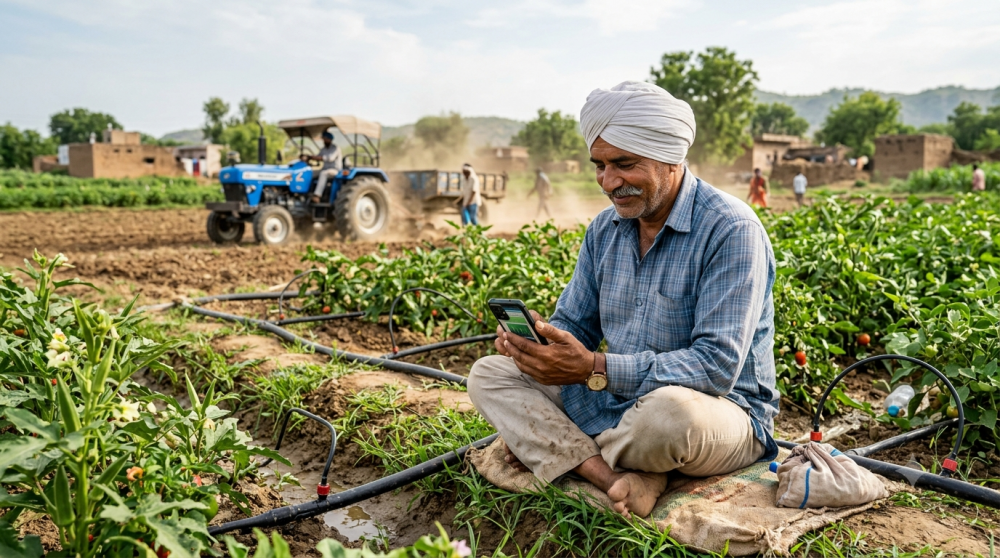
Not long ago, a Ludhiana farmer checking his crop on a phone screen sounded like a joke. Today it’s ordinary. The shift came because data got cheap and phones got affordable, so even a farmer with two acres can now open a weather app before deciding when to irrigate. On top of that, schemes under the Digital Agriculture Mission and drone-promotion programmes have brought the price of trying new tools way down. Technology in Indian farming is no longer a big-farm luxury — it’s becoming an everyday habit in the village.
| Pro Tip: Before buying anything, visit your nearest KVK. Most Indian districts have one, and they demo tools like drones and soil testing free of cost, so you see the benefit before you spend a rupee. |
What are smart farming technologies, in plain language?
Smart farming technologies are tools that sense what your field needs and act on it, like sensors that measure soil moisture, or irrigation that switches on only when the crop is thirsty. They save water, cut waste, and lift yields without extra guesswork.
Think of it as giving your field a voice. Instead of guessing when to water your wheat or how much urea to add, sensors and simple apps tell you what’s actually happening below the soil. The most useful ones for Indian farms right now:
• Soil-moisture sensors – so you irrigate paddy or wheat only when it truly needs it, saving on diesel and power.
• Weather-alert apps – a rain or frost warning the night before can save an entire mustard or potato crop.
• Soil testing via the Soil Health Card – it tells you the exact nutrient your plot is short on, so you stop over-spending on the wrong fertiliser.
How is AI actually being used in Indian agriculture?
AI in Indian agriculture mostly shows up in your phone: it forecasts weather, spots crop diseases from a photo, and suggests when to sell for the best mandi price. It doesn’t replace a farmer’s judgement, it just gives you a faster, more accurate second opinion.
“AI” sounds fancy, but on the ground it’s simple and practical:
Spotting disease from a single photo
See yellow patches on your paddy? Snap a photo in a free app like Plantix or Kisan e-Mitra, and it names the likely disease and suggests a treatment in seconds — early enough to save the crop before it spreads across the plot.
Weather you can plan around
AI-backed forecasts warn you about frost, unseasonal rain, or a heatwave a few days ahead, the difference between harvesting your wheat dry and watching it flatten in a storm.
Knowing when to sell
Some apps now predict which way mandi prices are heading, so you don’t sell your entire mustard stock the same week everyone else does and crash your own price.
Are drones worth it for a normal farmer?
Yes, even if you don’t own one. Kisan Drones can spray an acre of pesticide or liquid urea in about 7–10 minutes instead of a full day by hand, and most farmers hire them on-demand from a nearby drone operator or an Agri-drone ‘Didi’ rather than buying one.
Drones are the technology farmers ask about most, and for good reason. Instead of walking through your field with a spray tank on your back, slow, tiring, and risky for your health, a drone does it evenly in minutes. In India they’re increasingly used for:
• Spraying pesticide and liquid fertiliser on wheat, paddy and sugarcane
• Checking crop health across a large field from the air
• Mapping which corners of the field are stressed or under-watered
The government has been pushing drone adoption hard, including training programmes that help operators, many of them rural women that offer spraying as a paid service. So you get the benefit without the lakhs it costs to buy one.
| Pro Tip: Ask your Custom Hiring Centre (CHC) or FPO whether a drone-spraying service operates in your block. Splitting the hire cost across a few neighbouring farmers makes it very affordable per acre. |
Which farm technology should you try first? (Quick comparison)
Start with the cheapest, highest-impact tools:
A free Soil Health Card and a crop-disease app cost almost nothing and save real money immediately. Move to drip irrigation and drone-hire once you’ve seen the savings.
| Technology | What it does on your farm | Rough cost / how to get it (2026) |
| Kisan Drone | Sprays pesticide/urea on an acre in 7–10 minutes instead of a full day by hand | Custom-hire from a nearby CHC or Agri-drone Didi; govt training subsidy available |
| Soil Health Card + soil sensors | Tells you exactly which nutrient your plot lacks, so you stop over-buying DAP/urea | Soil Health Card is free at your KVK; basic sensors from ₹3,000–8,000 |
| Smart / drip irrigation | Waters wheat and vegetables only when needed — cuts tubewell power bills | PMKSY ‘Per Drop More Crop’ subsidy covers a big share for small farmers |
| Crop-disease apps (AI photo check) | Snap a yellowing leaf, get the likely disease + spray advice in seconds | Free apps like Kisan e-Mitra, Plantix; needs only a basic smartphone |
| e-NAM mandi platform | Sell paddy or mustard to buyers across states, not just your local arthiya | Free registration at your APMC mandi |
How does digital farming help you get a better price?
Digital farming connects you straight to buyers, market prices, and government schemes through your phone — reducing your dependence on middlemen. Platforms like e-NAM let you sell to buyers in other states, often at a better rate than your local mandi alone.
The biggest money leak for many Indian farmers isn’t the field, it’s the sale. Digital farming plugs that leak by putting information directly in your hands: live mandi prices, real-time weather, details of schemes and subsidies, and expert advice on pests and fertiliser. Through e-NAM, a farmer in Haryana can list paddy for buyers across states instead of accepting whatever the local arhtiya offers. More buyers means more competition for your crop — and usually, a better price in your pocket.
What’s stopping farmers from using this technology?
The main barriers are upfront cost, patchy rural internet, and simply not knowing these tools exist or how to use them. Government subsidies, KVK training, and pooling resources through an FPO solve most of these for small farmers.
Let’s be honest — it isn’t all smooth. The real hurdles Indian farmers face are:
1. Upfront cost — buying equipment outright is hard, which is why hiring and subsidies matter so much.
2. Weak internet — some villages still get patchy signal, though this is improving fast.
3. Digital literacy — not everyone is comfortable with apps yet; younger family members often help here.
4. Awareness — many farmers simply don’t know a tool exists or that a subsidy would cover most of its cost.
The fix isn’t complicated: better awareness, affordable hire-based options, and hands-on training, most of which your KVK, FPO, or Custom Hiring Centre already provides.
The bottom line for Indian farmers
Farming technology isn’t here to replace the knowledge you and your family have built over generations. It’s here to back it up with data, so fewer decisions come down to a guess. A free soil card, a disease-spotting app, a shared drone, drip irrigation on your vegetables, and selling through e-NAM: none of these need a big farm or big money. They just need one first step. Start small, start with what’s free, and build from there.
| Pro Tip: Your single best first move: get a free Soil Health Card from your KVK and download one crop-disease app this week. Together they cost nothing and can cut your fertiliser and pesticide bill from the very next crop. |
Frequently Asked Questions
What is farming technology?
Farming technology is the use of modern tools — drones, AI apps, soil sensors, smart irrigation, and digital mandi platforms — to make farming faster, cheaper, and more accurate. In simple terms, it helps a farmer grow more on the same land while spending less on water, labour, and fertiliser.
How is technology changing agriculture in India?
In India, technology is helping wheat, paddy, and sugarcane farmers cut water and fertiliser waste, spray crops with drones instead of by hand, get weather warnings before a storm, and sell through digital mandis like e-NAM for better prices. Cheap smartphones and government subsidies have made these tools reachable even for small farmers.
Can a small farmer with 2–3 acres actually use this technology?
Yes. Many tools are free or hire-based, so you don’t need to own expensive equipment. A free Soil Health Card, a crop-disease app on a basic smartphone, and drone-spraying hired through a Custom Hiring Centre or FPO all work well on small plots and start saving money quickly.
How much does a Kisan Drone cost to use?
Most farmers don’t buy a drone — they hire one on-demand from a local operator or an Agri-drone ‘Didi’ and pay per acre sprayed, which is affordable when shared among neighbouring farmers. Buying outright costs several lakhs, but government training and subsidy schemes are lowering that barrier for operators.
Which farming app is best for detecting crop diseases?
Free apps like Plantix and Kisan e-Mitra let you photograph an affected leaf and get the likely disease plus a treatment suggestion within seconds. They run on a basic smartphone and are a great, zero-cost first tool for any Indian farmer.
What is e-NAM and how does it help me get a better price?
e-NAM (National Agriculture Market) is a free online platform that connects your local mandi to buyers across India. By listing your produce there, you reach more buyers than your local mandi alone, which increases competition for your crop and usually gets you a better price. You register through your APMC mandi at no cost.
Do I need internet everywhere to use smart farming tools?
Not for everything. Weather alerts, soil-card data, and disease-detection apps need only occasional internet, and many features work on basic connectivity. Rural internet is also improving quickly across Punjab, Haryana, UP, and Rajasthan.
Where can I learn to use farming technology near me?
Your nearest Krishi Vigyan Kendra (KVK) is the best place to start — most Indian districts have one, and they demonstrate tools like drones, soil testing, and irrigation systems free of cost. Your local FPO and Custom Hiring Centre can also help you access shared equipment and training.