In the last decade, AI in business was synonymous with two things: one, AI for data analysis, and two, AI for improved CRM marketing.In the last decade, AI in business was synonymous with two things; one, AI for data analysis and two, AI for better CRM marketing.
It was a big company with a multi-million dollar machine learning project and if it wasn’t, it was a small company with a chatbot that could handle three queries before transferring the conversation to a human. The chasm was vast and growing between these two realities, and there seemed to be no way to bridge the divide.
That divide has been bridged in ways unimaginable just two years ago. The catalyst is not just one breakthrough tool. The technology has come a long way and been developed quickly without anyone realizing it: AI agents.
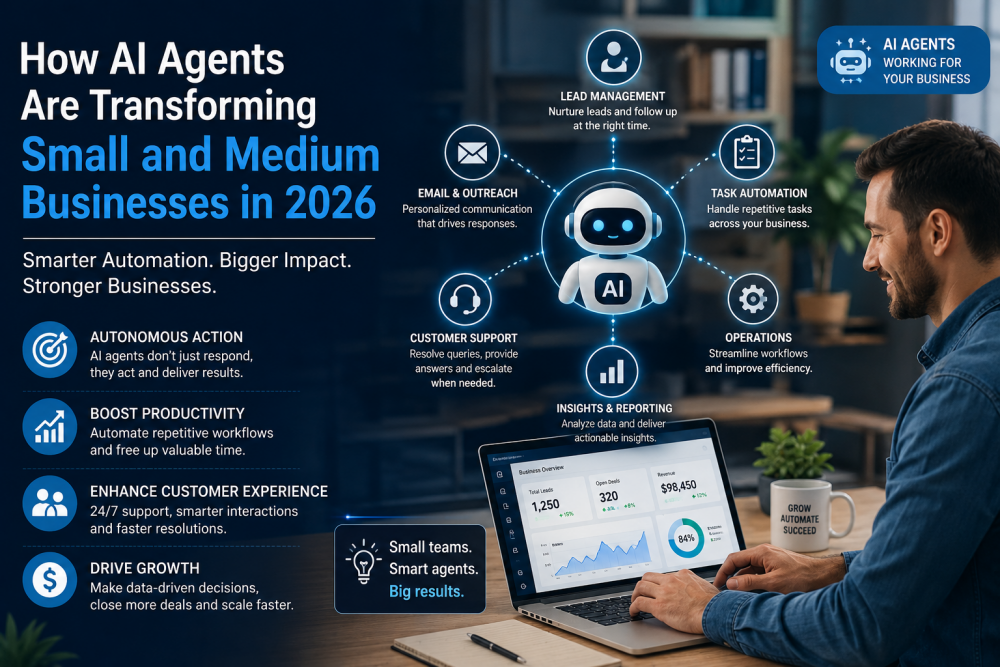
AI agents are not related to the AI tools that most businesses have been experimenting with. A tool is responsive when it is called. An agent acts. It follows objectives, takes decisions over multiple steps, runs other software on your behalf and runs without you having to start each one. This distinction is of great significance to small and medium enterprises who have always worked with small teams and small resources.
What Makes AI Agents Different from AI Tools
The easiest way to find the difference is with an example.
You use an AI tool to create a follow-up email to a prospect. Prompt it, it writes, you read it and you send it. Single step, single output, single human in the loop at each step.
The entire follow up process is coordinated by an AI agent. It checks your CRM for deals that have not been active for a set period of time, notifies them of the type of follow up that are best, depending on where the deal is in the sales funnel, it will create a customized message based on the information you’ve shared with them in the past and send it at the right time, based on the historical engagement pattern you’ve seen, it logs the activity back into the CRM and it will mark the deal for human review if the prospect replied with a question that requires judgment.
Humans set up parameters and look at results. The agent carries out the process. That’s a human and a technology tool relationship that is quite different and is what makes AI agents really gamechangers for businesses that don’t have the staffing to manage complex processes by hand.
The SMB Advantage in the Age of AI Agents
Large companies have always had the means to create operational complexity, with separate teams for every function, heavy software layers and multiple layers of management in their processes. In the past, small and medium enterprises have been able to compete by being quicker and more personal, but not as deep as an enterprise in terms of their operations.
The economics of operational capability are shifting in favor of smaller businesses thanks to AI agents.
AI agents can now scale to ten times the size of a company and process 10 times the amount of workflows in the same amount of time a 30-person company would take. The benefit is NOT that AI takes the place of human beings. It’s because a small team with AI agents can do more than a large team without AI agents can do.
This is a real leveling up in competition. The SMBs that take a measured approach to AI agent adoption are not only becoming more efficient; they’re also gaining a competitive edge. They are developing the capability which they did not have structurally before. That’s a different type of business change than most technology purchases provide.
Where AI Agents Are Creating Real Impact in 2026
There are a number of well-established categories of applications that are proving to really work for SMBs. They have in common that they feature processes that are of a sufficient value to warrant consistent attention, repetitive enough that humans tend to forget during stress and structured enough that they can be managed consistently and reliably by an agent with little human supervision.
Sales and Lead Management
There’s a predictable issue that plagues sales processes in SMBs. While the team is busy securing deals, lead nurturing suffers. At times of reduced activity, there is a rush to rekindle a “cold” pipeline. Business is a series of bursts of attention, not ongoing systematic follow-through.
AI agents for sales workflows uphold that consistency even when human agents are busy. They track lead activity, initiate follow-up actions on time, add to CRM data based on lead engagement, prioritize leads for follow-up based on engagement signals, and notify sales reps when a prospect’s activity indicates they are close to a decision.
The human still constructs relationships. The agent ensures that there are no loose ends between encounters.
Customer Support and Service
Customer support is always a resource-intensive section of the SMBs. All queries requiring human answers are time that is not used for other work. But there is often a direct link between the quality of support and customer retention and referrals, and it’s too important to not invest in.
AI agents are changing up this balance. The best implementations of the year 2026 are not a basic FAQ robot. They’re agents who know what’s going on, have access to customer data, can follow up on multiple turns, can make decisions for integrated systems such as order management, billing, and can escalate to a human agent with a full history of the interaction when it truly needs human input.
The outcome is coverage of help that can be duplicated manually and is accessible 24/7 and can be afforded by businesses of virtually any size. This is a true leveling feature for SMBs who are playing against larger competitors in the quality of their customer experience.
Operating and administrative processes
One of the expenses which is underestimated while operating a small business is the operational overhead of running a business. Each one of these tasks takes a lot of time individually, but all together they can consume hours out of people’s day who could be working on meaningful tasks.
AI agents can more reliably manage these processes, allowing human time to be devoted to tasks that require judgment. An agent that tracks the expiration of contracts and starts renewal processes 60 days before the end of the contract.
An agent that acts as a middleman to receive invoices and match them to purchase orders, flag any discrepancies, and route them for approval based on value thresholds.
An agent that gathers multiple data sources’ weekly reports and presents them in the format which each data source prefers. None of these jobs involves high-level judgment. They all need to be done reliably and consistently where humans tend to put it on the back burner when time is tight.
Marketing Execution
Unfortunately, one of the challenges of marketing in an SMB is that when the team is busy, marketing output decreases. Content goes unscheduled. Email campaigns fail to get sent. Social channels turn off their lights just when the business needs them the most.
AI agents that can be applied to marketing execution are always on the job, but they don’t need round-the-clock supervision. They plan what they post on social media, track the performance of their social media posts, and adjust their timing accordingly, create personalized email sequences based on user behaviour, and surface insights gained from performance data to inform a new round of planning decisions.
The human team is responsible for strategy and creative direction. The agent is responsible for doing what is necessary for strategy to function: for being consistent.
What Professional AI Development Services Bring to the Table
The implementation of AI agents in a real business setting isn’t as simple as signing up and turning on a platform. It is nearly always the agents that are least successful at doing an effective job, and almost always the agents that were deployed in a way that didn’t pay sufficient attention to how they are connected with the other agents, how they behave outside of their regular use, and how they are monitored and maintained over time.
Generic platforms fail to solve these problems, but professional AI development services are able to solve them. They create agent workflows that reflect the business’s workflow, not the template’s. They create the integrations that connect agents with the particular software stack that the business uses, such as a particular CRM, an accounting system, a project management tool, or a customer support system.
They provide a mechanism to “flag it” so that when an agent finds a situation which they do not cope with well, there is a mechanism in place to flag it, otherwise it fails silently.
In the case of SMBs, AI development services may offer a more valuable benefit than the technology itself: strategic guidance on where to start deployment, how to proceed, and whether it’s yielding the returns it promised.
Small and medium enterprises cannot afford to invest six months and a lot of money in an AI project that doesn’t yield the results expected if it failed to be anchored in business outcomes.
The difference between a well implemented and poorly implemented AI agent is not apparent in a demo. It can be seen in production when it is subjected to real edge cases and real operational processes rely on the agent performing reliably. That’s where the knowledge does the result.
Building an AI Agent Strategy That Scales
The companies best positioned to benefit from AI agents in 2026 are not necessarily the ones that attempted to get rid of everything. They began in a single process with a high friction level, deployed a process which was adept at dealing with that high friction, measured what was occurring with authenticity, and applied what they learned to the next process deployment.
This is a sequential approach and it is significant because of two reasons. First, it reduces the chances that any one implementation will not achieve the desired results. Second, it makes organizations more comfortable with the concept of AI agents, what they can be trusted to do, and where they cannot.
As time passes, that organization learning builds into an operation that gets smarter and smarter with the help of AI.
The first step to any SMB is to look at the process in the business that is wasting the greatest amount of time compared to the judgment it needs. In cases where it’s a process that’s primarily rule-based, requires a lot of information to manage across various systems, and happens often, the AI agent will be the most efficient and effective solution.
Final Thoughts
AI agents are revolutionizing small and mid-size businesses in 2026, not by replacing workers, but by transforming their workflows. It’s the idea of “going the distance” with something a small talented team can repeat over and over.
The companies that grasp this difference are thinking about AI agent adoption with an understanding of what they are looking to accomplish and how they will determine if they did.
The tools actually exist! This is a true capability. It’s not about who hears about AI agents first, but who has the time to take advantage of it. It’s the ones that think about implementation with care, have the right plan in place, and have the right skill set, and those who start with integrity and measurement instead of blind faith.
AI agents provide a compelling new ability for small and medium businesses that have always relied on agility and personal service: the ability to have the depth to play on consistency. It’s a strong spot to start in.