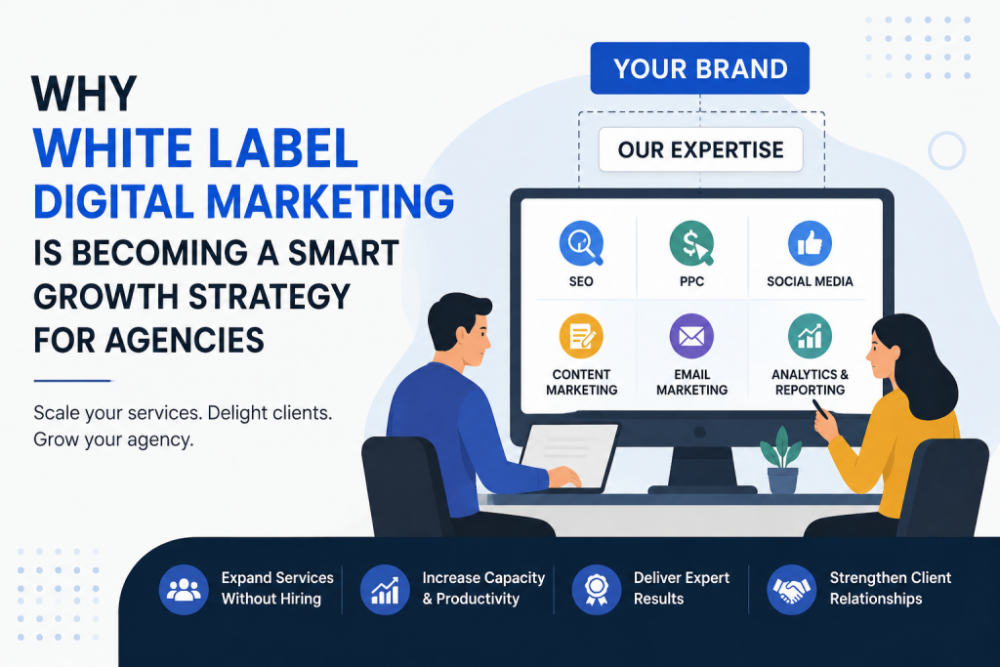
There is a point in the life of almost every digital agency when the same problem comes up: clients start asking for more.
A company that originally hired you for a website may suddenly want SEO. An SEO client may ask about social media. A business that came to you for paid advertising may want content, email marketing, or help with its local search presence.
Of course, you want to say yes. More services can mean more revenue and stronger client relationships.
The difficult part is delivering all of those services without turning your agency into a huge, expensive operation. That is where white label digital marketing can make sense.
For agencies that want to grow but aren’t ready to build a department for every service, it’s a model worth considering.
Growth Doesn’t Always Mean More Employees
It’s easy to assume that the next step for a growing agency is hiring.
Sometimes it is. But hiring isn’t always the best answer.
Suppose you have a team of five people and suddenly sign ten new clients. You could start recruiting, but finding experienced marketers takes time. Then there is onboarding, training, salaries, software, management, and everything else that comes with expanding a team.
And what happens if demand slows down six months later?
This is one reason agencies look at outsourcing certain parts of their delivery process. They can add capacity when they need it without immediately committing to a permanent increase in headcount.
White-label services fit naturally into that model.
Think of It as an Extension of Your Team
White labeling can sound complicated until you look at what actually happens.
Your agency remains responsible for the client. You decide what services to offer, communicate with the client, set expectations, and manage the relationship.
The white-label partner takes care of the agreed work in the background.
For example, a web development agency might have several clients asking for SEO. Instead of building an SEO department, the agency could work with a specialist provider.
The client still sees the agency as the service provider. The additional expertise simply comes from a partner behind the scenes.
That arrangement can work particularly well when the agency already has strong client relationships but doesn’t have the resources or expertise to handle every service internally.
The Real Benefit Is Flexibility
The biggest attraction of white label digital marketing isn’t necessarily that it is cheaper.
It’s the flexibility.
An agency can experiment with a new service without making a major investment upfront.
Say your clients are increasingly asking about content marketing. You don’t know yet whether there is enough demand to justify hiring a full-time content team.
Working with a white-label provider lets you test the waters.
If demand grows, you can continue the partnership or eventually build the capability internally. If it doesn’t, you haven’t spent months recruiting and setting up an entire department for a service your clients barely use.
That flexibility can be valuable for smaller agencies in particular.
Specialized Work Is Another Story
There is also a difference between offering a service and actually knowing how to do it well.
SEO is a good example.
An agency might know the basics of search marketing. I still have a hard time with more specific campaigns. Automotive companies for example face their search difficulties. Dealerships fight for visibility searches about services, questions about cars and searches, about particular brands and models.
A general marketing approach isn’t always enough.
If an agency starts working with dealerships, bringing in specialists with experience in Automotive SEO services can make the transition much easier.
The same idea applies to other areas where clients expect specialist knowledge. It’s often better to work with someone who already understands the field than to learn everything while a paying client is waiting for results.
What Happens to the Agency’s Own Team?
This is an important question.
White labeling shouldn’t mean that your internal team becomes disconnected from the work.
Someone still needs to understand the client’s goals, review what is being delivered, communicate changes, and make sure the marketing activity fits into the larger strategy.
The difference is that your team doesn’t necessarily have to perform every task themselves.
Your account manager might spend more time speaking with the client. Your strategist can focus on campaign direction. Your sales team can concentrate on bringing in new business.
Meanwhile, the specialist partner handles the work they were brought in to do.
When the responsibilities are clear, everyone has a better idea of what they are accountable for.
Not Every White-Label Provider Is Worth Using
This is probably the part agencies should think about most carefully.
The provider may be invisible to your client, but their work isn’t.
If the work is late, inaccurate, or poorly executed, your agency is the one answering the client’s questions.
So choosing a white-label partner based purely on the lowest price can backfire.
Before agreeing to work together, ask practical questions.
How do they communicate? Who will actually work on your projects? What happens when a client requests revisions? How detailed are their reports? Can they handle more work if your agency grows?
It’s also worth looking at whether they understand your type of clients.
A provider that is excellent at e-commerce SEO may not necessarily be the best choice for a local service business or an automotive company.
White Label Can Also Help With Client Retention
There is another benefit that is easy to overlook.
Clients don’t always leave because they’re unhappy with your main service. Sometimes they leave because they need something you don’t offer.
A client may be happy with your web development work but eventually decide they need SEO. If you don’t provide it, they might hire another agency for SEO — and that agency now has an opportunity to sell them everything else.
Being able to offer additional services can help you keep more of the client’s marketing budget within your own agency.
It doesn’t mean you need to become a “we do everything” agency.
It simply gives you more options when a client asks, “Can you help us with this too?”
Where Triple Minds Comes Into the Picture
If an agency wants to grow its marketing skills it can look at partners such as Triple Minds.
The key is to see the partnership as more than just outsourcing tasks. A good partner must fit into the agency workflow and know the client needs to talk clearly. Deliver work consistently.
When an agency wants to add SEO but does not want to build an in‑house team, a white label SEO agency such as Triple Minds can be a useful part of a larger digital marketing plan.
Is It the Right Move for Every Agency?
Technically no,
If you already have an in-house team and desire full control over each step of delivery, keeping everything in-house might be the better choice.
White labeling is helpful when you find yourself in one or more of these situations:
- When clients ask for the services you don’t provide
- You want to test a service before hiring specialists.
- You need access to expertise that’s not available internally.
- You want to take on work without instantly increasing headcount.
The decision should come down to what makes sense for your agency not simply because white-label services are popular.
The Bigger Picture
Digital agencies have always had to balance two things: winning new business and delivering great work.
As the number of marketing channels continues to grow, doing everything internally becomes harder.
That doesn’t mean agencies need to outsource their entire operation. In many cases, a better approach is to identify the areas where an outside specialist can genuinely add value.
That’s the appeal of white label digital marketing.
It gives agencies another way to expand without taking on every cost and responsibility that comes with building a larger team.
The smartest agencies aren’t necessarily the ones doing every task themselves.
They have a good eye on which work needs to stay in-house, which work can be shared, and which partnerships can help them serve their clients better.