
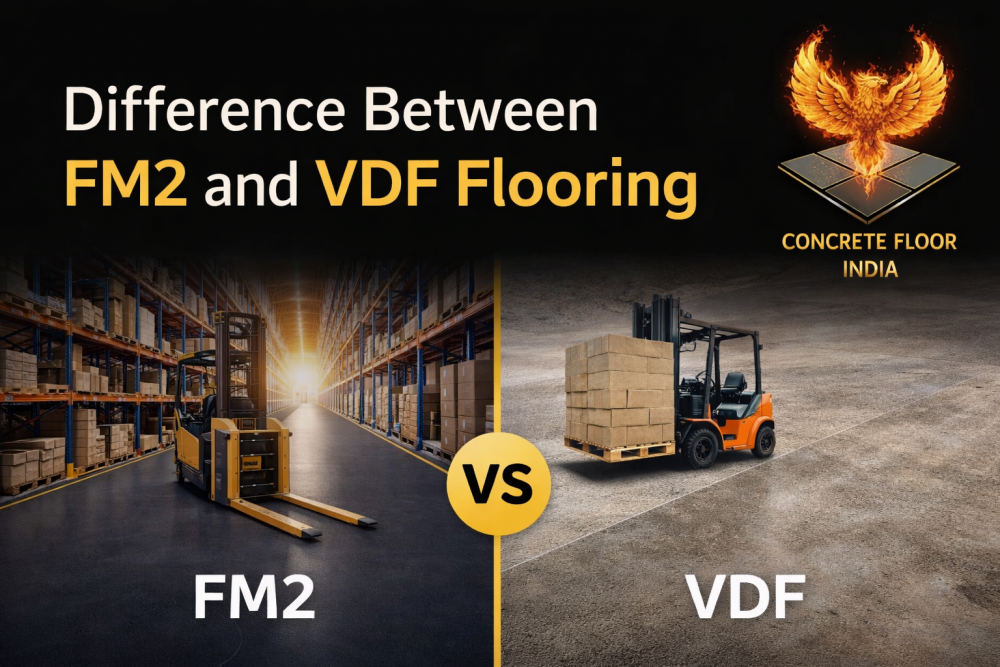
The choice of industrial and commercial flooring has a direct effect on safety, efficiency and cost of operations in the long term. FM2 and VDF flooring are among the most discussed options today. Both systems are concrete-based and intended for heavy use; however, their performance goals differ significantly. When warehouse flooring, factories or logistics buildings are planned, it is important to understand FM2 vs VDF flooring. This article defines the difference between FM2 and VDF flooring.
What is FM2 flooring?
FM2 flooring is a concrete flooring system designed to meet the specified requirements for flatness and Levelness. These criteria are essential in settings where material-handling machines are expected to move smoothly, quickly, and safely. FM2 floors are designed to minimize surface deviation, allowing the wheels to be in contact with the floor.
Laser screeding technology is primarily used for installation, with subsequent control in finishing and joint planning. The outcome is a very precise floor surface that helps achieve working efficiency, decrease vibration, and lessen wear on forklifts and racking systems. FM2 flooring is more than mere strength; it is also about accuracy with constant motion.
Where FM2 flooring is commonly used
- Narrow aisles and tall racking design of warehouses.
- The fast-paced warehouse areas that demand the use of forklift-guided navigation and a stable above-ground tolerance.
- The distribution centres involve high frequency and speed of movement of materials.
- Robotic handling system and VNA truck automated warehouses.
- Storage facilities that are more focused on the accuracy of operations rather than surface hardness.
What is VDF flooring?
VDF flooring, also known as Vacuum Dewatered Flooring, focuses on improving the internal concrete quality and surface durability. Vacuum pumps and filter mats are used to extract excess water during installation. Such a procedure increases the concrete density, accelerates the process, and makes the surface much harder.
In contrast to FM2 flooring, VDF flooring is not designed for extreme flatness tolerances. Instead, it gives precedence to strength, abrasion resistance and long-distance resistance to harsh industrial environments. Owing to its strength and affordability, VDF flooring is commonly used in heavy industrial environments where precise motion is not a major concern.
Where VDF flooring is commonly used
- The production facilities that run heavy machinery and those that run 24-hour production.
- Vibration, impact loads and rough handling in industrial workshops.
- Parking lots and ramps that are subjected to traffic daily.
- Power plants need hard flooring that cannot wear off easily.
- For the transportation of materials and equipment by industry, there are industrial corridors.
Key difference between FM2 and VDF flooring
1. Flatness and level control
One of the most significant differences between the two systems is flatness.
● FM2 flooring attains tight tolerances of flatness in material movements.
● VDF flooring has typical flatness for general industrial purposes.
2. Strength and surface hardness
The strength characteristics of the two systems differ significantly.
● FM2 flooring is structural steel and surface accuracy-oriented.
● VDF flooring provides increased hardness of the surface and better resistance to abrasion.
3. Installation technique
The difference between FM2 and VDF flooring is clearly highlighted by the construction methods.
● FM2 flooring involves laser screeds and high standards of finishing.
● VDF flooring uses vacuum dewatering methods in the densification of concrete.
4. Maintenance and lifespan
Maintenance requirements vary by the design of each floor to be used.
● FM2 flooring requires regulated maintenance to maintain flatness levels.
● VDF flooring can withstand heavy traffic, and the duration does not require long-term maintenance.
5. Cost and application suitability
The final flooring decision is normally based on the budget.
● FM2 flooring is more expensive since it requires precision equipment.
● VDF flooring is economical even in the heavy industrial setting.
Performance under operational conditions
For FM2 vs. VDF flooring, operational performance is critical. The FM2 flooring is most suitable for warehouses where forklifts operate at high speeds and carry heavy loads. Stability and efficiency in such spaces are susceptible to minor surface irregularities.
VDF flooring is well-suited to supporting heavy loads, both static and dynamic. It is wearable or scratch-resistant, anti-dusting, and maintains its integrity even in industrial environments. This is best suited to factories with less frequent but heavy machine movements.
Choosing the right flooring solution
The decision between FM2 and VDF flooring depends on how the space will be used in everyday life. FM2 flooring is also a good choice for logistics-oriented spaces where precision and movement accuracy directly affect productivity. VDF flooring is applicable in industrial buildings that emphasise durability, strength, and service life.
There is also a difference between FM2 and VDF flooring: it is not a matter of quality but of purpose. The two systems deliver strong results when used appropriately. Concrete Floor India, having appropriate assessment, technological proficiency, and expertise, will bring the appropriate solution to the flooring solution and make it fit with the real-life operational requirements.