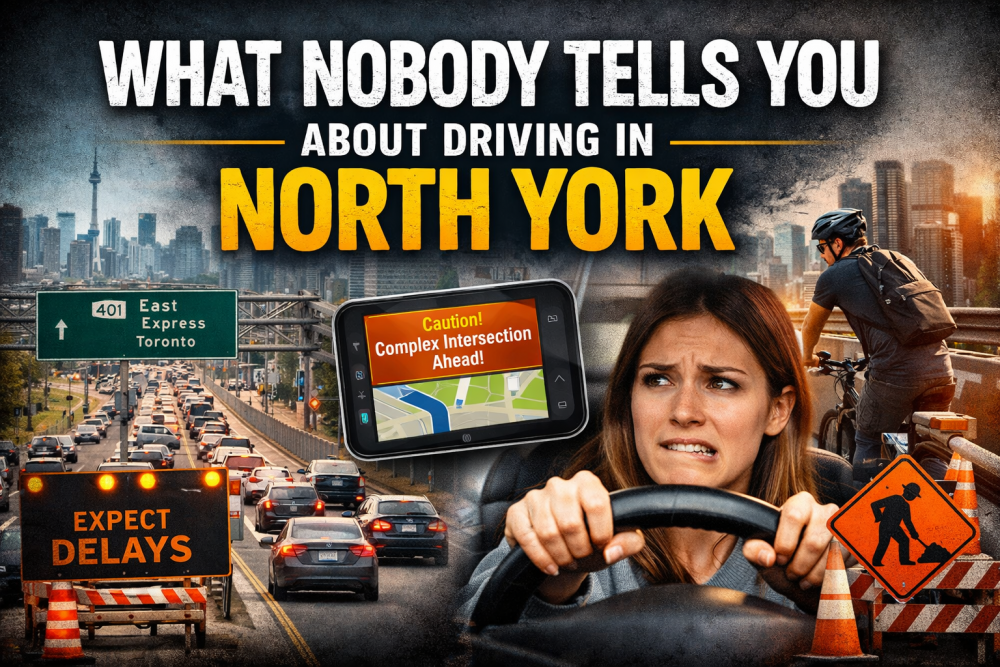
Let’s be honest — driving in North York can be a lot. It’s not just the traffic (though yes, the traffic). It’s the combination of everything happening at once: cyclists cutting in, construction out of nowhere, a pedestrian stepping off the curb, and you still trying to figure out which lane you’re supposed to be in.
Whether you’re just starting or you’ve been driving for years, North York has a way of keeping you on your toes. Here’s what actually makes it tricky — and what genuinely helps.
The traffic is real, and it doesn’t care about your schedule
Yonge Street at 5 pm is not the place to be learning how to change lanes. The congestion here is serious, and if you’re not used to it, it can make even a short trip feel exhausting.
The honest fix? Don’t throw yourself into rush hour before you’re ready. Build up gradually — start with quieter times, get comfortable with the feel of the roads, then work your way up. And when you’re in it, give yourself more space than you think you need. That buffer in front of you isn’t wasted space; it’s your reaction time.
Some of these intersections are genuinely confusing
North York has intersections with multiple turning lanes, advanced signals, and pedestrian phases that don’t always feel intuitive. It’s easy to hesitate or second-guess yourself — which, ironically, is when things go wrong.
The best thing you can do is slow your approach and actually look before committing. Know which lane you need before you get there. And if you miss a turn? Just keep going and come around again. No intersection is worth a rushed decision.
The 401 is intimidating — and that’s okay to admit
Highway 401 runs right through North York, and it is, without exaggeration, one of the busiest highways in North America. Merging into fast-moving traffic when you’re still building confidence is genuinely nerve-wracking.
Start small. Short stretches, off-peak hours, right lane until you’re comfortable. There’s no shame in easing into it. The goal is to get comfortable with highway speed and spacing gradually, not to prove something on day one.
Pedestrians and cyclists will keep you humble
Urban driving means sharing the road — constantly. In North York, that means crosswalks that appear mid-block, cyclists filtering through traffic, and kids near school zones who aren’t always predictable.
You really do have to slow your eyes down and scan more carefully than you might on a quiet suburban street. Checking crosswalks before pulling forward, watching for cyclists when you open doors or make right turns — these habits feel small, but they matter enormously.
Parking is its own skill set
Parallel parking on a busy North York street while someone’s waiting behind you is a rite of passage nobody warns you about. Tight residential streets, packed commercial strips, underground lots with columns in inconvenient places — parking here takes practice.
Use your mirrors, use your reference points, and permit yourself to take your time. Most people waiting behind you have been in the same spot. They can wait an extra 30 seconds.
Construction will reroute your whole plan without warning
North York is constantly under development, which means lane closures, detour signs, and road markings that have changed since the last time you were there. It happens to everyone.
The move is to slow down earlier than feels necessary, actually read the temporary signage, and stay calm when your usual route suddenly doesn’t exist anymore. Adaptability is genuinely one of the most underrated driving skills.
Nerves are normal — and they don’t make you a bad driver
A lot of new drivers feel embarrassed about being anxious behind the wheel, like it means something about their ability. It doesn’t. Driving in a dense, busy environment is objectively a lot to manage, and feeling nervous just means you’re taking it seriously.
What actually helps is practice — not one big scary session, but regular, consistent time behind the wheel. Starting on quieter streets. Having someone patient in the passenger seat. Debriefing on what went well, not just what went wrong.
This is exactly where a good driving school in North York makes a real difference. Instead of piecing it together on your own, you get an instructor who already knows these roads — the tricky intersections, the construction detours, the merge points on the 401 — and can walk you through them in real time, at your pace.
The bottom line
North York isn’t the easiest place to learn to drive, but it does make you a more capable driver. The drivers who navigate it well aren’t fearless — they’re just prepared. They’ve practised the situations that used to stress them out until those situations became routine.
If you’re building those skills, enrolling in a driving school in North York is one of the smartest moves you can make. You don’t have to figure it all out alone — and you’ll get road-ready a lot faster with someone in your corner who knows exactly what you’re up against.