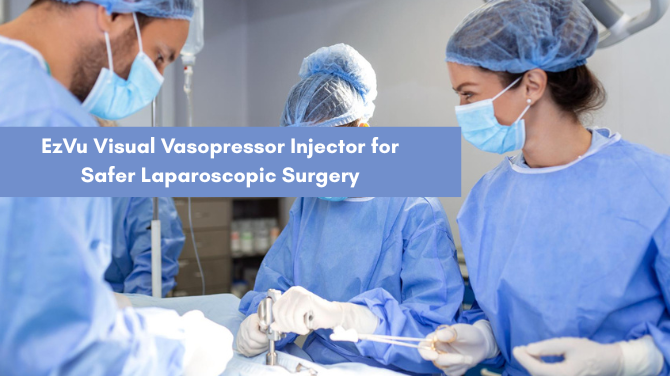
Modern gynecological and abdominal surgeries have been revolutionized by laparoscopic surgery. It offers several advantages, including shorter hospitalization, less pain, and faster recovery. Because of these benefits, it has been widely accepted by patients and surgeons. However, laparoscopy surgery has its own risks of complications. These can arise from insufflation and other factors, particularly the use of vasopressors to decrease blood loss. Devices such as the EzVu Visual Vasopressor Injector are designed to perform this step safely. They help reduce the risk of potentially harmful complications.
The Challenge: Vasopressor Injection Risks in Laparoscopy
Surgeons performing laparoscopic myomectomy or laparoscopic hysterectomy often inject diluted vasopressors, i.e. vasopressin, into the myoma or uterine tissue before excision. This helps constrict blood vessels, reduce bleeding, and improve visualization. However, this is not without risk. Vasopressors can cause severe complications, including sudden blood pressure and cardiac arrest, if they enter the bloodstream.
There is a significant problem with the needles being used. They are very long (≈ 33 cm) and completely opaque. Because a long and opaque needle is used, the small volume of blood that is aspirated, if any, will not be visible in the syringe. Thus, the surgeon may be unaware of any blood vessels being punctured and will proceed with injected vasopressors.
The Solution: What EzVu Does Differently
The EzVu Visual Vasopressor Injector was developed precisely to address this risk. The device, also sometimes referred to as a “visual vasopressor injection needle,” incorporates a small transparent window near the distal (tip) end of the shaft.
Here’s how it works in practice:
- After inserting the EzVu needle through a standard 5 mm laparoscopic port under visual guidance, the surgeon gently penetrates the target tissue (e.g. myoma capsule or uterine wall).
- The surgeon then aspirates with the syringe. If the tip has accidentally entered a blood vessel, blood will quickly appear in the transparent window. Because the transparent segment is close to the tip, the blood does not need to travel a long opaque shaft to become visible.
- On seeing blood, the surgeon can withdraw the needle, flush it, and reposition safely. If the aspiration yields only clear fluid, it is safe to inject the vasopressor.
This simple modification dramatically increases the sensitivity of detecting inadvertent vascular puncture even in very small vessels. According to the manufacturer, EzVu can detect as little as 0.03 ml of blood (less than a single drop).
Evidence Supports Safety Benefits
The concept behind visual vasopressor injection is not purely theoretical. In fact, a peer-reviewed clinical study published in 2017 described the use of a similar “visual vasopressor injection needle” (often referred to as VVIN) in laparoscopic myomectomy. In that study, surgeons performed 53 myomectomies: 23 with a standard opaque needle, and 30 using the visual needle. Among the 23 patients treated with standard needle, 4 (≈ 17.4%) showed a significant transient rise in pulse and blood pressure after vasopressin injection, suggestive of inadvertent intravascular injection or vascular absorption. In contrast, none of the 30 patients in the visual-needle group demonstrated such hemodynamic fluctuations when injections were done after confirming negative aspiration in the transparent window.
The authors concluded that the visual needle allowed early detection of vascular puncture, even in small vessels, and significantly reduced the risk of potentially catastrophic reactions.
For surgeons and hospitals, this represents a meaningful step forward: a small design change that delivers real-world safety improvements.
How EzVu Fits into the Overall Laparoscopic Safety Strategy
Laparoscopic surgery always demands careful technique, awareness of anatomy, and constant vigilance. As reviews note, intraoperative complications, especially vascular injuries, remain among the most serious risks.
Using EzVu doesn’t eliminate all risks, but it helps mitigate one specific yet serious danger: inadvertent intravascular vasopressor injection. By giving the surgeon direct visual feedback, EzVu adds an extra layer of safety.
Moreover, the device design follows general principles of minimally invasive surgery. It is inserted through a standard 5-mm port. It uses a 19-gauge needle, which is standard for vasopressor injection. The device also maintains consistency with existing laparoscopic procedures.
Considering such drastic cardiovascular implications of incorrect vasopressor injection, such as high blood pressure, bradycardia, cardiac arrest, or vasospasm, any device that can reduce the risk is worth consideration.
Practical Considerations for Surgeons & Hospitals
If you are considering integrating EzVu into your laparoscopic practice, here are a few practical tips:
- Training & Familiarity: Even though the device is intuitive, surgical teams should practice the aspiration-and-visualization technique. Proper aspiration and careful inspection of the transparent window must become a standard step before injecting a vasopressor.
- Sterile Handling: As instructed by the manufacturer, the EzVu model should be unwrapped and kept in packaging under sterile conditions, and should be inserted through 5 mm trocars. Then, the device should be filled with a vasopressor solution and air should be removed before insertion.
- Confirm Negative Aspiration Every Time: Ensure that the transparent window, along with the blood, before injecting, regardless of whether the last injection went in without a hitch.
- Complement, Don’t Replace, Vigilance: EzVu helps detect a vascular puncture that, before injection, but other standard safety measures should still be observed. These includes meticulous port placement, careful management of pneumo peritoneum, and thorough in-operation supervision.
Conclusion: A Simple Innovation — Big Impact on Safety
The EzVu Visual Vasopressor Injector brings a small but powerful improvement to laparoscopic surgery. By allowing surgeons to see aspiration of even a tiny amount of blood before injecting a vasopressor, EzVu helps prevent inadvertent intravascular administration, a common cause of serious hemodynamic complications. Clinical data from earlier studies support that the visual-needle design significantly reduces adverse cardiovascular reactions compared to standard opaque needles.
In the broader picture of laparoscopic safety, EzVu injects practical and intelligent dimensions to the existing measures. For laparoscopic surgical practices and facilities aiming for the top, embracing such innovation is a showcase of prioritizing patient safety without sacrificing surgical speed and efficiency.
If you own or manage a laparoscopic surgical facility or service, considering EzVu might be a wise and impactful decision.