
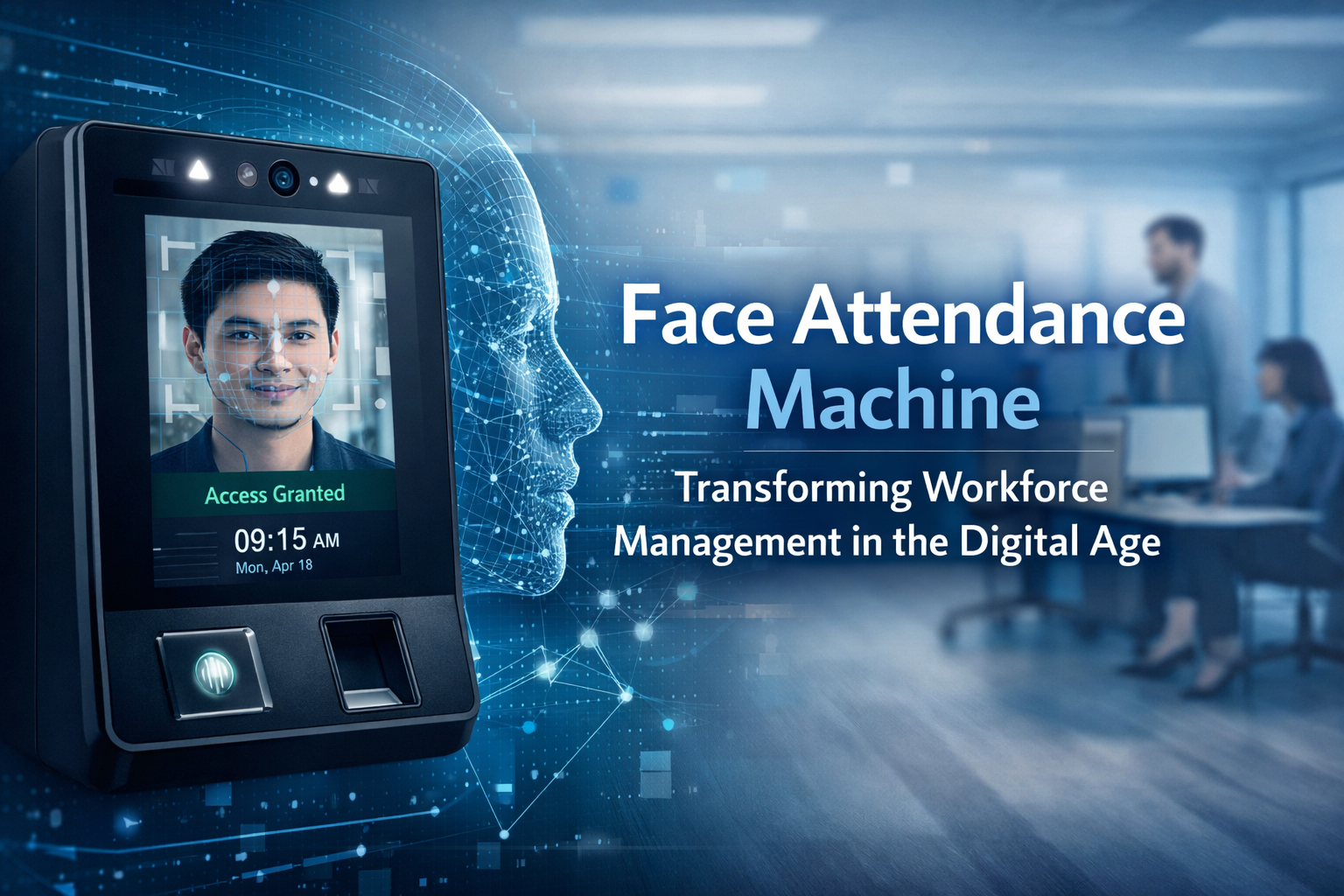
In the present day, digitalized, hectic world, companies are always seeking more intelligent means of dealing with their human resources effectively. Customary ways of tracking attendance like manual registers, punch and swipe systems are rapidly being eliminated in favour of superior biometric technologies. One of these innovations is the invention of the Face Attendance Machine that has become a groundbreaking technology that is transforming workforce management into a new dimension.
These systems offer a smooth, safe and very exact substitute to the traditional methods by using facial recognition technology to record the attendance of the employees. Face attendance machines can improve security, productivity, decrease the workload of the administrator, and even help make the experiences of employees better, in addition to merely marking time. Since companies are now digitally transforming, this smart attendance system is currently becoming an essential piece of equipment in the contemporary workplace.
The History of Time Tracking.
There has been an incredible revolution of attendance tracking over the years. During the early years, organizations were using hand written registers and manual time logs. Though these were simple, they were susceptible to human errors, manipulation and inefficiency. The development of mechanical punch cards was the first significant step in automation. Employees could now check in and out more effectively.
With the improvement of technology, electronic time clocks and RFID card systems were very popular. These solutions were also more accurate though problems like lost cards, buddy punching and administrative overhead remained. Biometric systems: Biometric systems would be the next jump as they would be using fingerprints, iris, and face recognition to connect attendance with the personal biological characteristics of a person.
Face Attendance Machines are the leading machines in this evolution. They combine artificial intelligence and biometric identification to provide a quick, contactless, and very reliable attendance solution that is aligned with the realities of the modern workplaces.
The operation of Face Attendance Machines.
Face Attendance Machines are based on highly advanced artificial intelligence algorithms of facial recognition. Upon approaching the machine, the device captures a picture of the face of an employee and compares it to the biometric templates that have been stored in the database. When a match is discovered, then attendance is taken immediately- sometimes almost a second.
These machines employ sophisticated methods like feature extraction, pattern recognition and deep learning to recognize individuals well and even with different lighting conditions or facial expressions. Liveness detection is also integrated into many systems to eliminate the spoofing attempts with the use of photos or videos.
After capturing attendance, the data is sent in real time to centralized software platforms which are integrated with HR systems, payroll software and access control solutions. This smooth integration means that it keeps proper records, it processes payroll automatically and it monitors the workforce effectively.
Optimizing the Employee Experience.
The possibility to make the experience of employees easier and more pleasant can be discussed as one of the most important benefits of face attendance machines. Facial recognition provides a 100 percent contactless and hassle-free way of taking attendance, unlike the traditional systems that need cards, passwords or fingerprints.
The workers do not have to be afraid of losing access cards or standing in long queues to check attendance. One only needs to take a short look at the camera to make the process complete. This convenience is time-saving as well as frustrating especially at peak time when the employees come in large numbers at the same time.
These systems are friendly to the user and they enhance a better working environment. Once attendance monitoring is done without issues, workers will be able to devote more of their time to their job and less to formalities in the administration and this will result in greater satisfaction and morale.
Improving the Level of Security.
Security is a sensitive issue among organizations that represent all industries. Face Attendance Machines are also essential in enhancing the security of workplaces because they would be able to admit only authorized people to the premises or sensitive places.
Facial recognition is based on distinct biometric information, which can never be easily replicated unlike cards or PINs, which are easily lost, shared, or stolen. This does away with the aspects like buddy punching whereby a colleague checks in on behalf of someone.
Several face attendance systems are also combined with access control to allow organizations to limit access (by time, location, or authorization level). The extra protection is especially appreciated by companies dealing with sensitive data, that are in a controlled sector or one dealing with high security premises.
The Impact on Productivity
The proper attendance tracking directly affects the productivity of the organization. Face Attendance Machines reduce time difference, remove manual error and timeliness, which instills a culture of responsibility in the workplace.
Through automation of the attendance process, the HR departments save time in rectifying records and payroll complaints. This gives them an opportunity to concentrate on some of the strategic initiatives like talent development, performance management and employee engagement.
Most companies claim that face recognition attendance systems have helped them improve discipline and efficiency. Through live data and clear accounts, the managers are able to track the attendance trends, detect problems in real time and do corrective measures in time. The outcome is a better structured, productive and well managed workforce
The Major Advantages of Face Attendance Machines.
Enhanced Accuracy
Facial recognition technology is infinitely more accurate than the conventional ways of attendance. It also practically eradicates any mistake that could have arisen due to manual typing and swapping of cards or fraud. This accuracy fosters equity and responsibility at the organization.
Streamlined Processes
By automation, there is a significant reduction of administrative workload. The attendance data is automatically captured, stored and processed thereby reducing paperwork and manual intervention. This workflow is lean and enhances efficiency and operational cost is minimized.
Increased Security
Face attendance machines increase the general security of the workplace by helping to avoid unauthorized entry and cure time fraud. They also make sure that the attendance logs capture real attendance which helps make organizations more upright.
Better Organizational Contentment.
Facial recognition systems make the working life of employees easier and faster. Contactless functioning, less waiting period, and attendance marking without any hassles will make the work culture more positive.
Real-time Monitoring
The managers will have access to real time data on attendance and make quick decisions and proactive management of the workforce. Problems like absenteeism or lateness can be handled at the moment.
Cost Savings Over Time
Face attendance machines are a cost-effective solution, even though the initial investment is high. The long-term savings come from fewer payroll errors, minimal time theft, and reduced administrative costs.
High-tech Reporting and Analytics.
The contemporary systems will offer detailed reports and dashboards which show the trends of attendance, overtime, and workforce behavior. Such insights help in planning strategies and optimization of resources.
Remote and Hybrid Work Adaptability.
Nowadays, many of the attendance solutions are able to be deployed both on the mobile platform and on the cloud platform creating an opportunity to accurately track even remote or hybrid employees. Such flexibility is in line with the current work models.
Difficulties and Introspections.
Face attendance machines have a number of disadvantages that companies need to think more about despite their numerous benefits.
Ethical Concerns and Privacy.
Biometric data collection and storage may not be comfortable to the employees. To establish trust, open communication, adherence to data protection laws, and explicit consent policies are required.
Preliminary Implementation expenses.
Hardware, software and system integration may be very expensive, especially to small and medium-sized businesses. Nevertheless, the investment can be justified by the careful planning and long term ROI analysis.
Technical and Environmental Factors.
The accuracy of recognition can be influenced by lighting conditions, arranging the camera and the change of faces. It is important to have regular system calibration, quality hardware and proper installation in order to have a reliable performance.
Employee Acceptance
It is not rare to have resistance to new technology. The employees can be assisted in adapting and accepting the new system with the help of comprehensive training programs, awareness, and continuous support.
The Biometric Technology and its Place in the Modern workspaces.
Biometric technology has emerged as a workforce management pillar in the contemporary world. It provides secure, accurate and automated identification and thus overcomes many of the constraints of traditional systems. In specific, facial recognition is a hygienic and touchless solution that became popular during the post-pandemic period.
With organizations increasingly forming digital transformation as an essential element of their new strategies, biometric attendance systems will become a new norm. This applies to business enterprises, factories, hospitals, and schools.
Big Data and Intelligent Workforce.
Intelligent workforce management is a new opportunity created through the integration of data analytics with face attendance systems. The attendance data can be used to determine the trends that are occurring, the anticipated needs in staffing, as well as efficient scheduling.
Managers have a great opportunity to understand how that particular employee behaves, what are the overtime and absenteeism rates and make information-based decisions that can enhance the efficiency and productivity. In the long run, this analytical method will result in improved workforce planning and performance of the organization.
Education and Preparation of Successful Implementation.
It is widely believed that face attendance machines can be successfully adopted only with training and constant support. Employees need to be informed about how the system works, how their data is protected, and the benefits it provides to both them and the organization.
The availability of technical support teams should be easy to fix the problem, carry out maintenance, and update software. An implementation process should be smooth so that it is highly accepted and returns investment is maximized.
Future of Face Attendance Machines.
The future of face attendance technology is bright. Accuracy, speed, and scalability will be further improved due to artificial intelligence, machine learning, and cloud computing advances. The unified system with smart office ecosystems, IoT devices, and sophisticated access control systems will make fully connected workplaces.
Face attendance machines will become an even more important part of workforce management. This is as organizations continue to embrace automation and digital innovation.
Conclusion
The Face Attendance Machines represent a significant convergence of biometric technology, artificial intelligence, and modern work management practices. They are changing the approach of an organization to its human resources. They provide precise attendance, increased security, real-time activities, and better employee experiences.
Although some issues, like costs of implementation and privacy concerns, can be raised, successful adoption is possible with proper planning, effective communication, and continuous support. Face attendance machines are not merely a technological adaptation in a digital transformation era. They are also an investment in the future of work.