
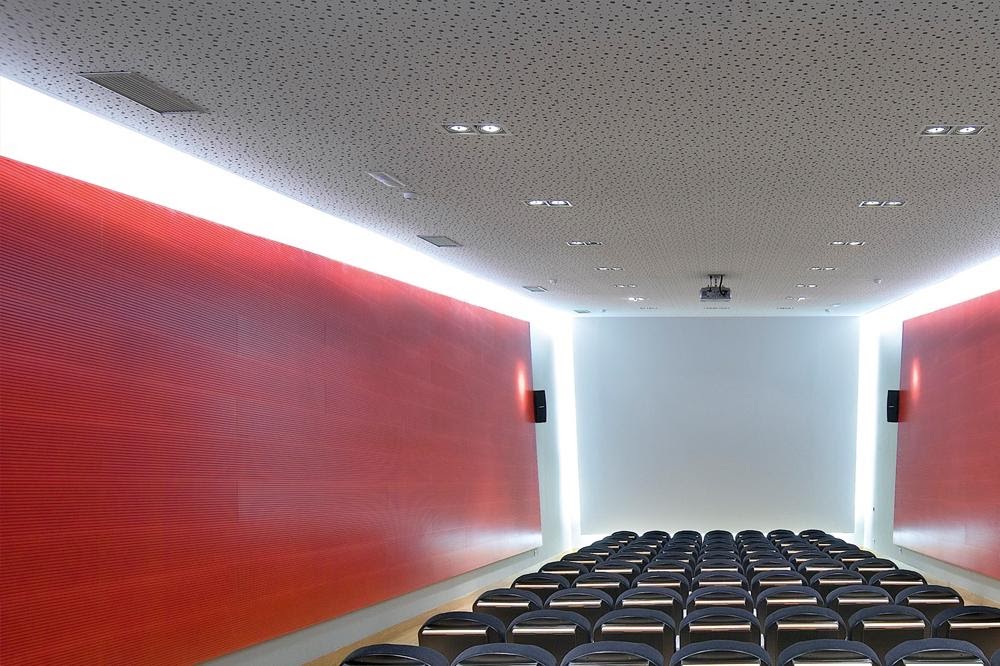
If you have ever been bothered by noise in a space, you should know the concept of an acoustic panel and its virtues.
There is a wide range of products when it comes to acoustic design, some closer to the technical field, and others closer to the aesthetic field, but when we seek the balance between the two, one of the products that best represents it is the acoustic panel.
The acoustic conditioning is the set of actions and implemented materials in a given space to achieve sound absorption balanced, so that there is a controlled presence of the same, and that offers a comfort optimal use of space.
Acoustic ceiling panels are part of one of the most used techniques in acoustic conditioning. It consists of portions, typically rectangular, made up of several moldings, for covering the dividing surfaces of a space, they are mostly used on walls and ceilings.
Within this sector, there are several companies that offer solutions in the wide variety of existing spaces. One of them is Gyptech, which lots of experience working with wood, is in charge of designing and manufacturing quality acoustic panels, following the line of technology and ecology.
Wood as an acoustic material
Like the wind, sound waves travel physically without being observed by the human eye, but felt through their vibrations present in materials. Acoustic panels are usually made of wood due to the good behavior of the material in the presence of sound.
Wood is one of the most commonly used materials in construction. It is valued not only for its aesthetic qualities but also for its acoustic properties. Its physical characteristics make it an excellent choice for acoustic conditioning. Among these, the following properties stand out:
- Rigidity. In the presence of sound waves, stiffness allows lower levels of vibration.
- Porosity. Being composed of fibers, it has a large number of pores that allow sound to enter and dissipate it through the material.
- Density. There are woods with high and medium degrees of density, this prevents the passage of sound waves.
Most acoustic panels are made primarily of wood, but can also include materials like glass wool, aluminum oxide, HDF, or MDF. These materials enhance the panel’s acoustic performance.
Advantages of acoustic panels
Acoustic panels have several advantages that complement each other, some of these are:
Comfort
Aesthetics
Acoustic control
Economy
Versatility
The main advantage of acoustic panels is the comfort they provide. Sound harmony is highly valued by anyone who wants to feel calm in a space.
The need to control noise depends on the function of the space. However, any enclosed area meant for comfort or enjoyment should have proper acoustic control.
Comfort is a result of acoustic control. Acoustic panels control sound in areas where it is needed while allowing free passage elsewhere, preventing it from becoming a disturbance. They allow the configuration of the sound to suit the user.
The aesthetics offered by these panels is quite varied, and since wood is such a versatile material, it increases the variety of designs. Even though there are decorative panels, any type of panel can have a pleasing aesthetic design.People have used wood for centuries, and most enjoy it in any form.
Another of its advantages is the economy, since being so useful and composed mainly of wood, both the demand and its production is high, which results in a product, in general terms, economical.
Versatility is another advantage of acoustic panels. They can be used on ceilings, walls, floors, and other surfaces. In addition, their material composition can be customized. Not all acoustic panels are the same; the choice depends on the space conditions and the specific project requirements.
Places where it is possible to use acoustic panels
As mentioned above, there are places where acoustic control is more important than others. This is defined primarily by the function of the space and, consequently, its dimensions.
Acoustic panels can be used in many spaces, regardless of their purpose. Common examples include auditoriums, theaters, concert halls, showrooms, cinemas, conference rooms, and offices.