Understanding Stainless Steel 304 Flat Bars
What is Stainless Steel 304?
SS 304 is an austenitic stainless steel containing chromium and nickel, typically 18% chromium and 8% nickel. It is not heat treatable, is easily weldable and has good resistance to corrosion in most normal environments. 304 stainless steel flat bar is the most commonly stocked stainless grade across metal markets in India, supplied in multiple forms year-round.
Common Applications of SS 304 Flat Bars
SS 304 Flat Bars are used in food processing equipment, pharmaceutical machinery, chemical plant fabrication, structural brackets, architectural trim, and general engineering work. The choice between hot-rolled and cold-drawn affects suitability for each of these uses.
Hot Rolling Process and Characteristics
The Hot Rolling Manufacturing Process
Hot rolling is carried out above the recrystallisation temperature, around 1100°C or higher for stainless grades. At that temperature the steel passes through a series of rollers and is shaped, then cooled. The cooling causes some contraction, which is why dimensional control is not precise. The surface comes out with a mill scale oxide layer, which is sometimes removed by acid pickling or shot blasting before supply.
Properties of Hot Rolled SS 304 Flat Bars
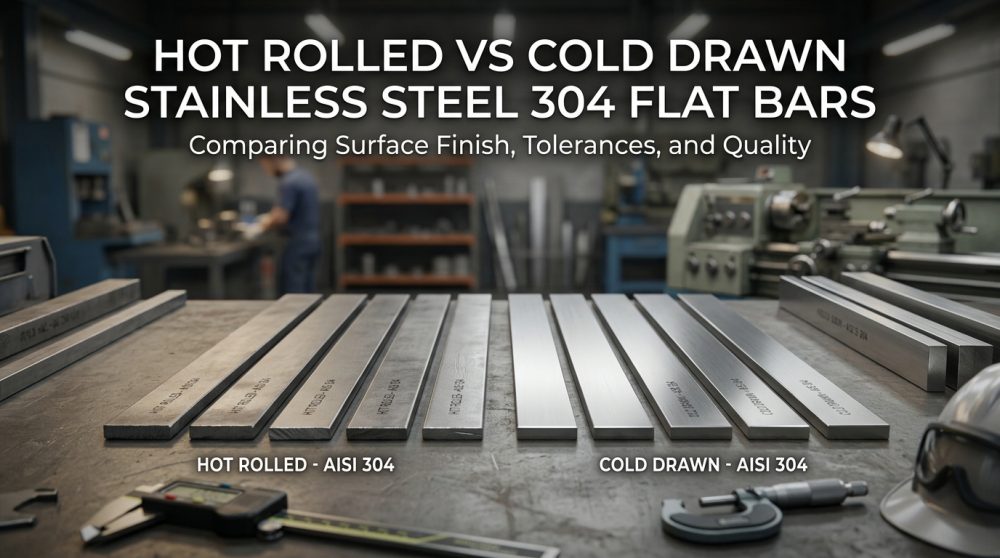
Hot-rolled flat bars cost less than cold-drawn equivalents because the process is simpler and faster. The material retains good ductility and bends or welds without issue. However, the surface is rough and uneven, and dimensional tolerances are wider. Variation in width and thickness is expected, both piece to piece and along the bar length.
Typical Applications for Hot Rolled Bars
These bars suit structural and general fabrication work best. Support frames, brackets, base plates, and internal equipment components are typical end uses. The surface condition and dimensional variation are acceptable here. If the part gets painted, coated, or hidden inside an enclosure, hot rolled is a practical and cost-effective choice.
Cold Drawing Process and Characteristics
The Cold Drawing Manufacturing Process
Cold drawing is done at room temperature. A bar is pulled through a die smaller than the starting cross-section, which reduces the dimensions and work-hardens the material. The die controls the final size much more accurately than a rolling mill can. The resulting surface is smooth and bright. Multiple passes may be used for larger reductions, with annealing in between to restore ductility.
Properties of Cold-Drawn SS 304 Flat Bars
Work hardening raises the tensile and yield strength above what hot-rolled material offers. Tolerances on width and thickness are much tighter and there is little variation along the bar. The surface finish is bright and smooth, requiring little additional treatment. The trade-off is cost. Cold drawing adds processing steps and the price per kilogram is higher.
Typical Applications for Cold-Drawn Bars
Cold-drawn SS 304 flat bars are used in architectural trim, decorative framing, handrails, and other visible applications where surface appearance matters. Precision-machined components and close-tolerance assemblies benefit from the dimensional accuracy. In food processing, pharmaceutical, and dairy equipment, the smooth surface is required for hygiene compliance.
Key Differences: A Comparative Analysis
The differences between the two products come down to four practical areas.
Mechanical Properties
Cold-drawn bars have higher strength and hardness due to work hardening. Hot-rolled bars are more ductile and easier to form. The right choice depends on whether strength or formability matters more in the application.
Dimensional Accuracy and Tolerances
Cold-drawn bars hold much tighter tolerances. Hot-rolled bars have wider allowances and more variation. For precision work or machined parts, cold drawing is necessary. For structural fabrication, hot-rolled tolerances are sufficient.
Surface Finish and Aesthetic Appeal
Cold-drawn bars are smooth and bright. Hot-rolled bars carry mill scale and a rougher texture. Any visible or hygienic application needs cold-drawn. Structural and hidden applications can be hot-rolled without issue.
Cost Implications
Hot-rolled costs less per kilogram. Cold-drawn carries a premium for the additional processing. Specifying cold drawn when hot rolled is adequate wastes budget. Specifying hot rolls where finish or tolerances are critical creates fabrication problems.
Relevant Standards and Specifications
ASTM A276 is the standard specification for stainless steel bars and shapes, including hot-rolled and cold-drawn SS 304 flat bars. This includes chemical composition, mechanical property requirements and testing. Material test certificates referencing the heat number should accompany every consignment. Established stockists in the Mumbai metal market, some operating for over two decades, typically maintain traceability documentation as a standard practice. Buyers should verify that certificates match the actual material before acceptance.
Conclusion: Choosing the Right 304 Flat Bar for Your Project
The decision comes down to what the application actually needs. Hot rolled works for structural, hidden, and general fabrication uses where cost matters more than finish or precision. Cold drawn is the right choice where surface appearance, dimensional accuracy, or strength are requirements. Getting this selection right from the start avoids unnecessary cost on one end and avoidable fabrication issues on the other.